
To measure a lithium-ion cell’s AC internal resistance (ACIR), connect a suitable battery tester using four-terminal (Kelvin) leads, apply the tester’s specified AC signal, and record the result together with its frequency and test conditions. A common quick-check frequency is 1 kHz, but the reading is a frequency-specific measurement—not a complete battery-health verdict.
What an ACIR reading measures
A battery tester applies a small alternating current and measures the resulting alternating voltage. Their relationship gives an impedance measurement. Depending on the instrument, it may report resistance (R), impedance magnitude (|Z|), or separate resistive and reactive components. Check the display definition and manual: those outputs are not interchangeable.
A fixed-frequency tester gives a result for that stimulus and frequency. Electrochemical impedance spectroscopy (EIS), by contrast, measures complex impedance across a range of frequencies. State the frequency and reported quantity whenever you record or compare ACIR values.
What a 1 kHz result means
Hioki describes 1 kHz as a generally used fixed frequency for quick battery testing. Its technical publication reports that IEC 61960-3:2017 specifies an AC measurement using alternating RMS current at 1.0 kHz ± 0.1 kHz for 1 to 5 seconds, with alternating RMS voltage measured at the battery terminals independently of the current contacts. This is a summary of the standard excerpt reported in Hioki’s publication, not a substitute for consulting the applicable standard edition and full scope. Hioki, Electrical Measurements of Lithium-Ion Batteries
What’s actually slowing this PC down?
Pick the symptom - the matching free tool is one click away.
#1 Best Overall

- 【Voltage Internal Resistance Battery Tester】FNIRSI battery tester can automatically test internal resistance and voltage value at the same time. The measured value can be used to determine whether the battery quality has decreased
- 【TFT HD Color Display】The display adopts advanced color HD technology and excellent layout. Compared with traditional monochrome displays, it can present test results more clearly and vividly, greatly enhancing the user's measurement experience
- 【Accurate Measurement】Adopts customized Kelvin four-wire connection method to avoid wire and contact resistance and improve measurement accuracy. Users can also manually adjust the voltage and resistance range
- 【Wide Application Range】Suitable for all kinds of batteries. Car battery tester, household battery. It supports historical records and export data tables of historical measurements. View 8 sets of voltage and resistance values to batch select batteries
- 【LED Display Handheld Meter】The resistance measurement range is up to 200Ω and the voltage measurement range is up to 100 V. The device must not be used with a DC voltage higher than 100V. Do not apply AC voltage under any circumstances
How to connect a tester and take a reading
For low-resistance cells, use a four-terminal (Kelvin) connection if the tester supports it. Two connections carry the test current; separate sense connections measure voltage at the cell terminals. Because the high-impedance sense circuit draws very little current, voltage drops across its leads and contacts affect the measurement much less than in a two-wire setup. Hioki summarizes the practice this way: “When measuring low resistance levels of 1 Ω or less, internal resistance is measured using the 4-terminal method.” Hioki, Lithium-ion Battery Internal Resistance Testing
- Check compatibility. Confirm the tester supports the cell’s voltage and expected resistance range, the required frequency, and the available probe or fixture. Follow the instrument’s safety instructions.
- Identify the measurement points. Place the current contacts and voltage-sense contacts as directed by the tester manufacturer. Ensure the sense points measure at the cell terminals, rather than beyond avoidable lead or fixture resistance.
- Run the measurement. Use the tester’s specified connection and measurement procedure. Record whether the displayed result is R, |Z|, or another quantity; do not infer the reported quantity from the word “resistance” alone.
- Log the conditions. Record cell identity, tester and fixture, connection method, frequency, reported quantity, cell voltage, temperature, and test timing. Use consistent conditions when comparing readings.
For very low impedances, lead layout, probe geometry, and environmental noise can also matter. Hioki describes a four-terminal-pair approach for reducing cable and noise effects; it is not automatically required for every cell or tester. Hioki BT4560-50 product specifications
Rank #2

- 【WIDE APPLICATION BATTERY TESTER】The FNIRSI HRM-10 battery tester is not only able to test car batteries, but also other types of batteries such as AA, AAA batteries, button batteries, lithuim batteries, lead-acid batteries,etc. The range of DC voltage is 0 - ±100V and resistance 0 - 200Ω. NOTE: The device must not be used with a DC voltage higher than 100V. Do not apply AC voltage under any circumstances.
- 【 KELVIN FOUR-TERMINAL SENSING】The FNIRSI HRM-10 comes with a kelvin clip test line. With Kelvin four terminal sensing, it can be possible to accurately measure resistance values less than 0.1 Ω while eliminating the inherent resistance of the lead wires connecting the measurement instrument to the component being measured. It will provide you accurate values and help you identify the problematic batteries.
- 【 DATA PRESET FUNCTION】The FNIRSI HRM-10 battery tester has auto mode.Voltage gears is: Automatic, 1V, 10V, 100V and the resistance gear is :Automatic, 20mΩ, 200mΩ, 2Ω, 20Ω, 200Ω. You could preset 8 sets of data and check if the batteries can meet the standard you set and help you quickly find out the problematic batteries.
- 【NO DATA WOULD BE MISSED】The FNIRSI HRM-10 internal resistance tester can automatically save all the test records. And you could connect the tester to your PC and transfer all the data to PC via EXCEL. It would be convenient for you to analyze.
- 【FASHIONABLE DESIGN AND COLORFUL DISPLAY SCREEN】Testing euipment need to be more cooler and user-friendly. This is the principle we live up to when we design the product. The display of FNIRSI battery tester adopts advanced color HD technology and was designed with excellent layout. Compared with traditional monochrome displays, it can present test results more clearly and vividly, greatly enhancing the user's measurement experience.
Control the comparison, not just the connection
Keep the frequency, connection arrangement, fixture, and other logged conditions consistent across measurements. There is no single rest-time, state-of-charge, temperature-conditioning, or repeatability protocol established for every chemistry, cell format, and test purpose. Set those conditions for the application and document them rather than treating one protocol as universal.
Choose the method that answers your question
| Method | What it measures | Best suited to | Important distinction |
|---|---|---|---|
| Fixed-frequency ACIR | AC response at one specified frequency | Quick, repeatable screening or acceptance checks when the tester’s range fits the cell | A single-frequency result does not show the full frequency-dependent impedance behavior. |
| Variable-frequency AC impedance | Impedance at multiple selected frequencies or across a frequency sweep | Investigating how impedance changes with frequency | More informative than one scalar reading, but still depends on instrument range and setup. |
| DC-IR | Resistance calculated from voltage and current changes during a current step or pulse | Applications that specify a pulse-based resistance method | Results depend on pulse conditions and measurement timing; DC-IR is not interchangeable with ACIR. |
| EIS | Complex impedance across a frequency range | Broader electrochemical characterization | It is a more involved characterization method than a quick fixed-frequency check. |
Before choosing an instrument, compare the measurement objective, frequency range, connection topology, resistance range and resolution, cell and fixture compatibility, test speed, and whether the instrument reports resistance alone or impedance components. Hioki lists the BT3562A as a 1 kHz AC four-terminal battery tester and the BT4560-50 as a variable-frequency four-terminal-pair impedance meter. The BT4560-50 product page lists a frequency range of 0.01 Hz to 1050 Hz for the described configuration. These are examples of instrument categories, not a complete market review; confirm the current specifications, model configuration, safety requirements, probe interface, and regional availability with the manufacturer. Hioki BT4560-50 product specifications
Recommended Free Tools
Rank #3

- Dual Measurement: Rechargeable battery tester measures battery internal resistance and voltage simultaneously, and supports batch testing of batteries
- High-Precision: Battery tester features a Kalman filter algorithm for precise and reliable results, ideal for battery production and maintenance, cell pairing, device testing, other DIY detection
- True Four-Wire Measurement: Battery voltage tester utilizes a true four-wire system at 1kHz AC sine wave for enhanced accuracy in low-resistance testing, minimizing measurement errors
- Versatile Use: Battery tester can test various batteries, such as lithium, lead-acid, UPS battery, 18650 battery, mobile phone battery, car starter battery and more, and can measure AC resistance of resistors and low-resistance components
- LCD Screen & PC Link: Designed with a clear backlit LCD display, the battery internal resistance voltage tester supports communication with computer or laptops for graphic analysis of data
What ACIR can—and cannot—tell you about cell health
An ACIR value is not, by itself, a universal state-of-health diagnosis. Hioki notes that lithium-ion internal resistance may change only slightly as a cell degrades. Its guidance also warns that a BT3554 reading on a protected lithium-ion battery includes resistance from the protection circuit, which limits the reading’s usefulness for robust deterioration judgments. Hioki, Measuring lithium-ion (Li-ion) batteries (Battery Tester)
Keysight describes 1 kHz ACIR as a fair estimate of ohmic resistance for lithium-ion cells in the range of a few amp-hours to a few tens of amp-hours—not as a universal characterization. Interpret a reading against an appropriate baseline or comparison set, with cell design, temperature, state, frequency, and measurement arrangement kept consistent. A shift is a reason to investigate under controlled conditions, not proof by itself of a particular fault or remaining capacity. Keysight, A Deeper Look at Lithium-Ion Cell Internal Resistance Measurements
Quick Recap
Best Value
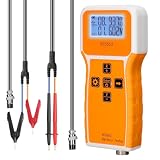
- 【Internal resistance & Voltage measurement】The battery tester can measure the battery internal resistance and voltage at the same time, this tool using four-wire test clamp, can better avert the influence of contact resistance and wire resistance, can carry out more accurate measurement.
- 【Clear & Backlight LCD Display】The digital battery tester features a Large LCD display screen that showcases the internal resistance, voltage and battery level of the tested battery, easy to read; The battery level is presented in battery level bar display, providing clear and precise information about the battery's status.
- 【Kalman Filter Mathematical Algorithm】This product adopts intelligent control, implanting Kalman filter mathematical algorithm, with high efficiency. It can also be used to measure the AC resistance of resistors and low-resistance high-precision resistance.
- 【Port Communication & Computer Analysis 】This product supports serial ports, and the measuring ranges of resistance is 1μΩ~200Ω, and the measuring ranges of voltage is 0.0001V~±100V direct current. Added serial port communication computer analysis software. Serial port needs to be opened in the machine to be able to communicate with the computer, the default is closed, the baud rate is 115200.
- 【Light Weight & Energy Saving】This tester built-in 1000mAh lithium battery to provide long service time, you can use the USB cable to charge in time. Portable size and easy to carry, you can take it with you to anywhere you want to use.
Rank #4

- ☑Digital LCD display, easy to read the measurement result. With backlight, it makes it easy to read in low light areas.
- ☑ Adopt 4-wire method which helps to ensure the accuracy of the measured value.
- ☑Handmade, rightExcessive appearanceCautious shooting.2017 high voltage battery internal resistance tester. True four line 1Khz AC sinusoidal battery internal resistance instrument 0.00001 ohm ---200 range
- ☑Test range up to 200 ohms with a minimum resolution of 0.01 milliohms and less than 5 milliohms. Press HOLD to enable the ZR function to measure internal resistance as low as 0.30--0.50 milliohms.
- ☑It is applicable for measurement of internal resistances of Lithium-ion, nickel-hydroxide, lithium-manganese cells or assembled battery.
Sources
- Hioki: Lithium-ion Battery Internal Resistance Testing
- Hioki: Electrical Measurements of Lithium-Ion Batteries
- Hioki: Measuring lithium-ion (Li-ion) batteries (Battery Tester)
- Hioki: BATTERY IMPEDANCE METER BT4560-50
- Keysight: A Deeper Look at Lithium-Ion Cell Internal Resistance Measurements
Product prices and availability are accurate as of the date/time indicated and are subject to change. Any price and availability information displayed on Amazon at the time of purchase will apply.

