
Start by adjusting speaker and seat placement, then make small changes to any built-in bass or EQ controls. Walls, corners, the desk, and the listening position can all affect what you hear, so test one change at a time from your usual seat. These steps may make bass fuller or more even, but they cannot make a small speaker reproduce frequencies beyond its physical capabilities.
Why desktop speaker bass changes with placement
Sound reflected from a nearby wall or desk can reinforce some bass frequencies and cancel others. Room modes can also make bass strong in one spot and weak in another. As a result, moving a speaker closer to a wall may add bass overall in one setup but make particular notes uneven or boomy in another.
Harman Kardon’s support guidance says wall and corner proximity can increase bass, while HARMAN Professional discusses boundary effects and room modes that can produce peaks or dips. A separate desk-scale effect, speaker-boundary interference response (SBIR), can cause cancellations depending on the speaker’s distance from a wall. SOVOX Engineering describes a close-to-wall approach for the geometry in its guide; it is not a universal rule for every desk. Harman Kardon’s placement guidance, HARMAN Professional’s monitor-placement guidance, and SOVOX Engineering’s SBIR guide describe these different effects.
Test speaker and listening positions
- Start from your normal listening seat. Keep left and right speakers as symmetrical as practical and aim them consistently toward your ears.
- Make one reversible change. Move both speakers a small amount closer to or farther from the wall, or adjust your chair position. Avoid changing several distances at once.
- Listen to familiar material again. Compare from the same seat and at a similar volume. Pay attention to whether bass is fuller, more even, or simply boomier.
- Keep the position that sounds most balanced. There is no single wall distance that works for all room and desk layouts.
For a more diagnostic demonstration, HARMAN Professional suggests playing a low-frequency sine wave through one speaker and moving around the room to hear how the tone changes by location. This illustrates room variation; it is not a measurement of your system. HARMAN Professional’s Chris Hansen, Director of Recording and Broadcast, says, “Most users don’t realize what kind of influence their room has on their monitors,” and notes that low-frequency performance correlates with speaker placement in the room.
#1 Best Overall

- Short Stand:PLEASE NOTED that the height adjustment range of the stand is 9"/23 cm to 14"/35 cm,the speakers can be firmly fixed at 9",10.6",12.3"and 14".If you prefer a higher one, welcome to choose other heights of stands in our store.
- Save Valuable Space on Your Desktop: This studio monitor stand takes up 32.5 cm² of surface to clamp on your desktop, saving even more desk space.
- Upgrade Desk Clamp: 3mm EVA pad on the clamp is helpful to protect the desktop surface from scratches. 5mm thickened clamps are stronger and less likely to cause deformation. Use grade 8.8 reinforced steel screws, not easy to loosen. Clamp adjustable range is 0-2.6 inches (0 - 6.6 cm), fits most desktops with different thickness.
- Universal Compatibility: Comes with 9"x 9" metal top plate, 2mm EVA anti-skid pad is helpful to avoid speaker vibrate. It fits most studio monitor speakers up to 50 lbs (23kgs). You can place your studio monitor, laptop, Hifi, CD player or projector.
- Easy to Install: Providing 4 pcs of M8*25 bolts and 1pc of Allen key 5mm to assist you install the desk speaker stand easily. If there are any problem or installation question, please contact us.
Adjust bass or EQ conservatively
If your speakers include a bass control, raise it in small increments and check the whole sound, not just one bass-heavy track. If they offer EQ, use it to trim an overly strong region or make a modest adjustment where the speakers still produce usable output. A fixed boost is not a reliable solution for every speaker and room; no universal EQ curve is established for arbitrary desktop setups.
EQ cannot create unlimited driver movement or deep bass output from a small speaker. Strong boosts can also make sound less balanced without overcoming the speaker’s physical limits.
Rank #2
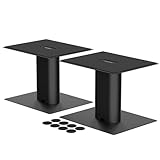
- Set of 2 Sturdy Speaker Stands – Includes two stands per pack, providing balanced elevation for stereo speaker setups, ensuring optimal sound staging and clarity.
- Perfect Height for Clear Audio – 6.1-inch (157mm) elevation positions speakers at ear level for improved sound projection and a more immersive listening experience.
- 200x165mm (7.9x6.5") Top Plate – Spacious and stable platform fits most desktop speakers, keeping them secure while minimizing vibrations.
- Non-Slip & Heavy-Duty Support – Each stand holds up to 44lbs and includes an anti-slip mat to prevent movement and enhance audio performance.
- Easy Assembly – A simple and intuitive design with clearly illustrated, step-by-step instructions ensures a hassle-free setup in just 10 minutes, making it quick and convenient for anyone
Controls and processing vary by model. Creative lists adjustable bass and treble controls and its BasXPort technology as features of the T100, describing the technology as enhancing bass without a subwoofer. Cambridge Audio describes room optimization, DynamEQ, and EQ presets for its L/R M. Those are manufacturer descriptions of specific products, not evidence that every computer or speaker has equivalent controls or that a preset will suit every room. See Creative’s T100 product page and Cambridge Audio’s L/R M desktop-listening guidance.
Consider pads or stands for the problem they address
- Isolation pads: If the desktop or speaker cabinet vibrates, pads are a reasonable experiment. HARMAN describes them as a way to isolate monitors and improve in-room response, but does not promise greater low-frequency extension.
- Stands or angled supports: These can help position speakers and bring tweeters closer to ear level, depending on the setup. The cited guidance does not establish stands as a direct bass upgrade.
HARMAN’s placement article discusses stands and isolation pads, while Cambridge Audio’s desktop guidance discusses stand height. HARMAN Professional and Cambridge Audio provide setup context.
Rank #3

- IMPROVED CLARITY - Surface vibrations caused by your speakers can result in muddy sound. SP6HD desktop speaker stands prevent this by utilizing heavy steel and closed cell foam padding to absorb as much resonance as possible.
- FULL RANGE OF SOUND - Capture every frequency your speakers have to offer by bringing their tweeters closer to ear-level. Each stand measures 6" tall, making them the ideal height for your YU4, YU6, TUK or other 4 to 7-inch speakers.
- UNIVERSAL DESIGN - Two top plate sizes are included to comfortably fit your preferred speakers. Each plate features a mounting hole and ¼"-20 screw to secure compatible speakers in place.
- EASY POSITIONING - Achieve optimal speaker placement by rotating each top plate up to 15° left or right, ensuring they're directed towards you.
- CLEAN APPEARANCE - Each stand features a hollow support column to conveniently route your cables. Enjoy more desk space with your speakers raised and cables hidden.
When placement and EQ are not enough
If the speakers have little low-frequency output, their design may be the limiting factor. A replacement 2.0 system designed for stronger bass may be a practical option if you do not want a subwoofer. Compare manufacturer frequency-response information and independent measurements when available, driver and cabinet size, useful bass adjustment or room EQ, computer-compatible inputs, and the space needed for placement and port clearance.
For example, Creative’s current T100 product page lists a 2.75-inch full-range driver and describes its BasXPort bass enhancement. Creative also lists 40 W RMS and up to 80 W peak; these are manufacturer-stated power figures, not an independent bass-response measurement or proof of sound quality. Do not rank speakers by wattage alone: power ratings do not establish low-frequency extension. Creative T100 specifications and feature descriptions.
Quick Recap
Rank #4

- 16° ANGLE - Get the most out of your speakers by tilting them toward your ears, ensuring you never miss out on those higher frequencies.
- MOUNTING HOLE - Secure YU4 or other compatible speakers in place with the provided 1/4"-20 screw.
- Foam padding - Maintain stability and reduce undesirable resonance.
- MINIMALISTIC DESIGN - S4's low-profile design keeps your desktop looking clean.
- SOLID METAL CONSTRUCTION - Premium build quality and ultra-stable design to keep speakers in place.
Product prices and availability are accurate as of the date/time indicated and are subject to change. Any price and availability information displayed on Amazon at the time of purchase will apply.

