
The Tool Desk
Outbyte PC Repair FREERepair Windows errors before they cause bigger problemsFix Now →Outbyte Driver Updater FREEFix the driver behind crashes, sound loss and screen glitchesFind Drivers →Find Cassiopeia’s W or the Great Square of Pegasus, use it to star-hop into Andromeda, then scan the indicated patch of sky with binoculars. M31 is most convenient to look for in Northern Hemisphere autumn and winter. Through binoculars, expect a soft, elongated glow with a brighter center—not the crisp spiral arms and colors seen in processed photographs.
When to look for Andromeda
Andromeda becomes prominent as autumn arrives in the Northern Hemisphere, according to NASA’s October 2024 skywatching guide. The Astronomical League’s 2024 handout gives an early-evening viewing window from late September through early March. These are broad seasonal guides, not precise directions: what you see and where it appears depend on your location, date, and time.
M31 is about 2.5 million light-years away, according to NASA. The key to finding it is recognizing a nearby constellation pattern; you do not need to see the galaxy with your naked eyes before using binoculars.
Choose a star-hop route
Start with whichever landmark you can identify more confidently. Cassiopeia and Pegasus provide two routes toward the same target.
Outdated Drivers Are Slowing You Down
One free scan finds every outdated or missing driver and matches the right update for your exact hardware.Free scan · exact hardware matchPC Slower Than It Used to Be?
A free scan shows the junk files, broken settings and background clutter dragging Windows down - then fixes them in one click.Free scan · Windows 10 & 11#1 Best Overall

- EASY-TO-USE ASTRONOMY BINOCULARS FOR BEGINNERS: Cometron 7x50 binoculars are an easy, affordable way to learn the night sky and get started with astronomy.
- 7X MAGNIFICATION: With a wide field of view that reveals a larger portion of the night sky, Cometron is ideal for panning across the Milky Way, exploring constellations, and viewing large objects like comets.
- 50MM OBJECTIVES WITH MULTI-COATED OPTICS: Large objective lenses gather more light while multiple layers of anti-reflective coatings boost light transmission. Views are bright and detailed with increased contrast and resolution.
- GREAT FOR DAY AND NIGHT USE: Not just for astronomy—these binoculars are also great for birdwatching, hiking, and scenic viewing with a close focus of 26.2 feet.
- TRIPOD-ADAPTABLE FOR STABLE VIEWING: Designed with a built-in tripod adapter socket so you can mount the binoculars on a standard tripod (adapter not included) for shake-free, extended viewing sessions.
Route A: Start at Cassiopeia’s W
- Find Cassiopeia, whose five main stars form a W or M shape depending on its orientation in the sky.
- Use the three westernmost stars as the reference. The Astronomical League’s 2024 handout says to draw an arrow south through them and extend it by about the width of Cassiopeia.
- That broad line points toward M31. Put binoculars to your eyes and scan around the indicated area rather than expecting a pinpoint target.
The word “south” here describes the handout’s star-hop, not a fixed direction on your horizon. The constellation’s orientation changes with time and location, so match the pattern to a current sky chart if the arrow does not make sense in your view.
Route B: Start at the Great Square of Pegasus
- Find the Great Square of Pegasus and identify its northeast corner.
- Follow the gently curving line of stars northeast to Beta Andromedae, also called Mirach.
- From Mirach, turn northwest by the distance between Beta Andromedae and Delta Andromedae, as described in the Astronomical League’s 2024 handout.
- Scan around that position with binoculars for M31’s diffuse glow.
NASA Goddard describes the area another way: from the Square’s northeast corner, follow three bright stars arcing west to east; from the middle star, go north past one star to a second, slightly curving star, then look just beyond for the galaxy. The routes are different landmark descriptions of the same general region. If you are unsure which stars you have identified, check a current chart before continuing the hop.
Rank #2

- POWERFUL 15X MAGNIFICATION: Giant astronomy binoculars with massive 70mm objective lenses and 20x power. Pair them with any tripod for long-distance land-based viewing or astronomical observation.
- WORKS WITH YOUR TRIPOD: Due to their size & weight, most users mount SkyMaster binoculars on a traditional photo tripod (not included). The built-in ¼”-20 adapter attaches to most tripods in seconds.
- BRIGHT, SHARP VIEWS WITH BaK-4 PRISMS: The SkyMaster is a favorite among those who view in dim conditions near dawn and dusk or at night for astronomy. BaK-4 prisms maximize light throughput to your eye so you see brighter, more detailed images.
- DURABLE AND WATER-RESISTANT: A rubber-armored housing protects your binoculars from damage and provides a secure gripping surface. The water-resistant exterior stands up to tough conditions and unexpected rainy weather.
- UNBEATABLE WARRANTY & CUSTOMER SUPPORT: Buy with confidence from Celestron, a leading optics brand in California since 1960. Your purchase includes a Celestron Limited Lifetime US Warranty & US-based expert tech support.
What Andromeda looks like through binoculars
The Astronomical League calls M31 “an obvious sight” through 10×50 binoculars. NASA describes the galaxy as a 3.4-magnitude patch of haze to the unaided eye; through binoculars, its bright core stands out and part of its wispy, saucer-shaped disc can be seen.
Look for an extended, faint oval rather than a sharply bounded object. Binoculars can show more of the galaxy’s broad glow than a narrow, highly magnified view, but they will not reveal the high-contrast color and spiral detail of an astrophotograph. The 10×50 example is not a claim that this is the only binocular size that can work.
Rank #3

- POWERFUL 25X MAGNIFICATION: Giant astronomy binoculars with massive 70mm objective lenses and 25x power. Pair them with any tripod for long-distance land-based viewing or astronomical observation.
- WORKS WITH YOUR TRIPOD: Due to their size/weight and high magnification, most users mount SkyMaster binoculars on a traditional photo tripod (not included). The built-in ¼”-20 adapter attaches to most tripods in seconds.
- BRIGHT, SHARP VIEWS WITH BaK-4 PRISMS: The SkyMaster is a favorite among those who view in dim conditions near dawn and dusk or at night for astronomy. BaK-4 prisms maximize light throughput to your eye so you see brighter, more detailed images.
- DURABLE AND WATER-RESISTANT: A rubber-armored housing protects your binoculars from damage and provides a secure gripping surface. The water-resistant exterior stands up to tough conditions and unexpected rainy weather.
- UNBEATABLE WARRANTY & CUSTOMER SUPPORT: Buy with confidence from Celestron, a leading optics brand in California since 1960. Your purchase includes a Celestron Limited Lifetime US Warranty & US-based expert tech support.
Improve your chances if you cannot see it
- Check the guide stars. Confirm Cassiopeia, Pegasus, and the stars in your chosen hop against a current local chart. The guides provide seasonal routes, not a compass bearing or altitude for every observer.
- Choose clear, dark conditions when possible. Dark skies help, while thin cloud, smoke, or haze can severely reduce visibility of faint detail.
- Do not rule it out under moderate light pollution. NASA notes that persistent observers may still see M31’s core from moderately light-polluted areas when the sky is otherwise clear.
- Let your eyes adapt and scan slowly. Move away from direct lights if practical, give your vision time to adjust, and sweep the area around the star-hop endpoint. The galaxy is diffuse, so it may not appear as soon as you point at its position.
For precise directions on a particular night, use a current sky chart or astronomy app set to your location and time. The seasonal descriptions alone cannot establish tonight’s exact position.
Quick Recap
Rank #4
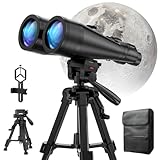
- POWERFUL ASTRONOMY BINOCULARS:20x80 Binocular for Adults High Powered With 20x magnification & 80mm objective lenses,deliver bright, detailed views of celestial objects like the Moon, star clusters, and deep-sky targets.
- WORKS WITH YOUR TRIPOD: Our astronomical binoculars weighs 4.66lb(2113g), and long-term hand-held will cause a burden on the arms and neck, so we equipped it with a 1/4 thread tripod, which can eliminate vibration and provide clear and stable observation.
- CRYSTAL-CLEAR VIEWS WITH BAK-4 PRISMS:The Stargazing Binoculars delivers exceptional brightness and clarity, making it ideal for low-light viewing at dusk, dawn, or under starry skies. The premium BaK-4 prisms enhance light transmission, revealing brighter images with sharper details—perfect for astronomical observation or twilight adventures.
- COMFORTABLE & NON-SLIP DESIGN:These binoculars for adults feature a rugged rubber-armored housing that absorbs shocks while providing a secure, non-slip grip. The waterproof construction ensures reliable performance in sudden rain, fog, or humid conditions.The O-ring sealing lens prevents dust and other debris from entering the inside of your binoculars, protecting your binoculars from damage
- UNMATCHED WARRANTY AND QUALITY SUPPORT:The high power binoculars inner leather bag for easy carrying and protection of the binoculars, perfect for bird watching, stargazing. Professional support team - always ready to provide you with expert help, feel free to contact us if you have any questions.
Product prices and availability are accurate as of the date/time indicated and are subject to change. Any price and availability information displayed on Amazon at the time of purchase will apply.

