
Quick wins for a faster PC:
Scan for outdated or missing drivers - takes under a minuteDriver Scan →Clear out junk files and repair common Windows errorsFree Scan →iTechGuides is reader-supported. When you buy through links on our site, we may earn an affiliate commission. As an Amazon Associate I earn from qualifying purchases. Learn more
To find a student STEM competition, use national directories and local school or fair listings to build a shortlist, then verify eligibility, entry route, deliverables, cost and deadline on each organizer’s current official page. There is no single U.S. application process: some programs accept individual entries, while others require a team, chapter, host site or nomination from an affiliated fair.
Find competitions, then verify them with the organizer
Start with a broad directory such as ORISE’s student competition directory. Also check the DoW STEM opportunities catalog and Society for Science’s competition and fair resources. Search closer to home, too: state science and engineering fairs, university events, school or district fairs, robotics leagues and chapter-based programs can be the entry point for opportunities that do not take direct applications.
Use directories to discover options, not to assume a student qualifies. Open the organizer’s current rules and check these details before investing time in an application:
- Grade and age: Note when the rules measure them—at application, the event or another specified date.
- Geography: Check eligible states or regions and any citizenship or residency conditions.
- Entry route: Determine whether students apply directly or need a fair nomination, school chapter, team or approved host.
- Format and subject: Check whether it is individual or team-based and whether it suits research, building, coding, robotics, math or another project type.
- Materials and schedule: List every required response, file, presentation and deadline, including the time zone. Separate registration from project submission and event dates.
- Practical commitments: Look for fees, adult consent, safety or ethics requirements, travel and public presentations. These vary by program; do not assume they are the same across competitions.
Compare options using the same criteria rather than ranking them by prestige alone. Awards and outcomes are not necessarily comparable across programs.
#1 Best Overall

- BUILD, CODE & DRIVE YOUR OWN ROBOT CAR: Turn coding, electronics and engineering into a working programmable robot car you can assemble, program and drive; ideal for weekend family projects, STEM classrooms, coding clubs, robotics lessons and maker challenges
- EXPLORE FPV, LINE TRACKING & OBSTACLE AVOIDANCE: Control the robot with the ELEGOO app or IR remote, view live FPV video through the onboard camera, follow black lines, avoid obstacles with the ultrasonic sensor and explore multiple interactive driving modes
- BEGINNER-FRIENDLY BUILD WITH GUIDED WIRING: Keyed XH2.54 connectors help reduce wiring mistakes, while the illustrated tutorial and example programs guide beginners step by step from chassis assembly and module connection to programming and the first successful run
- GO BEYOND ASSEMBLY WITH CREATIVE CODING: Program with Arduino IDE to explore movement, sensors and control logic, then modify example code to create custom routes, reactions and robotics experiments that develop coding, problem-solving and engineering skills
- COMPLETE RECHARGEABLE STEM ROBOTICS KIT: Includes an ELEGOO UNO R3 controller board, ESP32-WROVER-based camera and Wi-Fi module, line-tracking and ultrasonic sensors, motors, IR remote and a 2000 mAh rechargeable lithium-ion battery; recommended for ages 8+ with adult guidance for first-time builders
Examples of different competition entry routes
| Opportunity | Who can enter and how | Materials and timing |
|---|---|---|
| National STEM Festival | For the 2027 cycle, U.S. applicants must be in grades 7–12 when applying and at least 13 by April 11, 2027. The program describes eligibility across 56 U.S. Competition Regions; U.S. citizenship is not required. Students submit individually, not as teams. Region is based on the student’s usual home address, including for home-educated students. | Applications open January 11, 2027 and close April 11, 2027, at 11:59 p.m. Eastern. Prepare written project responses, a project PDF and a video. The application cannot be saved and resumed. A Champion role includes a public presentation in Washington, DC, October 19–24, 2027; that commitment is distinct from finalist status. |
| STEM4ALL Fall Cohort | For the 2026 Fall Cohort, U.S. students in grades 3–12 may enter individually or in teams of up to three. A completed project is not required to register. | Registration runs September 25–December 31, 2026. Project submissions run November 16, 2026 through January 16, 2027, at 11:59 p.m. Pacific. The submission includes an abstract, project poster and short presentation video. |
| Thermo Fisher Scientific Junior Innovators Challenge | For U.S. students in grades 6–8. Students must first compete in a Society-affiliated science fair; the top 10% of eligible sixth-, seventh- and eighth-grade competitors may be nominated. | The Society for Science page lists February 1–June 10 as the 2026 application period. Check the page for the next cycle’s dates and requirements. |
| Army Educational Outreach Program opportunities | Junior Solar Sprint is described as a free grades 5–8 program in which students design, build and race solar-powered cars; entry is through a registered TSA chapter or approved Army host site, with TSA middle-school rules applying. eCYBERMISSION is a virtual team competition for groups of three or four students in grades 6–9, focused on identifying a community problem and developing a science explanation or engineering solution. | Confirm current dates and participation details with the program’s official pages. The program descriptions establish different entry routes; they do not establish the cost of every other competition listed here. |
| Regeneron Science Talent Search | Society for Science describes STS as a research competition for high-school seniors. | Check the current application rules and cycle deadline on the organizer’s page; the overview does not establish them. |
These examples show why the entry route matters as much as the project topic. A student may be able to apply directly to one program, but need a qualifying fair or an approved chapter or host for another.
Use a step-by-step application workflow
- Make a student profile. Record grade, age on important dates, state or home region, interests, project status and preference for individual or team work.
- Build a shortlist. Search national directories and local school, fair, university, chapter and state listings. Save the organizer’s page for each candidate rather than relying on a third-party roundup.
- Confirm eligibility and route first. Check grade, age, location and format. If entry depends on an affiliated fair, registered chapter, school team or host, contact that organizer early.
- Read the current rules end to end. Check judging criteria, project-integrity guidance, privacy and consent terms, safety or ethics rules, submission limits and any travel or presentation commitments.
- Match the project to the prompt. Some competitions accept research, design, engineering, experimentation, invention, data, software, prototypes or systems. For the National STEM Festival, students select the theme that best matches the project’s main purpose. An existing school, science-fair, class, internship or extracurricular project may work if the rules allow it and the student’s own contribution is clear.
- Prepare the required files and permissions. Follow specified word, page, file and video limits and anonymization rules. Coordinate adult permissions and team contributions before the deadline.
- Submit through the official portal. Leave time for file conversion, recording, uploads and connection problems. The National STEM Festival’s 2027 application specifically has no save-and-return feature, so have materials ready before starting.
- Save proof of submission. Keep the confirmation and final files, then note any later interview, finalist, travel or presentation dates.
Plan around deadlines, formats and costs
Deadlines belong to a particular cycle, and the closing time zone matters. For example, the 2027 National STEM Festival deadline is 11:59 p.m. Eastern on April 11, while STEM4ALL’s 2026 Fall Cohort project deadline is 11:59 p.m. Pacific on January 16, 2027. Registration and project-submission windows may differ, so record each separately and recheck the official page before applying.
Rank #2

- BUILD WORKING ROBOTS: Teach your kids mechanical engineering in a way they can't resist! Designed for kids 12+, this kit will guide your learner through the process of building real, working robots - taught in a way that they'll understand!
- POWERED BY WATER: Use the power of hydraulics to harness and control the Hydrobot! The arm includes 6 different axes and can rotate up to 270 degrees - no batteries required
- MOVES, ROTATES & GRABS: Use the levers to control the gripper which can open and close or be replaced with suction components to pick up objects
- NOT JUST ROBOTICS: With our Teach Tech Kits, the learning doesn't just stop at robotics. Teach Tech instructions are specifically designed to develop problem solving skills, analytical thinking and curiosity in young minds
- Hands-on Building: This is an in-depth STEM building project, not a pre-assembled toy. Follow the detailed step-by-step assembly instructions, take time to ensure proper assembly, and enjoy a true STEM experience. Expect multiple hours of build time.
Submission formats can also differ substantially. The 2027 National STEM Festival calls for written responses, a PDF and a video; STEM4ALL’s Fall Cohort calls for an abstract, poster and short presentation video. A required digital poster does not by itself mean a physical display board is required. Follow the event’s own specifications before buying or printing supplies.
The Tool Desk
Outbyte PC Repair FREERepair Windows errors before they cause bigger problemsFix Now →Outbyte Driver Updater FREEScan for outdated or missing drivers - takes under a minuteDriver Scan →Do not assume a competition is free—or that an advertised program cost covers travel or materials. The Army Educational Outreach Program describes Junior Solar Sprint as free. Costs for the other opportunities in the table are not established here; check their current rules for fees and any travel, supply or participation expenses.
Rank #3

- Intro to Robotics & Circuits: The kit includes motors, PCB microcontroller boards, and wires, by assembling and operating this robotic arm, It offers a fantastic first-time opportunity for children to know how electronic circuits work and control mechanical movement. Combining 3D puzzle with electrical enginnering, it's Fun and entertaining robotic science experiment for kids ages 8-14 and up! Note: 6 AA batteries needed but not included.
- Spark Interest in Engineering: This mechanical arm perfectly combines education with fun. Kids gain hands-on experience in physics & engineering principles while enjoying the thrill of building and play, making learning exciting. It sparks interest in future engineering and science pursuits.
- Challenging & Cool Wood Building Set! With wooden pieces and precise assembly tutorial, this wood building kit offers a satisfyingly complex building experience that enhances problem-solving skills, patience.
- Perfect Gift Idea: Designed for people who love to build and create, this DIY electronics kit for kids makes a gift or basker stuffer for boys and girls, tweens, teens, adults on birthday, christmas, easter, valentine day, also works for students in educational institutions, school science classes like science summer camping toy, or as STEAM game for families. It provides hours of challenging fun and a great sense of accomplishment once completed.
- STEM Project & Fun Toy for All Ages: No solidering required, the robot arm toy comes with all accessories you need to assemble this. Developing a lifelong love for science, the mechanical engineering kit is good for kids, teens, adults, boys and girls 8,9,10,11,12,13,14 years old and up
Choose a route that fits the student and project
For a student who already has a substantial individual project, a direct-entry showcase may be the simplest path, provided age, geography and materials fit. A middle-school student interested in research can look for an affiliated fair if aiming for a nomination-based competition. Students who prefer building with peers may find a chapter- or host-based challenge a better fit. A high-school senior considering a research competition should review the current senior-specific application requirements directly.
There is no single best competition for every student. The useful match is the one whose eligibility, entry route, subject, workload and schedule suit the student’s circumstances and whose rules clearly permit the project.
Quick Recap
Best Value

- 6 IN 1 STEM KITS: These science experiments contain a reptile robot, a balance car, a bubble machine, a fiber lamp and a buzzer wire game kit. Kids will be proud of building their own robot. REQUIRES (NOT INCLUDED): BUBBLE SOLUTION, AA BATTERIES
- FAMILY BONDING TIME: Doing scientific experiments together is a good way for parents and children to build a great family relationship. Complete science projects with your kids as their friend and teacher, that’ll be an unforgettable and precious time
- UNIQUE GIFT IDEA: Our DIY robotic kits designed for kids age 8-12 are cool stuff for a budding inventor, very suitable for elementary students to show their talents in a science fair. Packaged in a beautiful gift box, these assembled electronic gadgets are perfect gifts for boys and girls for birthdays and Christmas
- LEARN BY PLAYING: Encourage your kids to build their own robots and enjoy DIY science activities. By playing with these electric robots, children's curiosity and interest in physics will be stimulated, and they'll know how much fun it is to create a circuit by themselves
- EASY TO ASSEMBLE: All components of the STEM kits are made with odorless and safety materials. Mini screwdriver and detailed step-by-step instruction manuals make it easier and more convenient to assemble the model
Rank #4
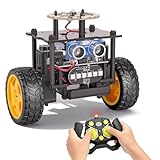
- 【EggTailz Smart Robot Car】This is an educational STEM toys for kids to get experience about electronics assembling and robotics knowledge. DIY assembly and construction will help to cultivate children's concentration and hands-on ability. It is a great combination of challenge and excitement, learning and fun
- 【Multi-functional STEM Toys for Ages 8-13】Equipped with ultrasonic radar allows the car to detect and avoid obstacles in real-time. Headlights for illumination, Taillights for warning, recreating the authentic driving experience. Plus an additional top ring-light, a dazzling light show is about to begin!
- 【Excellent Robot Toys for Children】Featuring advanced self-balancing technology, this 2WD toy car for kids can stays upright and self-corrects its angle. Built-in a rechargeable battery, eco-friendly and convenient—fully charges in 2 hours for 1-4 hours of playtime. Note : Remote control requires 2 AA batteries (Included)
- 【Double Modes, Double the Fun】Auto-Go Mode: the toy car autonomously explores and cruises around the room; Remote Control Mode: you can steer the toy car to forward, backward, turn left, turn right, and 360-degree rotation. Both modes feature radar obstacle avoidance capabilities, offering dual playstyles for twice the enjoyment
- 【Awesome Gift for Kids 8-12】Surprise your child with this awesome robotics kit. Great entertainment away from screens—get kids moving and thinking while reducing their reliance on electronic devices. Perfect educational toy gift for birthdays, Children's Day, Christmas, party, summer camps, back-to-school season, or family fun time
Product prices and availability are accurate as of the date/time indicated and are subject to change. Any price and availability information displayed on Amazon at the time of purchase will apply.

