
What’s actually slowing this PC down?
Pick the symptom - the matching free tool is one click away.
Estimate a wind-turbine site in two stages: screen it with wind maps, parcel layout, terrain and nearby obstacles, then assess wind at the intended hub height alongside turbulence, access, tower footprint and local rules. A map or acreage figure can help rule out poor candidates, but neither guarantees that a particular property will produce useful energy.
The practical questions are: “Is there enough wind on my site?” and “How do I choose the best site for my wind turbine?”
Is there enough wind on my site?
Start with a wind map, but treat it as a regional screening tool rather than a site-specific forecast. The U.S. Department of Energy’s WINDExchange says areas with good exposure and annual average wind speeds around 4 m/s or greater at 30 m are generally considered to have a suitable resource for small wind projects. That is a broad benchmark—not a pass/fail rule or a promise of annual electricity production. DOE WINDExchange Maps and Data notes that maps cannot resolve every local terrain and ground-cover feature.
Check the map height against the planned hub height
A map’s wind estimate applies to a specified height and geographic scale. Compare that height with the turbine’s planned hub height: wind conditions can differ higher above the ground, and trees, buildings, terrain and surface roughness can alter local speed and direction. A map that looks favorable at one height may not describe the wind experienced by a turbine at another.
#1 Best Overall

- Designed Beginner Kit:6 Pcs mini Generator motor,6 Pcs Motor Mounting Bracket Holder,6 Pcs 2mm Shaft Propeller(3 Pcs 4 Vanes and 3 Pcs 3 Vanes,Color random),9 Pcs LED(Red,Yellow,Green),6 Pcs Quick Connector,Color English Manual
- Different voltage corresponds to different speed, Voltage:DC 3V;Rated Speed:1500 RPM;Voltage:DC 4.5V;Rated Speed:2500 RPM;Voltage:DC 12V;Rated Speed:6500 RPM;Motor Body Diameter:24mm/0.94";Motor Height:22.21mm/0.87";Shaft Size:8.25x2.0mm/0.32"x0.08";Line length:14cm/5.51in
- This is a multi-functional beginner's Kit. It can be driven by wind, gears and pulleys to generate current to light up LEDs. It can also be driven by solar panels or batteries to make various solar and electric toys.
- Using the parts in our kit, you can assemble a simple wind power generation model, which can be used to test whether the motor in the kit is damaged, and it can also explain how wind energy is converted into electrical energy, which is then converted into light energy through LEDs.
- Warning: If you have purchased a rocker switch, please pay attention to the product picture to avoid short circuit caused by wrong wiring. High temperature will cause the battery box to melt. Children should use it under the supervision of an adult. When you are not using it, please disconnect the power supply.
Use nearby weather data cautiously
Airport and weather-station readings can provide context, but they are only a rough screen for a specific parcel. The station may measure at a different height, sit in a location chosen for weather reporting rather than wind-resource assessment, or be separated from your land by different terrain and vegetation. A short reading from a handheld anemometer does not establish annual wind conditions.
When greater confidence is worth the effort
Direct measurement at the site provides more confidence. DOE’s preferred methodology is to measure at a height matched to the turbine hub and collect data for at least one year; this is guidance, not a universal legal requirement. Measurement takes time, effort and money. A wind anemometer with a data logger can support preliminary monitoring, but proper height, placement, duration and analysis matter. For a major investment or a complex site, consider an experienced small-wind site assessor.
Estimate energy, not just average wind speed
Mean wind speed alone is not enough to predict output. Estimate production using the selected turbine’s power curve, the site’s annual average wind speed and wind-speed frequency distribution, planned tower height and micrositing conditions. Account for losses as well. The same average speed can correspond to different wind patterns and therefore different turbine production.
Rank #2

- FIFTH-GENERATION WIND TURBINE KIT: Updated version of the best-selling STEM kit about wind power and energy, kids can make their own wind turbine to explore this renewable energy source.
- OPTIMIZED FOR INDOOR & OUTDOOR USE: Design includes a new blade hub and gear ratio to enhance performance in outdoor wind and with indoor fan setups.
- WHAT YOU LEARN: Dive into the technology behind one of the most promising sources of clean energy, how it has been used it the past, and how it is used today.
- INCLUDES ELECTRIC MODEL CAR: Use your turbine to generate and store electricity to power a model car in just two minutes—no batteries required!
- GUIDED JOURNEY THROUGH WIND POWER: The 32-page, full-color manual provides illustrated step-by-step assembly instructions and easy-to-understand explanations about the scientific concepts at work.
How much space does a wind turbine need?
There is no universal acreage requirement. DOE says a system large enough to supply a significant portion of an average U.S. home’s electricity generally requires at least 1 acre. That is a broad land-area guide, not proof that any one-acre parcel is suitable: turbine size, tower placement, setbacks, access and local limits all affect feasibility. See the DOE Small Wind Guidebook.
Do these 3 things before closing this tab:
1Scan for outdated or missing drivers - takes under a minute2Clear out junk files and repair common Windows errors3Fix the driver behind crashes, sound loss and screen glitchesThink beyond the rotor’s visible circle. The usable site must accommodate the tower and, where applicable, guy wires, construction and delivery access, maintenance, safe clearances, the space needed to raise or lower the tower, and the route for electrical wiring. Long wire runs can increase conductor cost and electrical losses.
Use obstacle-height rules as screening heuristics
DOE’s guide gives a general rule of thumb: place the turbine so the bottom of the rotor is at least 30 feet above any obstacle within 300 feet. In its separate site-selection discussion, the guide recommends locating the turbine upwind of buildings and trees and 30 feet above anything within a 500-foot horizontal radius. These are guidebook heuristics expressed in different contexts, not substitutes for engineering judgment or local code.
Rank #3

- Wind-Powered LED Light Display: This small wind-mill generator powers a 10-meter colorful tape lights used to decorate the backyard. Mount it in an open place and the colorful tape lights will light up with the wind without batteries or external power supply. The brightness of the tape lights varies with the strength of the wind. The stronger the wind, the brighter the lights. Add a touch of dynamic color to your backyard on windy evenings. It needs to be installed in an open area for better performance
- Interactive Backyard Experience: Assemble this small wind-mill generator and fix it in an open space, making wind power practical in your yard. You will watch the strip lit up on every windy night, which is fun
- Durable Construction and Easy Installation: Most of its parts are DIY assembled. It can withstand super strong winds. It can be fixed to your railings, higher places, or other open areas with the complimentary flange and 4 screws. The use of brushless motor makes the windmill rather durable. The blades are made of anti-aging materials of ASA/PC
- All-Weather Durability: It is rain-proof and age-resistant, and can be used outdoors for a long time. Further, it is noise-free. A wind blowing from any direction can be used efficiently as the tail vane enables the blades adapt themselves to different directions
- Simple Assembly and Smart Design: It needs to be installed in an open area for better performance. It is cleverly designed and constructed, and is easy to assemble with straightforward instructions for quick setup
Look beyond the immediate parcel
Assess the features that can affect the wind approaching the turbine: hills, ridges, bluffs, gullies, trees, buildings and windbreaks. DOE advises evaluating large terrain features up to a mile away and smaller objects, especially within 500 feet. An elevated or exposed location may improve wind access, but landforms can also cause turbulence. Include current and foreseeable obstacles, and note their height and direction relative to prevailing winds.
How do terrain and turbulence affect a site?
A parcel can feel windy yet offer poor turbine conditions. Hills, buildings, trees and windbreaks can change wind speed and direction, while ground clutter near a small turbine can create turbulence. DOE’s guide says turbulence can reduce estimated annual energy output by 15% to 25% for small turbines in typical ground-clutter sites, because turbine power curves are often developed at lower-turbulence sites. That range is specific to the guide’s described context; it is not a prediction for every turbine or property.
During screening, document prevailing wind directions and examine the terrain and obstacles in those directions. A site assessment should consider wind speed, direction, turbulence, wind shear, uncertainty, topography, obstacles and micrositing adjustments—not just a single map value.
Rank #4
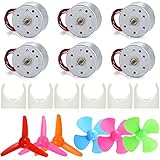
- Designed Beginner Kit: 6 PCS mini dc motor, 6 PCS Motor Mounting Bracket Holder and 3 PCS different colors 4 Vanes shaft propellers and 3 PCS 3 Vanes shaft propellers
- Parameter: Different voltages correspond to different speeds. Voltage: DC 3V, rated speed: 1500 RPM, voltage: DC 4.5V, rated speed: 2500 RPM, voltage: DC 12V, rated speed: 6500 RPM. Color: silver. Motor Body Diameter: 24mm/0.94"
- Two-way Conversion: When the bearing rotates, it generates electricity, when receiving power, the bearing will rotate. This mini wind generator set enables the conversion of kinetic and electrical energy
- Good Present: This learning toy is good for curious kids, let the children know the driving principle of the motor, how the propeller rotates to produce wind. Cultivate children's practical ability, so that knowledge is no longer theoretical
- Warning: Suitable for 8+ years, please see the picture carefully, use the correct circuit diagram to avoid short circuit, short circuit will produce high temperature and cause the battery holder case to melt and burned, the kids must use under the supervision of adults
How to choose the best site on a parcel
Compare candidate locations by expected net annual energy and uncertainty, not by apparent windiness alone. The best position must balance wind exposure with the physical installation, access and local compliance.
- Define the goal. Review electricity use, costs and the utility’s rate structure to determine what the turbine is expected to provide.
- Map the parcel. Record topography, vegetation, ground clutter, access, soils and hazards.
- Mark obstacles and wind directions. Include existing and likely future obstacles, their heights and positions, and the prevailing winds.
- Screen wind information. Compare map and station data with the intended hub height; decide whether on-site measurement or expert modeling is warranted.
- Evaluate micrositing and production. Consider wind shear, shading, turbulence and uncertainty, then estimate energy with the actual turbine power curve.
- Plan the full installation. Include losses, tower and guy-wire footprint, wire runs, construction and maintenance access.
- Verify local requirements. Check zoning, height and setback rules, permits, utility interconnection, aviation and environmental requirements.
- Compare viable options. Weigh net annual energy estimates and uncertainty against total cost, turbine and tower options, maintenance access, footprint and compliance.
For multiple candidate sites or turbine configurations, a comparison table can keep the decision grounded in the same factors:
| Factor | What to compare |
|---|---|
| Energy and uncertainty | Estimated net annual energy for the particular turbine, including assumptions and uncertainty. |
| Wind data | Hub height versus map or measurement height; wind direction, speed distribution and duration of on-site measurement, if any. |
| Terrain and exposure | Nearby landforms, vegetation, buildings, ground clutter and turbulence in prevailing wind directions. |
| Physical footprint | Tower location, rotor clearance, guy-wire radius where applicable, access and room to raise or lower the tower. |
| Electrical and service access | Wire-run distance and expected losses, construction access and future maintenance access. |
| Local compliance | Applicable height limits, setbacks, permits, interconnection and other local requirements. |
| Economics | Installed and operating costs alongside expected production and maintenance needs. |
Which local rules should you check?
Ask the relevant local authority about zoning, permits, maximum structure height and setbacks before settling on a tower location. Setbacks may be measured from property lines, inhabited structures, roads, project infrastructure or other designated interests. An ordinance may specify a fixed distance or a multiple of turbine height; the actual rule depends on the jurisdiction. DOE explains these setback concepts in its WINDExchange Ordinances guidance.
Free tools Windows power users keep installed
One-click scans. No signup required.
Best Value

- Build and experiment with a real, working 3-foot tall wind turbine to learn how wind is one of the most promising sources of clean, renewable energy available today.
- Single-piece blade construction for improved durability and better aerodynamics.
- Generate electricity to charge a battery and power a small model car.
- New weatherproof battery box can be left outside!
- Includes stakes to secure the turbine to the ground.
Also check with the utility about interconnection requirements, and determine whether aviation or environmental reviews apply to the proposed site. A technically promising wind location may still be impractical if the allowed height, required separation or connection conditions do not work for the project.
A practical decision rule
Continue evaluating a site when the wind screening is promising, the intended hub height can access that resource, the turbine has a feasible footprint and service route, and local requirements appear manageable. Seek better measurement or qualified site assessment when terrain is complex, obstacles are substantial, the estimate carries high uncertainty or the investment depends on dependable output. A favorable map or a parcel meeting a general acreage guideline is a reason to investigate—not a final site approval.
Quick Recap
Product prices and availability are accurate as of the date/time indicated and are subject to change. Any price and availability information displayed on Amazon at the time of purchase will apply.

