
Encourage smarter classroom AI use by making it serve a specific learning goal—not simply finish a task. Students should still do the core thinking, learn to check AI-generated claims, and understand when assistance is allowed. Teachers remain responsible for instruction and consequential assessment, while schools need age-appropriate, privacy-conscious tools.
What smarter AI use in the classroom means
AI literacy is more than knowing how to write a prompt. The OECD and European Commission’s 2026 framework describes it as knowledge, skills, and attitudes that help primary and secondary learners understand AI, critically evaluate its outputs, and use it ethically and creatively. Read the framework.
In practice, students need to know what a tool can and cannot establish, how to check its answers, and how to use it without handing over the learning itself. A polished AI response is not proof that a student understands the subject.
Start with the learning goal, not the tool
Before introducing AI to an activity, identify what students are meant to learn and whether using AI helps them learn it. The OECD’s Digital Education Outlook 2026 warns that “Successfully performing a task with GenAI does not automatically lead to learning.” A student may produce a better-looking result while practicing less of the reasoning or foundational skill the assignment is intended to develop.
#1 Best Overall

- 【10000+ Free Images, AI-Powered Drawing Robot for Early Learning】 Children can simply tell the IBEED robot what they want to draw using their voice. Once connected to WiFi, the AI instantly generates new pictures. With access to over 10,000 free AI-generated images—from animals and plants to imaginative fantasy characters—every voice command becomes a creative adventure, unlocking limitless imagination.
- 【Touchscreen Drawing Companion, More Than Just Cards】 Our drawing robot is a fun and engaging creative partner, featuring a high-definition touchscreen and built-in storage. Children can simply tap the screen to select from a library of local images without the need to insert or swap cards (card functionality is also included). The intuitive operation helps kids develop coordination and concentration while drawing, eliminating the frustration of lost or damaged cards and offering endless choices at their fingertips.
- 【AI Prompt Learning — Build Creativity Together with Kids】 Our robot is more than a drawing teacher—it’s your child’s first step into AI. By describing what they want to draw using voice, kids learn how to communicate with AI through prompts, boosting language and logical thinking. We highly encourage parents to explore prompt crafting first, then guide their little ones. This innovative parent-child interaction not only strengthens bonding but also prepares children with future-ready AI collaboration skills.
- 【Turn Real Life into Magical Art – With Just a Snap by APP!】 Simply connect the robot to your phone via WiFi, take a photo of your child's favorite toy or a happy family moment, and watch the AI instantly transform it into a cute cartoon sketch. The drawing robot then draws it live on paper, right before their eyes! It's not just a toy; it's a magical bridge between imagination and reality, giving your little ones a sense of wonder and a unique painting experience they'll cherish.
- 【Parental Mode & Privacy Protection, Safe and Secure】 We prioritize children's privacy and safety. Parents can activate Parental Mode with one click to disable network access for offline use, or turn off the microphone to ensure no recording risks. All AI generation processes comply with child privacy protection standards, giving parents complete peace of mind.
The OECD recommends that learning and teaching develop valued human knowledge and skills—including independent thinking and foundational skills—without GenAI, with educational GenAI, and then with general-purpose GenAI. That sequence puts the underlying skill first rather than making AI the default. The OECD report synthesizes emerging evidence; it does not guarantee that any particular classroom use will produce learning gains. See the OECD report.
- Name the skill or knowledge students should demonstrate.
- Decide whether AI adds a meaningful learning opportunity or merely speeds up completion.
- Keep a version of the task in which students practice the foundational skill without AI when that skill is the objective.
- Consider who the tool is for, what problem it addresses, and what evidence supports its educational value.
Teach students to question AI output
Make evaluation part of the assignment, not an optional final check. Students can compare an AI answer with trustworthy sources, identify unsupported confidence or errors, notice missing perspectives, and revise their own work. These habits put AI literacy into practice: understanding a tool is different from accepting its output.
Rank #2

- 🤖【AI Learning Companion for Kids】Designed to grow with your child, the AI Robot combines learning and entertainment in one interactive companion. Kids can practice drawing, learn letters, listen to stories, sing songs, chat with AI, watch educational videos, and play fun games—all through a friendly touch-screen robot that keeps children engaged while encouraging creativity and curiosity.
- 🎨 【Interactive Drawing & Educational Content】Children can trace pictures directly on the 7-inch HD touchscreen, learn step by step how to draw, color their artwork, recognize letters, and explore educational activities designed to improve creativity, hand-eye coordination, and early cognitive development.
- 📱【 Powerful Android System with Endless Apps】Built-in Google Play Store lets you download your favorite educational apps, learning software, streaming services, and games. Equipped with 1GB RAM, 16GB internal storage, expandable TF card support, Wi-Fi (2.4GHz), Bluetooth connectivity, and OTA online updates to keep your robot up to date.
- 💬【Smart AI Conversations & Fun Moving Companion】More than just a learning device, Voltix features intelligent AI voice interaction that can answer questions, chat with kids, tell stories, and sing songs. Smooth wheels allow the robot to move around, dance, and interact naturally, creating a more engaging companion experience.
- 🔋【Long Battery Life & Family-Friendly Design】Powered by a built-in 4000mAh rechargeable battery, the robot provides approximately 4–6 hours of continuous use on a single charge. The bright 7-inch HD display (1024 × 600 resolution) delivers vivid visuals while the compact design makes it perfect for bedrooms, playrooms, travel, and family activities.
Classroom examples
- Test an explanation: Have students compare an AI-generated explanation with the textbook or another reliable source, then mark what is accurate, incomplete, or wrong.
- Evaluate a counterargument: Ask AI for a counterargument to a student’s claim. Students decide whether it is relevant and support their judgment with evidence.
- Compare feedback with a rubric: Students request feedback on a draft, check each suggestion against the assignment rubric, and explain which changes they accept or reject.
These are examples for designing activities, not interventions proven effective by the sources cited here. The learning comes from students’ evaluation and reasoning, not from the mere presence of an AI tool.
Set clear boundaries for each assignment
Tell students which kinds of assistance are permitted and which are not for that task. Rules can differ by learning objective: using AI to brainstorm possible research questions is not the same as asking it to write an essay that is meant to demonstrate a student’s own writing and reasoning.
The Tool Desk
Outbyte PC Repair FREEClear out junk files and repair common Windows errorsFree Scan →Outbyte Driver Updater FREEScan for outdated or missing drivers - takes under a minuteDriver Scan →Rank #3
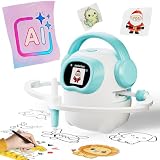
- 【10000+ Free Images, AI-Powered Drawing Robot for Early Learning】 Children can simply tell the IBEED robot what they want to draw using their voice. Once connected to WiFi, the AI instantly generates new pictures. With access to over 10,000 free AI-generated images—from animals and plants to imaginative fantasy characters—every voice command becomes a creative adventure, unlocking limitless imagination.
- 【Touchscreen Drawing Companion, More Than Just Cards】 Our drawing robot is a fun and engaging creative partner, featuring a high-definition touchscreen and built-in storage. Children can simply tap the screen to select from a library of local images without the need to insert or swap cards (card functionality is also included). The intuitive operation helps kids develop coordination and concentration while drawing, eliminating the frustration of lost or damaged cards and offering endless choices at their fingertips.
- 【AI Prompt Learning — Build Creativity Together with Kids】 Our robot is more than a drawing teacher—it’s your child’s first step into AI. By describing what they want to draw using voice, kids learn how to communicate with AI through prompts, boosting language and logical thinking. We highly encourage parents to explore prompt crafting first, then guide their little ones. This innovative parent-child interaction not only strengthens bonding but also prepares children with future-ready AI collaboration skills.
- 【Cloud Gallery with Regular Updates, Endless Freshness】 The robot connects via WiFi to our cloud server, granting access to an ever-expanding official image library. We regularly add new patterns and themes, ensuring children always have fresh content to learn and draw, sustaining long-term interest and exploration. No need for extra card purchases—one purchase, continuous updates.
- 【Parental Mode & Privacy Protection, Safe and Secure】 We prioritize children's privacy and safety. Parents can activate Parental Mode with one click to disable network access for offline use, or turn off the microphone to ensure no recording risks. All AI generation processes comply with child privacy protection standards, giving parents complete peace of mind.
- Specify whether AI may be used for brainstorming, explanations, outlining, feedback, editing, or drafting.
- When relevant, ask students to disclose how they used AI—for example, what they asked it to do and what they changed after reviewing its response.
- Ask students to explain or defend submitted work so that the teacher can assess their understanding, not only the final product.
These are practical classroom recommendations, not a universal policy prescribed by a source. Schools and teachers should align assignment rules with their jurisdiction’s current requirements and their own learning goals.
Protect students and keep teachers in control
Check age appropriateness and privacy
Do not assume that a public chatbot is suitable for students simply because it is accessible. UNESCO’s 2023 guidance, whose page was updated on 16 January 2026, calls for human-centered and age-appropriate approaches, attention to data privacy, and validation of tools for ethical and pedagogical suitability. It describes “a human-agent and age-appropriate approach to the ethical validation and pedagogical design processes.” Read UNESCO’s guidance.
Rank #4

- Unleash Creativity with Smart Drawing Robot - Watch your child's imagination soar as this interactive educational toy guides them through captivating art projects, transforming learning into an exciting adventure.
- Tailored for Young Minds - This Montessori learning toy is designed for 3-8 year old boys and girls, fostering cognitive development and fine motor skills in a fun, engaging way. Suitable Users for: Preschoolers, Elementary Kids, Aspiring Artists.
- Art Anywhere, Anytime - A versatile robot drawing machine perfect for home, classroom, or travel. Suitable Occasions for: Daily learning, Creative playtime, Holiday gifts, Educational settings.
- Endless Fun with Voice Guidance - Featuring AI educational learning and 192 diverse drawing cards, this smart companion makes complex drawing simple and enjoyable, boosting confidence with every stroke.
- Safe & Durable for Little Hands - Crafted from premium, child-safe materials, our interactive painting toy ensures a secure and long-lasting play experience. Plus, enjoy peace of mind with our 24-month warranty service.
Schools should assess a tool before classroom use, including whether it is suitable for the students’ ages and what happens to information entered into it. The cited guidance does not establish one age threshold or tool policy that applies everywhere.
Reserve consequential assessment for professional judgment
AI may help generate feedback or assist a teacher’s workflow, but it should not take over decisions with meaningful consequences for students. The OECD’s 2026 assessment chapter says AI-generated marks or feedback require human validation and do not replace professional human feedback. Teachers need to check whether AI output is accurate, relevant to the learning objective, and fair before using it. See the OECD chapter on assessment and teaching responsibility.
Best Value

- CODING FOR THE CLASSROOM: The Sphero Mini 16-Pack includes 16 tabletop-friendly programmable robots designed for group learning. Introduces computer science, logic, and problem-solving through hands-on coding in the Sphero Edu app. Find free lessons & activities that teach computer science concepts and enhances learning in core subjects like math, science, and ELA
- EXPANSIVE ACTIVITY LIBRARY: The Sphero Edu app offers a vast array of activities that teach computer science concepts and enhance learning in core subjects like math, science, and ELA, making it easy for educators to incorporate STEAM into their curriculum
- LEARN TO CODE: Students can start coding with Draw and Blocks before progressing to JavaScript or Python. The Sphero Edu app and built-in AI Assistant help students understand concepts like loops and variables through real-time guidance and code explanations
- BUILD FOUNDATIONAL AI LITERACY: Students discover how robots use data, sensors, and code to make decisions and how AI tools support learning and problem-solving-building early understanding of how artificial intelligence works in the real world
- PACKED WITH TECH: Each Sphero Mini robot features a gyroscope, accelerometer, motor encoders, and programmable LED for instant visual feedback-bringing movement, creativity, and engineering concepts to life
Give teachers ongoing support
Effective classroom use depends on teachers being able to judge when AI supports learning and when it gets in the way. UNESCO’s 2024 teacher framework sets out 15 competencies across five dimensions: human-centered mindset, ethics of AI, AI foundations and applications, AI pedagogy, and AI for professional learning. It describes three progression levels: Acquire, Deepen, and Create. See UNESCO’s teacher framework.
Professional learning should continue beyond a one-time introduction. Teachers need time to build AI literacy, adapt classroom activities, discuss ethical questions, and make informed decisions about when not to use AI. The U.S. Department of Education’s 22 July 2025 guidance also discusses AI literacy, educator development, differentiated instruction, privacy, and engagement with affected stakeholders, especially parents. Its grant-related descriptions are specific to the United States, not universal requirements. Read the Department of Education announcement.
Use a practical test before adopting a tool or activity
For any proposed classroom use, check whether it meets the following conditions. These criteria synthesize OECD and UNESCO principles; they are not a published scoring rubric.
- Learning objective: Is the tool tied to a specific objective rather than used for novelty or speed alone?
- Student thinking: Do students still perform the core cognitive work they are meant to learn?
- Age and privacy: Is the tool suitable for these students, and has the school considered how it handles their data?
- Teacher oversight: Can the teacher inspect and validate the output, especially if it affects assessment?
- Access: Can students participate equitably, including those with different access needs or technology availability?
- Evidence: Is there a way to tell whether students learned the intended skill, rather than merely completed the task?
What teacher survey figures do—and do not—show
OECD’s 2026 report page attributes these 2024 findings to TALIS, a survey of lower-secondary teachers. They describe those respondents and measures, not all teachers or students:
- 37% of lower-secondary teachers reported using AI for their job in 2024.
- 57% agreed that AI helps write or improve lesson plans.
- 72% believed AI can harm academic integrity by letting students pass off work as their own.
The figures show both practical interest and concern among surveyed teachers; they do not demonstrate that AI improves student learning. See the OECD’s report page and TALIS figures.
Quick Recap
Product prices and availability are accurate as of the date/time indicated and are subject to change. Any price and availability information displayed on Amazon at the time of purchase will apply.

