
Quick wins for a faster PC:
Repair Windows errors before they cause bigger problemsFix Now →Fix the driver behind crashes, sound loss and screen glitchesFind Drivers →A small amphibious robot can move across wet ground and travel in water, but those are different engineering problems. Wet-ground traction, staying afloat and moving across the water surface, swimming underwater, and crossing the air–water boundary each call for different mechanisms. Start by choosing which modes the robot must perform; then design its feet, support, propulsion, and water protection around those requirements.
Decide what “swim” means for your robot
For a small robot, “swimming” can mean paddling on top of the water or moving while submerged. Neither is the same as walking on a wet solid surface. A robot that must switch between modes also needs a reliable way to cross the air–water interface.
- Wet-ground travel: The robot stays on a solid surface, where a water film can interfere with contact and traction.
- Water-surface travel: The robot is supported by buoyancy and, depending on its size and contact geometry, surface tension. Its moving legs must not destabilize that support.
- Submerged swimming: The robot must generate thrust in water while keeping vulnerable components protected.
- Transitions: Entering or leaving the water requires overcoming the forces at the interface; floating or swimming alone does not guarantee a controlled transition.
Write down the primary mode, required secondary modes, payload, operating terrain, and whether the robot must transition between land and water. There is no universally best architecture in the cited research: prototypes differ in scale, materials, actuation, and purpose.
Design wet-ground traction around the water film
Water on a solid surface can reduce usable traction. One tested strategy used tapered, hydrophobic feet with very small contact areas. In a 2018 Nature Communications study, the researchers reported a contact angle near 115° for their roughened foot surface and a friction force more than 40 times lower than in their reference configuration. Their particular soft millirobot averaged 0.5 mm/s on a wet surface at a 1 Hz drive frequency. These are results for that prototype, not expected performance figures for a different robot.
The Tool Desk
Outbyte PC Repair FREEClear out junk files and repair common Windows errorsFree Scan →Outbyte Driver Updater FREEScan for outdated or missing drivers - takes under a minuteDriver Scan →#1 Best Overall

- BUILD, CODE & DRIVE YOUR OWN ROBOT CAR: Turn coding, electronics and engineering into a working programmable robot car you can assemble, program and drive; ideal for weekend family projects, STEM classrooms, coding clubs, robotics lessons and maker challenges
- EXPLORE FPV, LINE TRACKING & OBSTACLE AVOIDANCE: Control the robot with the ELEGOO app or IR remote, view live FPV video through the onboard camera, follow black lines, avoid obstacles with the ultrasonic sensor and explore multiple interactive driving modes
- BEGINNER-FRIENDLY BUILD WITH GUIDED WIRING: Keyed XH2.54 connectors help reduce wiring mistakes, while the illustrated tutorial and example programs guide beginners step by step from chassis assembly and module connection to programming and the first successful run
- GO BEYOND ASSEMBLY WITH CREATIVE CODING: Program with Arduino IDE to explore movement, sensors and control logic, then modify example code to create custom routes, reactions and robotics experiments that develop coding, problem-solving and engineering skills
- COMPLETE RECHARGEABLE STEM ROBOTICS KIT: Includes an ELEGOO UNO R3 controller board, ESP32-WROVER-based camera and Wi-Fi module, line-tracking and ultrasonic sensors, motors, IR remote and a 2000 mAh rechargeable lithium-ion battery; recommended for ages 8+ with adult guidance for first-time builders
The design principle is to limit the effects of the water film while retaining the contact behavior needed for the intended gait. Foot shape, surface treatment, material, robot load, and drive motion work together; a hydrophobic coating by itself does not establish that a robot will move reliably.
A separate light-driven soft-robot study, first published in 2023, reported a water-surface speed increase of nearly 10 mm/s associated with superhydrophobic treatment in its experiment. Its actuation method and scale differ from a conventional motor-driven robot, so it is evidence that surface treatment can affect locomotion, not a direct performance comparison.
Rank #2

- 🎁Ideal Gift for Kids & Teens: Celebrate child’s growing skills and important milestones with this 5-in-1 Programmable robot set. Whether for birthdays, holidays, or achievements, it’s the perfect gift that encourages learning and hands-on fun—a gift that grows with them
- ✨STEM Educational Toys: The robot set for kids ages 8+ combines the fun of STEM learning. It encourages hands-on learning and early programming as they build, which can spark creativity and imagination and provide hours of screen-free play
- 📱Flexible Dual Control Modes: Control the Robotic kit with the intuitive app (Bluetooth) or remote. Enjoy fun features like basic programming, path, and precise movement, exploring endless interactive play
- 🔄 5-in-1 Buildable with Varying Difficulty: The Robot Kit with Progressive Difficulty! From simple robots to complex models, kids can build a robot, dinosaur, car, tank, and more. Adjustable head, arms, and tail allow for fun, playful poses. Perfect for kids 8-12 to develop skills step by step and ignite creativity
- 🛠️Clear & Detailed Build Instructions: This robot kit includes 488 pieces, with clear, colorful step-by-step instructions to make assembly easy. Kids can build their own robots independently or with family, enjoying quality time together and a confidence-boosting building experience
Choose how the robot will be supported on water
A surface-running robot must support its static weight and remain stable as its legs move. Buoyancy and surface tension can both contribute, but their relative importance depends on the robot’s size and contact geometry. Simply copying a foot shape from another prototype is not a reliable scaling method.
Footpads that combine buoyancy and surface tension
A 2018 hybrid microrobot used footpads whose upward support came from buoyancy and surface-tension effects. For that specific design, the authors estimated that surface tension supplied about 25% of the net upward force, with the remainder attributed to buoyancy. The prototype’s reported mass was 1.6 g. Those values describe its design, not a general mass limit or support ratio for small amphibious robots.
Crashes, No Sound, or Screen Glitches?
Random freezes, missing sound and display glitches usually trace back to one bad driver. Find and replace yours safely.Free scan · under a minuteWindows Errors? Fix Them Before They Spread
Repair common Windows errors and clear accumulated junk for a smoother, more stable PC - no reinstall needed.Free scan · no reinstallRank #3

- This robot kit is a hands-on learning experience that illustrates the value of alternate energy sources
- The robot is powered by the chemical reaction of salt water and charcoal, and is safe and non-toxic
- This kit contains all the parts and materials needed to create a salt-water powered robot
- Detailed assembly instructions included
- Recommended for ages 8 years and up
Separate support and actuating legs
A 2011 aquatic microrobot study described a water-strider-inspired layout with ten support legs, two miniature DC motors, and two actuating legs. Its model identified leg radius and contact angle as important factors in supporting force. This approach separates the job of supporting the body from the job of driving it across the surface, but the reported configuration is a research design rather than a ready-made build specification.
Make swimming strokes produce net thrust
A paddle that pushes water equally on its power stroke and recovery stroke can give back much of the thrust it generated. A useful swimming gait therefore needs asymmetry: for example, a paddle that opens to push water on the power stroke and folds or offers less resistance on the return.
Rank #4

- Hands-On STEM Robot Learning---This STEM robot kit combines coding, electronics, and robotics into a fun, hands-on learning experience. Powered by an ESP32 controller and guided by 16 story-based tutorials, this robotics kit for kids helps children ages 8–12 and 12–16 build real-world STEM skills. Ideal for robotics for kids, classroom teaching, or at-home learning.
- 3 Programming Languages for All Skill Levels---This coding robot kit supports Scratch, Arduino, and Python, making it suitable for beginners and advanced learners alike. Scratch block coding is perfect for younger kids and first-time coders, while Arduino and Python support deeper learning for teens and tech enthusiasts. A flexible programmable robot designed to grow with students.
- Mobile-Friendly Coding – Learn Anytime, Anywhere---Unlike many traditional robot kits, this robotics kit supports programming on computers, laptops, tablets, and mobile devices like smartphones and iPads. Kids can code directly on mobile devices, making it especially suitable for schools, training centers, and self-learning at home. A practical STEM kit for kids in modern learning environments.
- Build Your Own Robot – Beginner-Friendly DIY---This robot building kit includes HD videos and illustrated step-by-step instructions, allowing kids to assemble the robot independently or with parents. No soldering required. The building process strengthens hands-on skills, patience, and confidence—making it a strong choice among STEM toys for kids and engineering kits for kids. Tutorial path: ACEBOTT Official Website → Resources → WIKI & Assembly Video Note: Batteries not included.
- App & Remote Control for Interactive Learning---Control the robot using the smartphone App (iOS & Android) or the included IR remote. Kids can instantly see how their code affects movement and behavior, reinforcing core coding logic. This robot kit keeps learning engaging while remaining easy to use for beginners.
Passive flaps for surface swimming
The 2018 hybrid microrobot used passive unidirectional flaps. The authors reported a water-surface speed of 2.8 cm/s at a 5 Hz swimming gait. This is a result for that particular prototype and gait, not a target speed for a new design.
Magnetically actuated flapping for underwater swimming
A separate miniature soft robot used periodic magnetic fields to produce non-reciprocal flapping and swim while submerged. Magnetic actuation can suit research-scale soft designs, but it depends on external magnetic equipment rather than an ordinary onboard propulsion package. The appropriate choice depends on whether the robot must be self-contained and on the water mode it needs to support.
Recommended Free Tools
Best Value
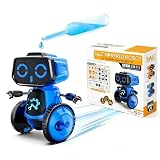
- This robot kit is hands-on learning experience that illustrates the value of alternate energy sources.
- This kit contains all the parts and materials needed tocreate a salt-water powered robot.
- The robot is powered by a primary battery formed from magnesium sheets, carbon sheets, and saline solution, which is safe and non-toxic.
- No batteries required! Fun and educational.
- Recommended for ages 5 years and up!
Treat entering and leaving the water as separate design tasks
The air–water interface resists casual transitions. The 2018 hybrid microrobot used electrowetting pads to change surface wettability and sink at a chosen time and location. Its return to land also required design attention, including a modified leg transmission to help overcome surface forces.
The same study reduced trapped air volume in the chassis and circuit boards and coated circuitry with approximately 10 µm of Parylene C to avoid underwater shorting. These are implementation details from that prototype, not universal waterproofing instructions or a sealing standard. Protection must be selected for the actual components, duration, depth, and operating conditions; the available studies do not establish a general waterproofing specification.
Compare architectures against the mission
| Architecture | What it demonstrates | Main design consideration |
|---|---|---|
| Hydrophobic, tapered feet with small contact areas | Wet-solid-surface locomotion in a soft millirobot | Results depend on foot geometry, surface treatment, gait, and scale; the reported wet-ground speed is prototype-specific. |
| Footpads with electrowetting and passive flaps | Ground walking, water-surface travel, controlled sinking, underwater walking, and return to land in a 2018 hybrid microrobot | Transitions require additional mechanisms and control; the demonstrated design was a research prototype. |
| Water-strider-inspired support and actuating legs | Water-surface support and propulsion using separate support and actuating legs in a 2011 microrobot study | Support depends on geometry, including leg radius and contact angle; the study does not provide a universal parts list. |
| Soft magnetic flapping | Submerged swimming driven by periodic magnetic fields | Requires external magnetic actuation rather than a conventional onboard propulsion package. |
These approaches are not directly comparable in speed or capability: they were tested at different scales, with different materials and actuation methods. Use the table to narrow the mechanism to investigate, not to predict how a new robot will perform.
Turn the requirements into a design sequence
- Specify the modes. State whether the robot needs wet-ground travel, surface locomotion, submerged swimming, or particular transitions. Do not use “amphibious” as a substitute for defining the required behaviors.
- Set the load and size constraints. Estimate the body mass and payload the design must carry. Weight and contact geometry affect support on water, while a change in scale can alter how much surface tension contributes.
- Select support and propulsion separately. Decide how the body stays supported in each mode, then choose a gait that produces thrust without sacrificing stability. A wet-ground foot design does not by itself solve water propulsion.
- Specify transition behavior. Decide how the robot will enter and leave the water, and what mechanism or control action will trigger those changes. If it must submerge, account for the forces needed to break through the surface.
- Plan protection for actual exposure. Identify which electronics face water and what exposure they must tolerate. A coating used by one paper is evidence of one implementation, not a complete sealing design for another robot.
- Check fabrication and control feasibility. Consider whether you can make and repair the necessary compliant structures, surface treatments, linkages, or electrowetting mechanism, and whether the chosen actuator can be packaged and controlled in the intended environment.
What the published prototypes can—and cannot—tell you
The studies establish workable principles and demonstrate specific locomotion modes, but they do not yield a universal build recipe. The reported speeds, mass, support-force estimate, and coating thickness belong to particular experiments; combining them would not describe a single tested robot. For an unspecified project, the evidence also does not establish an off-the-shelf component list, cost, or suitable waterproofing standard.
Do these 3 things before closing this tab:
1Clear out junk files and repair common Windows errors2Fix the driver behind crashes, sound loss and screen glitches3Repair Windows errors before they cause bigger problemsA practical design therefore begins with a defined scale, payload, environment, and meaning of “swim.” Once those are fixed, select an architecture for the primary mode and add transition mechanisms only if the mission requires them.
Quick Recap
Product prices and availability are accurate as of the date/time indicated and are subject to change. Any price and availability information displayed on Amazon at the time of purchase will apply.

