
You can make a handheld virtual pet with a microcontroller, a small display, a few buttons, a buzzer and a protected rechargeable battery. An ESP32 is a flexible choice for a color-screen build; an Arduino Nano suits a simpler monochrome version. Start by prototyping the electronics, then program the pet’s needs and actions before designing a case.
Choose a controller and display
The board determines which displays and libraries are practical, how much room you have for graphics and game logic, and how much wiring your build needs. Two demonstrated approaches are an ESP32-based monochrome build and a color-screen build using an ESP32-C3; an Arduino Nano is another option for a simpler pet.
| Build choice | Display example | Best fit |
|---|---|---|
| ESP32 reference build | 0.96-inch SSD1306 I2C OLED, 128×64 pixels | Compact monochrome graphics and a straightforward wiring reference. ArduinoGotchi project |
| ESP32-C3 color build | 1.69-inch ST7789, 240×280 pixels; the project notes ST7735 modules as an alternative when reducing memory demands | Color graphics, animations and sprite customization. ESP32-C3 project |
| Arduino Nano build | Display details are not stated on the project page | A simpler monochrome-oriented alternative. Arduino Nano project |
Match the display’s interface and library to the exact board and module you buy. I2C uses fewer signal wires than SPI, while a color display can require more memory and rendering work than a small monochrome screen.
Gather the parts
For a basic handheld prototype, plan on these components:
Free tools Windows power users keep installed
One-click scans. No signup required.
#1 Best Overall

- Puppy dog pet play: Giga Pets Puppy brings classic 90s virtual pet fun back with handheld puppy care, interactive activities, and digital animal play boys and girls can enjoy anywhere each day
- Learn to take care of a pet: Name, tame, feed, play, and care for your virtual pet bestie! This electronic pet toy helps boys and girls practice patience, daily care, and responsibility through play
- Feed, play, and train: Care for your electronic puppy with daily feeding, games, vet visits, tricks, and playful routines that help boys and girls stay engaged through daily pet care and fun
- Virtual pet keychain: GigaPets for boys and girls puts digital pet fun in the palm of your hand! Attach this portable virtual pet keychain and bring app-free handheld play on everyday adventures
- Perfect gift: Unlike a traditional GigaPet, Puppy gives boys and girls a playful digital dog friend to feed, train, care for, and enjoy each day! This digital animal game is ideal for ages 6+
- An ESP32 development board or Arduino Nano.
- A compatible small OLED or TFT display.
- Three or four tactile buttons for pet actions and menus.
- A piezo buzzer for sound feedback.
- A protected single-cell 3.7 V LiPo battery, a suitable 1S charging circuit and a regulator or boost stage appropriate to your board and display.
- Jumper wires or a small prototyping board, plus a USB cable for programming and charging as supported by your chosen hardware.
The ArduinoGotchi reference explicitly lists the protected battery, charger and power-conversion components alongside the display, buttons and buzzer. Review its parts and wiring reference before buying: board voltage and display requirements affect the power circuit you need.
Wire buttons, display and sound
Connect the buttons
Use one GPIO input per button. A common arrangement uses the microcontroller’s internal pull-up resistor: configure each input as INPUT_PULLUP, wire the button between that pin and ground, and treat a LOW reading as pressed and HIGH as unpressed. This logic is easy to reverse accidentally in code, so test each control before assigning actions.
The firmware walkthrough demonstrates this button-input pattern alongside the pet model and display logic. See the firmware tutorial.
Rank #2
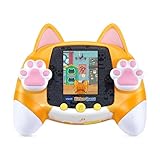
- Adopt an adorable kitten and explore more than 30 meow-velous adventures, games and activities
- Adopt and care for your virtual pet kitten and collect coins for toys, beds and decorations; talk to the kitten for an exciting surprise
- Explore the town as a kitten and find missing puzzle pieces, play arcade-style games or test memory with search activities
- Cat-themed toy with adorable paw controls includes a certificate of adoption and kitten care chart for added role-play enjoyment
- Intended for ages 4+ years; requires 4 AA batteries; batteries included for demo purposes only; new batteries recommended for regular use
Connect the screen and buzzer
Wire an I2C OLED to the board’s I2C pins, or connect an SPI TFT to the specific pins required by its module and library. Pin assignments vary by board and display, so follow the matching project’s wiring rather than copying a pin map from another build. Connect the piezo buzzer to a suitable GPIO output and use short tones to confirm actions or signal a need.
What’s actually slowing this PC down?
Pick the symptom - the matching free tool is one click away.
Prove the circuit before making it portable
First power the build from USB and check the display, every button and the buzzer. Add the battery and charging circuit only after the board-and-display combination works. Confirm the charger is designed for a single-cell LiPo and that the regulator or boost stage supplies the voltages your components require; do not connect a bare LiPo directly to a board or display unless its specifications explicitly allow it.
Program the pet as a state machine
A virtual pet is a small embedded program that stores needs, accepts actions, updates those needs over time and redraws the screen. Separate those jobs so that a button press does not freeze the clock or animation.
Rank #3

- Magical unicorn play: Giga Pets Unicorn brings back classic 90s virtual pet fun with animations, handheld care, and interactive toy play built around a magical unicorn friend for boys and girls
- Learn to take care of a pet: Name, tame, feed, play, and care for your virtual pet bestie! This electronic pet toy helps boys and girls practice patience, daily care, and responsibility through play
- Feed, play, and train: Care for your electronic pet unicorn with daily feeding, games, vet visits, tricks, and nurturing play that helps boys and girls watch the digital pet grow through care
- Virtual pet keychain: GigaPets for boys and girls puts digital pet fun in the palm of your hand! Attach this portable virtual pet keychain and bring app-free handheld play on everyday adventures
- Perfect gift: Unlike a traditional GigaPet, Unicorn brings magical pet care to life, giving boys and girls a sweet digital friend to feed, play with, and grow! Digital animal game is ideal for 6+
Define the pet’s state
Start with fields such as hunger, happiness, energy, age and the time of the last update. Set sensible bounds for each meter so a value cannot grow indefinitely or fall below zero. Pick the meaning of each scale—for example, whether a larger hunger value means more hungry or better fed—and use it consistently in the rules and graphics.
Update needs on a timer
Use elapsed time to change the pet’s meters at intervals rather than making them drop once per screen redraw. The main loop can check for elapsed time, apply the need changes, read controls, trigger any animation or sound, and render the latest state. Timer-based updates keep the pet’s behavior predictable even when a display refresh takes longer than expected.
Map controls to actions
Give each button a clear purpose, such as feed, play, clean or sleep. Actions should change the relevant state: feeding can reduce hunger, play can raise happiness while using energy, and sleep can restore energy. Add limits and feedback so the user can tell when an action has an effect.
Rank #4

- UNIQUE, SQUISHY PLAY EXPERIENCE: Create your own utopia of adorable characters that look & FEEL squishy. Combining digital pet & sensory play, Punirunes’ one-of-a-kind tactile feel will have you hooked
- TOUCH TO INTERACT: Place a finger in the Punirunes pod & discover a squishy button that responds to touch. Watch as your finger appears on the color display, mirroring your movements
- SO MANY WAYS TO PLAY: Take care of your Punirunes. Make food, clean their room, pet them, bathe them & play Punirunes kids games. Earn coins & customize them with accessories, change their colors, decorate their rooms & more
- UNLOCK 55 CHARACTERS: Collect 55 Punirunes including rares, in one toy. As you care for & build friendships with your digital BFFs, use seeds to help them grow up from baby to kid to adult
- MUST-HAVE GIFT: Punirunes is a must-have for those who enjoy anime, collectibles, kawaii & cute stuff. Fun alternative to fidget toys, a handheld game console or video games. Includes 3 AAA batteries
Draw the pet and its status
Render a pet sprite together with readable status bars or icons. For a small monochrome OLED, keep shapes bold and labels short; on a color TFT, use color to distinguish moods or needs without relying on color alone. The firmware tutorial organizes the work around a pet model, update logic, button input, sprites and display rendering.
Add animation, sound and progression
Once the basic loop works, add idle animation, short sound effects, mini-games or changes in appearance as the pet ages or reaches milestones. Keep animation timing separate from need timers so a lively screen does not accelerate hunger. The ESP32-C3 project exposes animation timing, mini-game behavior and sprite arrays for customization. Explore its display and behavior example.
Independent reader supportYour contribution helps us test, update, and keep practical guides available for everyone.Build an enclosure after prototyping
Keep the electronics on a breadboard or temporary plate while you settle button placement, screen visibility and battery position. A case is not required to prove the pet works; postponing it makes wiring and code changes easier.
Do these 3 things before closing this tab:
1Clear out junk files and repair common Windows errors2Fix the driver behind crashes, sound loss and screen glitches3Repair Windows errors before they cause bigger problemsBest Value

- Abundant Quantity: you will receive 36 pieces virtual pets in 5 styles (5 x transparent heart, 4 x solid color heart, 4 x ellipse, 8 x macaroon, 15 x mini), and button batteries are included; They are rich in quantity and various in styles, fit for your different needs
- Convenient to Carry: each virtual pet key chain has proper size and light weight, which is suitable for kids to hold; And each virtual pet game is equipped with a key chain, which is easy to fix a backpack or key
- Easy to Use: the handheld virtual pet has 4 buttons, namely reset, select, decide and cancel, which are easy to operate; Just set the time, modify the name and choose the pet you like, then you can easily get started; For the detailed operation, please refer to the user manual
- Sturdy Quality: the digital pet is made of quality plastic, which is safe and reliable, not easy to break; Each digital pet is built with a large speaker for clearer and more realistic sounds, and it is equipped with 2 pieces button batteries, and you can easily change the battery with 1 screwdriver included when the battery runs out
- Popular Gift: the 90s pet toy adopts classic design, which will be the popular gift for most people on birthdays, Halloween and Christmas; And the 90s pet game can be applied as candy bag filler, Christmas stocking filler, Easter egg filler, school classroom reward, carnival reward, miniature novelty toys and more
For a printed enclosure, the ArduinoGotchi design uses separate top, bottom, spacer and battery-holder pieces fastened with M3 screws and nuts. A printing service is an alternative if you do not own a printer. The Arduino Nano project recommends PETG for its enclosure. See the enclosure project and the Nano build for their respective designs.
Flash, test and refine
- Install the board support. In Arduino IDE, add support for the exact ESP32 or Nano-compatible board you selected, or use the project’s documented PlatformIO workflow.
- Install matching libraries. Use the display and input libraries required by your chosen module and project. A library for one display controller may not work with another.
- Connect over USB and select the board and port. Compile and resolve any board, library or pin-definition errors before uploading.
- Upload with the device still open. Confirm that the screen starts, buttons register with the intended pressed logic, and the buzzer responds.
- Exercise the pet’s states. Test feeding, play, cleaning and sleep, then let timed needs change and verify the bars and animations reflect the underlying state.
- Check battery operation and charging. Verify the board remains stable on battery power and that the selected charger behaves as specified before closing the case.
- Close the enclosure only after the fit is proven. Make sure buttons move freely, the screen is visible, and the battery and wiring cannot be pinched by the shell.
The ArduinoGotchi and firmware projects describe Arduino IDE or PlatformIO upload workflows. Battery-runtime figures and a reliable total build cost are not established for these examples, so plan to measure runtime on your own hardware rather than assume a particular result.
Build from parts or start with a kit?
Building from separate parts offers more control over the board, display, enclosure and game rules, and it makes the electronics and firmware easier to adapt. It also leaves you to check compatibility and assemble the power system. Arduino’s CircuitPet is a kit-oriented alternative described as “Build & Code Your Own Handheld Virtual Pet!” Its listing includes a board, acrylic casing, buttons, RGB LED, buzzer, LiPo battery and display board, but it was marked sold out when checked; availability may change.
Quick Recap
Product prices and availability are accurate as of the date/time indicated and are subject to change. Any price and availability information displayed on Amazon at the time of purchase will apply.
The Tool Desk
Outbyte Driver Updater FREEScan for outdated or missing drivers - takes under a minuteDriver Scan →Outbyte PC Repair FREEClear out junk files and repair common Windows errorsFree Scan →
