
Recommended Free Tools
Windows 11 has no universal fan-speed control: what you can adjust depends on your PC, motherboard, graphics card, and firmware. Start with the manufacturer’s official utility for your exact model; on desktops, check the motherboard’s UEFI/BIOS fan settings, and use a separate GPU-vendor control only for graphics-card fans.
Windows power mode may change how a supported device manages performance and cooling, but it is not an RPM dial. Before changing anything, identify whether the fan is in a laptop, CPU cooler, case, or graphics card, then use the instructions for that device.
Choose the control that matches your device
| Route | Best suited to | What it can do | Important limit |
|---|---|---|---|
| Manufacturer utility | Laptops and branded PCs | Offer supported thermal or performance modes, and sometimes fan controls. | Features and names depend on the exact model. |
| UEFI/BIOS | Desktop motherboard-connected fans | Set a temperature-responsive fan curve when the board supports it. | Menu names and available controls vary by board. |
| GPU-vendor control | Discrete graphics-card fans | Manage the graphics card’s own cooling behavior. | Does not control CPU or case fans. |
| Windows power mode | Devices that support Windows power-mode behavior changes | May affect workload and cooling behavior. | Does not set fan RPM directly. |
1. Identify the fan and your PC model
First decide whether the noise comes from a laptop, CPU cooler, case fan, or graphics card. On a desktop, identify the motherboard and graphics-card models; on a laptop, note the exact PC model. Consult the manufacturer’s support page or manual for supported controls. Fan behavior may be handled by firmware, an embedded controller, drivers, or proprietary software, so a control that works on one model may not exist on another.
2. Try the manufacturer’s official utility
For a laptop or branded PC, visit the manufacturer’s support page for the exact model and look for its official thermal, performance, or fan-management software. Use only controls documented for that device. Some models provide preset modes, while others may expose additional fan options or none at all.
What’s actually slowing this PC down?
Pick the symptom - the matching free tool is one click away.
#1 Best Overall

- Cable length: 13 inches (33.0 cm). 1007 24AWG Tin-plated copper wire. Strong conductivity, corrosion and oxidation resistance. The wire insulating layer is made of PVC, insulated, flame retardant and safer.
- 1 to 5 way splitter pc case fan hub 4-pin PWM fan power supply extension cable cord, better power supply for PC computer case internal motherboard fans.
- Support 4-pin and 3-pin fans cable, the 1 to 5 splitter 5 way hub fan power extension cable compatible with 4-pin and 3-pin PC case motherboard fans. This hub can also be compatible with 3-pin fans, due to 3 pins no PWM controller, 3-pin fans will run in full speed.
- ,Easy to plug; 5 way 4-pin male connector jack fan hub cable.
- PWM Fan Hub, 4-Pin PWM PC Fan Hub Power Supply Cable 1 to 5 Way Splitter for 12V Desktop Computer Cooler Fans -2pack
For example, Microsoft says Surface fan behavior varies with workload and points users to Settings > System > Power & battery > Power mode > Recommended as a supported choice. MSI’s notebook troubleshooting guidance describes its own model-dependent Fan Feed and Cooler Boost controls. Those labels and steps are not universal for other computers.
If the official utility does not recognize a fan or lacks fan controls, check the model’s documentation rather than installing software intended for a different device.
Rank #2
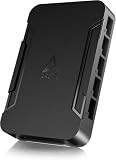
- OPTIMIZE YOUR AIRFLOW: While multi-fan setups improve cooling, they increase complexity. Using a dedicated fan controller ensures precise management and superior performance for your PC build.
- MAX OUT YOUR FAN SETUP: Enjoy independent control for every fan, moving beyond limited hub signals for customization.
- POWER YOUR BULD: Supplies up to 2 A per port and a total maximum current of 4.5 A, unlike motherboards where different ports may provide varying output levels.
- PLUG & PLAY SUPPORT: Native driver support for both Windows and Linux (Kernel 7.2+) enables compatibility with a wide range of fan‑control and monitoring software.
- ZERO CABLE CHAOS: Centralized cable management through a fan controller ensures a cleaner build by eliminating the need for extensions and Y-splitter cables.
3. Check desktop motherboard fan settings in UEFI/BIOS
UEFI/BIOS is the motherboard firmware that starts before Windows. If a desktop motherboard supports fan tuning, its manual can show where to find it. The control may be called Hardware Monitor, Smart Fan, Q-Fan, or something similar; these are examples, not standard menu names.
- Find the exact motherboard model and open its official manual or support documentation.
- Follow the manufacturer’s instructions to enter UEFI/BIOS.
- Look for the documented fan-monitoring or fan-tuning section.
- If available, use the board’s temperature-responsive automatic curve and the fan mode specified for the connected fan.
- Save the setting as directed by the manual, then check system temperatures and fan behavior during normal use.
As one model-specific example, an MSI motherboard manual documents a Hardware Monitor menu with PWM/DC selection and a temperature-linked Smart Fan curve. Your board may use different labels or offer different controls. Avoid forcing a fan off or choosing a fixed low speed as a general noise fix.
Rank #3
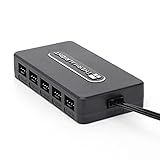
- Thermalright is a Taiwanese brand with more than 20 years of development. It has a certain popularity in domestic and foreign markets and has a decisive influence in the player market. R & D product lines include: CPU air-cooled radiator, chassis cooling fan, thermal conductive silicone pad, thermal conductive silicone grease, CPU fan controller, anti falling off mounting bracket, support mounting bracket and other commodities.
- Built in strong double-sided sticker, fixed on the chassis with double-sided sticker. SATA power line direct transmission, more concise and more efficient. Maintain stable output under high load.
- Small body, large capacity. Multi line control to keep cables in order.
- This fan hub supports the installation of 10 groups of fans, making it easy to manage wiring. Strong paste installation mode, convenient SATA power line direct transmission, and safety is guaranteed.
- Support fan speed reading. (due to the limitation of PWM mainboard IC reading principle, only the speed of a single fan inserted into the red interface is recognized).
4. Treat graphics-card fans separately
A discrete graphics card’s fans may follow their own automatic firmware behavior or be managed by a utility from the GPU vendor. These controls are separate from motherboard settings for CPU and case fans. Check the graphics-card manufacturer’s documentation for the exact model; do not assume a motherboard fan setting will change GPU fan speed.
What Windows 11 can and cannot do
Windows does not provide a universal fan-RPM slider. Microsoft’s thermal-management guidance says Windows can receive fan notifications and telemetry, but it does not control proprietary fan solutions. The guidance also states that Windows’ fan-noise signal informs operating-system resource decisions and “would not control Fan RPM.”
Rank #4

- 8-way fan splitter board for powering, controlling and monitoring multiple fans, transmits PWM signal from PC motherboards or optional NA-FC1 fan controller to all connected fans
- 4-pin (for 5V and 12V fans) and S-ATA (for 12V only) inputs can be used simultaneously (power via S-ATA, RPM & PWM via 4-pin), safety fuses provide protection against overcurrent and short-circuits
- Up to 54W total power via S-ATA (12V fans only) and 24W via 4-pin interface, ideal both for 12V PC case fans and 5V applications (with Noctua 5V fans that include USB power adaptor cables)
- Easy installation on any magnetic surface such as steel PC case panels thanks to four strong mag-nets, included NA-EC1 input cable for connection to motherboard fan headers
- Full compliance with all applicable safety standards (EN 62368-1, EN 55035, EN 55032, UL-507), CE, UKCA and UL certification, renowned Noctua quality backed up by a 6 year manufacturer’s warranty
Windows 11 power mode may affect performance and, on supported devices, cooling behavior. To check it, open Settings > System > Power & battery > Power mode and choose an available mode appropriate for your needs. The result depends on the PC and its manufacturer’s implementation; this setting does not directly set a fan percentage or RPM.
Independent reader supportYour contribution helps us test, update, and keep practical guides available for everyone.If fan controls are missing or the PC is overheating
- No fan option in the utility: The exact model may not expose manual control. Check its official support documentation.
- A desktop fan is not adjustable in UEFI/BIOS: Confirm the motherboard supports control for that connection and consult its manual.
- The graphics-card fan is unaffected: GPU fans are controlled separately from motherboard-connected fans.
- Sudden abnormal noise or overheating: Follow the manufacturer’s troubleshooting or service guidance instead of forcing a low fan speed.
Thermal behavior is platform-specific. If the computer overheats or the noise changes suddenly, prioritize diagnosis and manufacturer support over manual tuning.
Best Value

- Fan extension cable for PC computer motherboard fan, make you easier to DIY PC computer
- The PC fan controller is a 4-pin female connector that supports both 4-pin and 3-pin fan cables and is compatible with all 4-pin and 3-pin housing fans.
- 15-inch fan power extension cable with tinned copper wire core for use without affecting fan performance
- The pc fan splitters with a 2.9MM thick adhesive backing that fits in the right place in the chassis for a clean and tidy look inside the PC case.
FAQ
Can I set fan RPM from Windows 11 Settings?
No. Windows 11 Settings does not provide a universal per-fan RPM control. Use the official utility or firmware controls supported by your specific device.
Can Windows power mode make my fan quieter?
It may affect performance and cooling behavior on supported devices, but it does not directly set fan RPM. Microsoft recommends the Recommended power mode for Surface fan behavior; other devices may work differently.
Where do I control a desktop CPU or case fan?
If the motherboard supports it, check its UEFI/BIOS fan settings and manual. The available controls and menu names vary by motherboard.
Can motherboard settings control my graphics-card fan?
Not usually. Graphics-card fans may use their own firmware or GPU-vendor utility, separate from CPU and case fan controls.
Why is there no fan option for my laptop?
Many laptop controls are model-specific and handled by the manufacturer’s firmware or software. Check the official support page for your exact model; a manual fan curve may not be offered.
Quick Recap
Product prices and availability are accurate as of the date/time indicated and are subject to change. Any price and availability information displayed on Amazon at the time of purchase will apply.

