
Free tools Windows power users keep installed
One-click scans. No signup required.
Compare the exact graphics-card model under similar workloads, then judge its sustained temperature alongside its fan noise—not as separate scores. A cooler card is not automatically the better choice if its fans are much louder, and review results do not transfer reliably between different cards that use the same GPU chip.
Start with the exact graphics-card variant
A GPU chip can appear in cards with different coolers, fan counts, power settings, and fan curves. A review’s temperature and noise figures describe the particular card tested and the review’s test setup. Record the complete manufacturer and board-partner model name; do not treat one variant’s readings as representative of every card built around that GPU.
For example, Tom’s Hardware’s RX 7600 review describes its own test conditions, including a sound meter 10 cm from the card and a 31–32 dB(A) test-environment noise floor. Those figures illustrate that review’s method; they are not universal measurement standards or a current ranking of RX 7600 models. Read the RX 7600 review’s noise and thermal results.
Compare the conditions behind each result
Before comparing numbers from two reviews, note what was being measured and how. Results are most useful when the reviews use the same lab and protocol. If the conditions differ or are not disclosed, treat the figures as clues rather than a precise head-to-head comparison.
#1 Best Overall
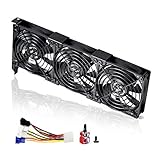
- 3 x 92mm fans combined into one interface, can be connected to the motherboard's 3-pin or 4-pin interface and you only need to access one interface to run all the fans
- This cooling fan's total size is 11in(L) x 4.72in(W) x 1.18in(H), designed for most universal graphic card video card VGA cooling,just please check the size to make sure your pc has enough space
- D-type interface cable included four interfaces, three voltages: 5V, 7V and 12V; different voltages with different airflow, speed and noise. You can select the appropriate voltage interface to start the fan
- The double ball bearing has a service life of 65,000 hours, and the 7 blades produce strong airflow to keep the computer case cool
- packing list: 3 x 92mm fans (PCI bracket screwed), 1 x multi-voltage cable ,1 x mini screwdriver,1 x fixing screw
| What to check | What to record | Why it matters |
|---|---|---|
| Exact model | Full manufacturer and board-partner model name | Cooler design and fan behavior vary between card variants. |
| Workload | Game or benchmark, resolution, settings, and load or power context | Different workloads create different heat and fan demand. A synthetic test describes that benchmark, not every game. |
| Duration and state | Warm-up time; idle, peak, or sustained readings | A short snapshot can miss heat soak and fan ramping. |
| Temperature | GPU core and, if available, memory or hotspot readings; sensor source | Readings are meaningful only when you know which component and sensor they describe. |
| Acoustic method | dB(A), distance, microphone position, noise floor, and test environment | Sound-pressure readings from different protocols may not be directly comparable. |
| Fan behavior | RPM or percentage; automatic curve or fixed speed; fan-stop behavior | Fan speed trades cooling against noise, so the operating mode changes what the result means. |
| Environment | Open test bench or case, ambient temperature, and airflow | A restricted case or different room conditions can change results; an open-bench test does not guarantee the same outcome in a compact build. |
| Performance context | Sustained clocks or performance alongside temperature and noise | A low temperature alone does not show whether the card maintains useful performance or avoids throttling. |
Read temperature and fan noise together
There is no single temperature or noise threshold that makes every GPU a good or bad buy. The model, workload, sensor, measurement setup, and airflow all affect the result. Look for a card that maintains the performance you need at a sound level you find acceptable, rather than choosing the lowest temperature in isolation.
Tom’s Hardware makes the trade-off explicit in its RX 7600 review: “Last we have GPU temperatures, and it’s worth pointing out that many graphics cards choose to prioritize lower noise over temperatures.” A warmer result may reflect a quieter fan strategy rather than a cooling failure; check the card’s exact specifications and its clocks under load before drawing a conclusion. See the review’s temperature and fan results.
Rank #2

- 2 x 92mm fans combined into one interface, can be connected to the motherboard's 3-pin or 4-pin interface and you only need to access one interface to run all the fans
- This cooling fan's total size is 7.36in(L) x 4.72in(W) x 1.18in(H), designed for most universal graphic card video card VGA cooling,just please check the size to make sure your pc has enough space
- D-type interface cable included four interfaces, three voltages: 5V, 7V and 12V; different voltages with different airflow, speed and noise. You can select the appropriate voltage interface to start the fan
- The double ball bearing has a service life of 65,000 hours, and the 7 blades produce strong airflow to keep the computer case cool
- packing list: 2 x 92mm fans (PCI bracket screwed), 1 x multi-voltage cable ,1 x mini screwdriver,1 x fixing screw
Use dB(A) carefully
dB(A) is useful for comparing measurements made under comparable conditions, but it does not describe the full character of a fan’s sound. Tom’s Hardware’s graphics-card noise methodology notes: “Rather, it produces complex noise covering a spectrum of frequencies.” Fan design and sound spectrum, microphone distance and direction, room noise, and equipment can all affect what a meter records. The article explains A-weighting in relation to human hearing and references DIN EN 61672-1/-2; it is not a substitute for checking a review’s actual measurement setup. Read Tom’s Hardware’s graphics-card noise methodology.
Do not assume that two reviews’ identical dB(A) figures mean the cards will sound equally loud to you if the labs used different distances, microphone positions, or noise floors. Prefer comparisons from one reviewer using one protocol, or reviews that disclose enough detail to assess the difference.
Recommended Free Tools
Rank #3
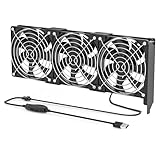
- 【Durable & Compact Design】This cooling fan is built with high-quality materials for enhanced durability. Its compact size makes it easy to install in tight spaces, providing reliable active cooling for graphics cards or server components
- 【Broad Compatibility for High-Performance Hardware】Ideal for graphics cards and other server hardware that require additional cooling. Perfect for use in consumer chassis with limited airflow to improve system stability and performance
- 【Adjustable Fan Speed for Custom Airflow】With a speed range of 1500–3000 RPM, the fan allows you to fine-tune airflow based on your cooling needs. Whether you prioritize silent operation or maximum cooling, this fan gives you full control
- Flexible Power Options with USB & 4-Pin Support】Comes with a USB to 4-PIN PWM cable for easy 12V power connection. The fan can be turned on or off manually, offering flexible control
- 【Complete Kit, Ready to Install】Includes 1 x cooling fan, 1 x USB to 4-PIN cable, and 1 x mounting screw. Everything you need for a quick and hassle-free installation—no additional parts required
Distinguish a standard review result from a cooler-efficiency test
Default fan-curve testing
A standard review test answers: how does this complete card behave under a particular workload with its default automatic fan curve? This is useful for understanding likely out-of-box behavior, especially when comparing cards tested by the same reviewer. It is not a promise of the same noise or temperature in your own case.
Noise-normalized testing
A noise-normalized test asks how effectively a cooler handles heat at a controlled noise level. TechPowerUp’s Sapphire RX 7600 Pulse OC cooler-comparison page describes a game-like workload and a 35 dBA target measured at 50 cm, with GPU on-die temperature reporting. Those are parameters of that page’s methodology, not a universal standard or an estimate of each card’s normal gaming noise. Differences in power draw and heat output can also complicate cooler-efficiency comparisons unless the heat load is controlled. See TechPowerUp’s RX 7600 Pulse OC cooler comparison.
Rank #4
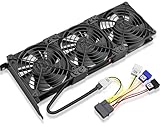
- Package include: 1 Piece Graphic Card Fans ( 3-Fans connected ) with 1*Power D-type Interface cable
- Dimension: 92mm(L) x 92mm(W) x 25mm(H) / 3.62in(L) x 3.62in(W) x 1in(H) in per fan. Totally Size: 276mm(L) x 120mm(W) x 30mm(H) / 10.86in(L) x 4.72in(W) x 1.18in(H)
- Rated Voltage: DC 12V; Rated Current: 0.45Amp; Rated Speed: 3x 1800 RPM; Air flow: 3x 39.8 CFM; Noise: 3x 24.8 dBA
- D-type interface cable included four interfaces, three voltages: 5V 7V and 12V; Different voltages with different airflow, speed, and noise. you can select the appropriate voltage interface to start the fan.
- 3 fans combined into one interface, Can be connected to the motherboard's 3-pin or 4-pin interface and you only need to access one interface to run all the fans.
A fixed fan-speed result answers a different question from a default automatic fan curve, too. Raising fan speed can reduce temperature at the cost of more noise; use whichever result matches what you want to learn.
Independent reader supportYour contribution helps us test, update, and keep practical guides available for everyone.Check warmed-up readings, not just a brief snapshot
For your own card or a review that publishes sensor logs, prioritize sustained load data over idle temperature or an initial peak. Tom’s Hardware’s GPU temperature guide recommends running a game or graphics workload for about 15 minutes or more so the GPU has time to warm up. Its RX 7600 review separately reports that its Metro Exodus workload ran for over 15 minutes before the cited fan-speed and noise example; that duration belongs to that test, not to a universal testing rule. Read the GPU temperature monitoring guide and the RX 7600 test details.
Best Value

- Ventilation Fan: Designed to quietly ASUS GT/RT- AC5300 , cool Xboxs, CPU/ GPU, Playtations, Rokus, TVs, receivers, mondems, routers, DVRs, window fans ,network appliances, DIY aquarium cooling and other audio video electronics
- Variable Speed Control: 110V - 220V Fan power supply with speed control function, turn the knob to adjust the speed, 4V - 12V adjustable fan speed,and can turn off the fan . | Input: 100V - 240V 50/60Hz | Output: DC 3-12V 200-2000ma
- DIY Vertical Window Fan: Can both vertical and horizontal, provide efficient cooling and ventilation. Mining rigs rely on the cooling power of fans for optimal operation.Double Metal Protective, the fan is equipped with double metal protective net
- Easy to Install: Draw out air in refrigerators, provide ventilation in greenhouses, prevent amplifier overheating, and vent hot air from living room consoles like PS4. Y cable connects 2 fans, two fans can be 42cm/16.5 in far away from each other
- Dual Ball Bearing: 240mm x 240mm x 25mm / 9.45in(L) x 4.72in(W) x 1in(H) in in total. | Rated Voltage :12V | Rated Current: 0.93A at full speed | Airflow: (82CFM)x4 at 12V | Speed: 2500 RPMx4
To inspect readings yourself, GPU-Z’s Sensors tab can display and log temperature, clock speed, and fan speed to a CSV file. MSI Afterburner and HWiNFO are also identified as sensor-monitoring tools in Tom’s Hardware’s guide. Compare logged clocks with specifications for the specific GPU; a temperature should not be judged against a generic threshold or examples from an older GPU generation.
- Identify the exact card model and GPU before interpreting its readings.
- Run a game or graphics workload relevant to how you use the card, and allow it to warm up; the guide suggests about 15 minutes or more.
- Log temperature, clock speed, and fan speed during the workload, rather than relying only on idle or a brief peak.
- Review sustained behavior together: temperature, clock stability or performance, and fan speed.
- Check the GPU’s specific specifications if you are trying to diagnose an unexpectedly high temperature.
Match the workload to how you will use the card
Game results help answer how a card behaves in games; synthetic benchmarks describe performance and cooling under their own test conditions. Neither necessarily predicts every other workload. A stress test can expose high-power or thermal behavior, but should not be mistaken for ordinary gameplay. When reading reviews, favor the workload closest to yours and keep its settings and duration in view.
Quick Recap
Turn the comparison into a buying decision
- Write down the full model name for each card you are considering.
- Find temperature and acoustic results from the same reviewer where possible, and record the workload, duration, and fan mode.
- Check that temperature readings identify the sensor and that noise results disclose dB(A), distance, microphone position, and noise floor.
- Compare sustained temperature with fan noise and sustained clocks or performance—not with temperature alone.
- Use noise-normalized cooler tests to compare cooling efficiency, and default-fan-curve results to understand out-of-box behavior.
- Account for your own case airflow and ambient conditions; an open-bench result cannot guarantee how a card will sound or run in your build.
Product prices and availability are accurate as of the date/time indicated and are subject to change. Any price and availability information displayed on Amazon at the time of purchase will apply.

