
Start by matching the lens to your camera’s mount and confirming that it covers a full-frame sensor. Then choose the focal-length range, aperture, stabilization and size that fit what you photograph. For a small camera, a compact standard zoom can be a practical everyday lens; a faster lens may make more sense if low light, moving subjects or background blur matter more than keeping the kit small.
How do I choose a lens for a compact full-frame camera?
- Check the mount and sensor coverage. A lens that physically attaches is not necessarily designed to cover the full-frame sensor. Confirm the mount, full-frame coverage and any crop-mode requirements in the camera and lens specifications.
- Choose your framing range. Think about whether you mostly photograph wide scenes, everyday subjects or distant details. A zoom’s short end sets how wide you can frame; its long end determines how much reach it offers.
- Balance aperture against size. A larger maximum aperture admits more light and can allow faster shutter speeds, which is useful for action. Compact zooms commonly trade some aperture for a smaller, lighter package.
- Account for stabilization and subject movement. Lens stabilization can help reduce blur from camera shake. It does not, by itself, establish that a moving subject will be frozen; shutter speed and the camera’s particular features also matter.
- Assess the complete camera-and-lens kit. Compare lens weight and dimensions, autofocus and video needs, close-focus requirements, controls and how the lens balances on your compact body.
Why compatibility comes first
Identify your camera’s lens mount before comparing focal lengths or buying. Also verify that the lens projects an image circle large enough for the full-frame sensor. Some systems allow smaller-format lenses to mount on full-frame bodies, but use may involve a crop and camera settings that should be checked.
For Sony E-mount, Sony identifies full-frame lenses with the FE designation. Sony’s compatibility guidance says: “The cameras and lenses are interchangeable, but some caution is required depending on the camera/lens combination.” FE is a Sony-specific naming example, not a universal rule for other brands. Sony’s E-mount compatibility guidance explains the combinations and qualifications.
What focal length is useful for everyday photography?
A 28–60mm zoom and a 28–70mm zoom share the same wide end, but the 28–70mm reaches farther. Either range may suit everyday scenes, depending on whether you value a compact lens or want more framing flexibility at the long end. Neither range is universal: your subjects and shooting distance should decide.
Outdated Drivers Are Slowing You Down
One free scan finds every outdated or missing driver and matches the right update for your exact hardware.Free scan · exact hardware matchPC Slower Than It Used to Be?
A free scan shows the junk files, broken settings and background clutter dragging Windows down - then fixes them in one click.Free scan · Windows 10 & 11#1 Best Overall

- Fast, quiet VXD linear motor for high-speed and high-precision autofocus
- MOD (Minimum Object Distance) of 7.1” at wide end and maximum magnification ratio of 1:2.7 for creative close-ups
- New design provides enhanced texture and greater user-friendliness
- Compact at 4.6" long and weighing just 19 oz
- Moisture-Resistant Construction and Fluorine Coating
A 28mm wide end is not as wide as a shorter focal length, so it may feel restrictive for expansive landscapes or tight interiors. Conversely, if you often photograph details or subjects from farther away, the extra reach of a 70mm long end can be useful. Consider the scenes you actually shoot rather than choosing a range because it is labeled “standard.”
Compact Sony FE zooms to consider
These examples are for Sony E-mount cameras only. Confirm the exact model and compatibility with your body; the available specifications do not establish comparative optical quality, autofocus performance or handling across brands.
Rank #2
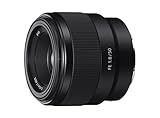
- Large F1. 8 maximum aperture enables beautiful defocusing effects
- 7-blade circular aperture creates beautiful defocused bokeh
- Compact, lightweight design Ideal for full-frame e-mount cameras
- Aspherical element controls spherical aberration and coma
- Double-gauss configuration suppresses field curvature & distortion
| Lens | Coverage and aperture | Stabilization and weight | Potential fit |
|---|---|---|---|
| Sony FE 28–60mm F4–5.6 (SEL2860) | 28–60mm; variable maximum aperture of F4–5.6 | Weight not stated in the cited product information | A compact standard zoom option for Sony E-mount users who prioritize a small kit. Sony describes it as compact with full-frame performance. Sony product page |
| Sony FE 28–70mm F3.5–5.6 OSS (SEL2870) | 28–70mm; variable maximum aperture of F3.5–5.6 | Optical SteadyShot; Sony lists 295g | Offers more reach than the 28–60mm while retaining a variable-aperture standard-zoom design. Verify the model identity and availability. Sony product page |
| Sony FE 28–70mm F3.5–5.6 OSS II (SEL28702) | 28–70mm; variable maximum aperture of F3.5–5.6 | Optical stabilization; weight not stated in the cited product information | A separate version of Sony’s 28–70mm full-frame zoom. Check that a listing is for the OSS II and confirm suitability for your camera body. Sony product page |
Is a 28–60mm enough for everyday photography?
It can be enough if your usual subjects fit that range and you value compactness. The 28mm end handles many everyday scenes, while 60mm provides some tighter framing, but it offers less reach than a 28–70mm zoom. It is not a universal choice for interiors, distant subjects or every style of photography; consider whether those situations come up often for you.
Independent reader supportYour contribution helps us test, update, and keep practical guides available for everyone.When should I choose a faster lens?
A larger maximum aperture can admit more light and permit a faster shutter speed, which can help when photographing action or working in dim conditions. It may also help separate a subject from the background, depending on the lens and shooting situation. The trade-off is that a faster lens may be larger or heavier, so weigh that benefit against the compactness you want.
Do these 3 things before closing this tab:
1Clear out junk files and repair common Windows errors2Fix the driver behind crashes, sound loss and screen glitches3Repair Windows errors before they cause bigger problemsRank #3

- Supreme lightweight portability that makes telephoto shooting fun
- Uncompromising image quality with 15 elements in 10 groups that lets you focus on creativity
- Up-close shooting performance (31.5" / 1:9.4 Wide & 59.1" / 1:5.1 Tele)
- Moisture-Resistant Construction
Stabilization addresses camera movement, not the movement of the subject. If you photograph people, pets or sports in motion, a lens’s stabilization alone does not guarantee a sharp result. Consider aperture, shutter speed, autofocus needs and the capabilities of your particular camera body together.
Quick Recap
Best Value

- World’s first high-speed standard zoom lens for APS-C cameras with the focal length range of 17-70mm 4.1x zoom ratio
- Outstanding optical performance with 16 elements in 12 groups featuring two GM (Glass Molded Aspherical) lens -elements and one hybrid aspherical lens element
- Upgraded VC effective in combination with Sony APS-C mirrorless cameras, leveraging AI for video shooting
- Close focusing capability with MOD of just 7.5” at 17mm / 15.4" at 70mm
- Moisture-Resistant Construction and Fluorine Coating
Rank #4

- Full-Frame Dual-Ring Pancake Lens: At just 23.8mm thick and 130g light, this lens packs both a dedicated aperture ring and a focus ring into an ultra-compact body. Slip it into your pocket and hit the street.
- Excellent Close-Up Performance: With a 0.2m minimum focusing distance and 0.2x magnification, capture fine textures and small subjects with stunning clarity and smooth background blur.
- Outstanding Optical Quality: 6 groups and 8 elements with 2 aspherical and 1 high-refractive index lenses deliver sharp, detailed images from center to edge.
- Versatile 26mm Focal Length: A natural, familiar perspective that works across street photography, travel scenes, and everyday life.
- Reliable STM Autofocus: The gear-type STM motor keeps the lens compact while delivering responsive, near-silent focusing performance suited for everyday shooting.
What to verify before buying
- Exact mount and full-frame image-circle coverage.
- Whether a crop mode is required for the lens and how that affects your images.
- Focal-length range matched to your usual subjects and shooting distance.
- Maximum aperture at the focal lengths you expect to use.
- Whether stabilization is in the lens, the camera body or both, and how it works with your specific body.
- Lens dimensions and weight in relation to the compact camera you plan to carry.
- Exact model and version, especially when comparing the Sony 28–70mm OSS and OSS II.
Product prices and availability are accurate as of the date/time indicated and are subject to change. Any price and availability information displayed on Amazon at the time of purchase will apply.

