
Choose a screen size that suits your room and viewing position, then use the projector’s own throw ratio to calculate how far its lens must sit from the screen. The key is to calculate from the image’s width, not its diagonal, and to verify mounting geometry in the exact model’s manual before installing a permanent mount.
What size projector screen fits your room?
Start with the usable screen wall and the seats from which people will watch. A screen should fit the wall and feel comfortable from the intended viewing position; choosing the largest size that physically fits is not automatically the best choice. BenQ’s screen guide discusses 16:9, 4:3, and 2.35:1 aspect ratios and gives viewing-angle suggestions, but these are guidance rather than universal standards for every room or viewer. BenQ’s screen-size guide
Choose the aspect ratio and a candidate diagonal
Match the aspect ratio to your content and the screen area you can use. Then choose a candidate diagonal that fits the wall and works from your seat. A diagonal describes the distance from one corner of the image to the opposite corner; it is not the horizontal width needed in the throw-distance calculation.
As viewing-angle guidance, BenQ attributes a 30-degree minimum field of view to SMPTE and a 40-degree cinematic recommendation to THX. The same guide gives rough viewing-distance heuristics of screen diagonal multiplied by 1.6 for standard viewing and by 1.2 for cinematic viewing. Treat these as recommendations reported by BenQ, not as guarantees or universal medical or ergonomic rules. BenQ’s screen-size guide
PC Slower Than It Used to Be?
A free scan shows the junk files, broken settings and background clutter dragging Windows down - then fixes them in one click.Free scan · Windows 10 & 11Crashes, No Sound, or Screen Glitches?
Random freezes, missing sound and display glitches usually trace back to one bad driver. Find and replace yours safely.Free scan · under a minute#1 Best Overall
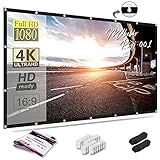
- CONVENIENT TO STORAGE AND CARRY : Compact one-piece,lightweight and folding design. You can fold the projector screen in small size and put it in your backpack or suitcase
- WIDE APPLICATION : Ideal choice for home theater movie,office,education, conference room presentation, public display, outdoor movie and more
- ANTI-CREASE AND HIGH ABSORBANCE MATERIAL : Made with natural Polyester fabric that The projection is sharper and brighter than most other projection screens, The Projector screen are thicken and smooth, no wrinkle when folded / crushed.
- EASY TO SET UP : The Projector Screen can be fastened easily with hooks, ropes, bracket, nails, double side tape on the wall/mount.
- 120 Inch Viewing Screen :Features 16:9 aspect ratio with a 120 inch diagonal, offering an expansive 104" x 58" viewing area
How do I calculate throw distance?
Throw ratio is the distance from the projector lens to the screen divided by the projected image’s horizontal width. Rearranged, the calculation is:
Throw distance = image width × throw ratio
Use the ratio for the exact projector and lens. Sony states that its throw distance is measured from the lens reference point; check your model’s manual for its measurement reference and installation definitions. Sony Support: How to calculate throw distance
Rank #2

- 1. 【Lightweight & Foldable 16:9 Screen】 Designed for casual indoor and outdoor use. This high-density polyester projection screen offers a wide viewing angle. It is incredibly lightweight and folds compactly to fit in your own backpack, making it the perfect budget-friendly choice for camping, backyard movie nights, or temporary setups.
- 2. 【Important: Material & Best Environment】 To achieve extreme portability and a highly cost-effective design, this screen is made to be thin and lightweight. IT IS NOT a thick, heavy-duty professional home theater screen. For the best image quality, we highly recommend using it in completely dark environments or hanging it directly against a solid, opaque wall..
- 3. 【Foldable Design & Crease Removal Guide】 Please note: The screen is shipped folded in basic packaging to minimize costs, so creases are normal upon arrival. To easily remove wrinkles, simply stretch the screen tightly using the included accessories for a few days, or iron it on the LOWEST heat setting with a damp cloth.
- 4. 【What's Included & Wall Safety Warning】 Package includes: 1x Projector Screen, Ropes, Hooks, and Double-Sided Tapes for quick setup (NOTE: Stand, bracket, and carry bag are NOT included). WARNING: Only use the tape on completely smooth surfaces like glass or tile. For painted walls, strictly use ropes or nails to prevent the tape from damaging your wall paint.
- 5. 【Budget-Friendly Casual Viewing】 Built for convenience and extreme value, this minimalist screen is the perfect entry-level accessory for casual family gatherings. If you are a professional cinephile looking for a premium, heavy, wrinkle-free fixed-frame screen with luxury packaging, this highly portable model might not fit your advanced needs.
Convert diagonal size to image width
First convert the chosen diagonal to horizontal width using the selected aspect ratio. For a 16:9 image, BenQ’s example gives an approximate width of 7.2 feet for a 100-inch diagonal. That is the width to use in the equation—not 100 inches. BenQ US: Projector screen size and distance
Apply the projector’s throw ratio
For a fixed throw ratio, multiply the image width by that ratio. For a zoom lens with a minimum-to-maximum ratio, multiply the width by both ends of the range to find the supported distance interval, then confirm the placement in the model-specific calculator or table.
Rank #3

- NEW GENERATION CHASSIS AND ACCESSORIES:We address the problem of unstable projector screens,Chassis and accessories have been improved,Lengthened and weighted the chassis to make the projector screen and stand more stable and we have added two holes in the chassis to pass through the customized fluorescent floor nails,You don't have to worry about projector screen stability problems.
- ELASTIC-MATERIAL PROJECTION SCREEN:120 inch projector screen is made of afoldable washable premium milk silk material,Foldable and washable,Keeps it clean,Provides high-resolution images,Evenly supports front and rear projections.With 16:9 format and 160°wide viewing Angle,You can enjoy the movie night.
- QUICK SETUP IN NINE MINUTES:STWUI outdoor projector screen comes with an instruction manual,We ditched the inferior plastic components and the all-iron bracket can be assembled in just a few steps.Very quick and easy.Removable beam for easy assembly without tools.
- EASY TO CARRY:STWUI portable projector screen holder fits into an accompanying storage bag (7.8*17.7 in),Making it a great choice for travel and camping.Movie screen takes up little space and can easily go anywhere.Its portability makes it widely used for a variety of outdoor or indoor activities,Suitable for families,Camping,Courtyards,Schools,Offices,Weddings,Churches,etc
- REST ASSURED TO BUY:Add the projector screen to your shopping cart now,We will provide you with 24 hours of professional after-sales service,If you are not satisfied for any reason,Please contact us,We will give you a satisfactory answer.
For example, Sony’s VPL-FHZ75 example uses a 100-inch-wide image and a lens throw range of 1.39:1 to 2.23:1. It calculates a lens-to-screen distance of 139 to 223 inches (3.53 to 5.66 m). This is a worked example for that projector and lens range, not a general recommendation. Sony Support: How to calculate throw distance
How far should my projector be from a 100-inch screen?
There is no single distance for every 100-inch screen: the diagonal alone does not specify image width unless you also know the aspect ratio, and different projectors have different throw ratios and zoom ranges. For a 100-inch diagonal 16:9 image, BenQ’s example uses an approximate width of 7.2 feet and a throw ratio of 1.13:1 to give a distance of 8.2 feet. That figure applies to BenQ’s example, not to projectors generally. BenQ US: Projector screen size and distance
Rank #4

- Movie Screen Fabric: Made from white, soft-touch material, our thickened, smooth projector screen is crease-free and nontransparent, delivering brighter colors. It uses washable materials and can be washed either by hand or in a washing machine. Quality is strictly controlled, making it ideal for outdoor projector use.
- Movie Screen Design: The Unique projector screen is 150 inches in 16:9 Screen format, 160° wide viewing angle, Provides a 132"×72" viewing area. Suitable for manual projector screens
- Projector Screen Mounted: The screen can be fastened easily with hooks, brackets, nails, double side tape from left to right, and the wall/mount pull down the white projector screen ties
- Portable/Functional: Portable projector screens are a compact all-in-one, lightweight and foldable design for easy portability, you can fold the Projection Screen to put it in a backpack or suitcase
- Multi-Scenario Application:From creating an immersive home theater in your living room to facilitating presentations in classrooms and offices, or hosting outdoor movie nights in the backyard or on vacation. Projector screen outdoor durability and easy setup make it a versatile tool for entertainment, education, and business.
To determine the distance for your setup, convert the diagonal to width for your aspect ratio, then use the exact projector’s published ratio or distance table. A short-throw projector may reduce the required room depth, but the supported image sizes and distances depend on the specific model and lens.
Independent reader supportYour contribution helps us test, update, and keep practical guides available for everyone.Why the throw equation is not enough to plan a mount
The equation gives a lens-to-screen distance; it does not determine the image’s vertical position, lens shift, offset, projector-body clearance, or cable space. Manufacturer tables can list different distance ranges and offsets for different screen sizes, so use the table or calculator for your exact projector rather than treating another model’s figures as universal.
The Tool Desk
Outbyte PC Repair FREERepair Windows errors before they cause bigger problemsFix Now →Outbyte Driver Updater FREEScan for outdated or missing drivers - takes under a minuteDriver Scan →For example, Epson’s EB-992F reference table lists a 100-inch 16:9 image at 134–181 cm projection distance with a 23 cm offset. Its 150-inch entry lists 202–273 cm and a 35 cm offset. Those values apply to the EB-992F table, not to other projectors. Epson Support: EB-992F projection distance and offset table
Measure the usable screen wall and available lens-to-screen distance, allowing for the projector body, cables, seating, doors, windows, and any mount. Before drilling, check the actual model’s manual or calculator for placement reference points, offsets, lens shift, and clearance requirements. A zoom range provides a distance interval, but installation constraints still need to be checked at the intended position.
Quick Recap
A practical setup sequence
- Measure the room. Note the usable screen wall and maximum available distance from the planned lens position to the screen. Keep body depth, rear clearance, cables, and other obstacles in mind.
- Choose an aspect ratio. Select one that suits the content and the screen area available, such as 16:9, 4:3, or 2.35:1.
- Pick a candidate diagonal. Check that it fits the wall and suits the viewing position rather than choosing only by maximum wall capacity.
- Calculate the image width. Convert the diagonal using the selected aspect ratio.
- Find the exact projector’s specification. Use its published throw ratio or projection-distance table. For a fixed ratio, multiply width by ratio; for a zoom range, calculate the minimum and maximum distances.
- Confirm geometry before installation. Check the manufacturer’s model-specific table, calculator, or manual for offset, lens shift, reference points, and clearances before fixing a mount or drilling.
Product prices and availability are accurate as of the date/time indicated and are subject to change. Any price and availability information displayed on Amazon at the time of purchase will apply.

