
Check CPU and GPU temperatures while the slowdown is happening, then compare each reading with that exact component’s specifications and its thermal or power-limit indicators. A brief temperature spike is not, by itself, proof of a problem: processors can adjust power and frequency to manage heat, and a slowdown can also come from a power or current limit.
How to check CPU and GPU temperatures
Use a hardware-monitoring utility that reports the sensors available on your system. For NVIDIA GPU readings, NVIDIA lists GPU-Z and EVGA Precision among the tools you can use. A monitoring application may expose different sensors from another application; Windows documentation also notes that reported values may be direct sensor readings or extrapolated values. Treat the sensor name and source as part of the reading, not as interchangeable measurements.
- Start monitoring before launching the game or demanding application that triggers the slowdown.
- Reproduce the same workload and note the CPU and GPU readings, observed sensor names, and whether the values spike briefly or remain elevated.
- Record clock or performance behavior and any thermal, power-limit, or current/EDP indicator shown by the monitoring tool.
- Compare the readings with the specifications for the exact CPU or GPU model. An idle reading alone may not explain a problem that occurs only under load.
For context on temperature reporting in Windows, see Microsoft’s thermal management documentation.
What temperature is too high?
There is no single CPU or GPU temperature cutoff that applies to every computer. Intel says a processor’s throttle temperature depends on the processor and BIOS settings; NVIDIA says the maximum operating temperature varies by GPU model. Check the specification for the exact component rather than relying on a generic online threshold.
#1 Best Overall
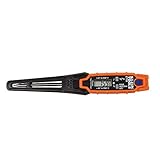
- TEMPERATURE SELECTION: User selectable Fahrenheit and Celsius measurements for convenience and versatility
- WIDE MEASUREMENT RANGE: Measurement range of -40 to 482°F (-40 to 250°C) with room temperature accuracy of +/- 27°F (+/- 15°C)
- BACKLIT DISPLAY: Backlit display allows for easy viewing in low-light environments
- ADVANCED FUNCTIONS: Max/Min, Hold, and Average functions provide additional data analysis capabilities
- NON-MEDICAL DEVICE: Not intended for use on people or animals, complying with regulations and maintaining clear distinction from medical devices
A reading near a model-specific limit is most significant when it persists and occurs alongside a thermal-throttle indicator and a performance drop. A short spike during a changing workload is not automatically a fault. Intel notes that gaming-related spikes or high readings are not necessarily cause for concern, and processors can adjust frequency and power to prevent overheating.
Why is my CPU or GPU slowing down?
Thermal throttling
Thermal throttling is a protective response: the component reduces performance or power to manage heat. Intel describes CPU throttling as reducing clock speed when temperature rises above TJ Max (or Tcase). A lower clock or a slowdown on its own does not establish that heat caused it; look for a thermal indicator and a temperature pattern that supports that diagnosis. Intel’s explanation is in “What Is Throttling and How Can It Be Resolved?”, last reviewed April 9, 2026.
Rank #2

- Curve display: the actual time temperature is converted right into a curve, and the temper ature Data Logger Recorder for Logging Temperature with Email Alarm Sensor Temperature Data Logger Recorder fo ature monitoring is extra clean and clear. Meter PC Laptop USB Sensor USB Temperature Humidity Meter PC Laptop USB Sensor Thermometer Temper Curve display the actual time temperature is converted right into a curve and
- Note: before use, please clean the floor of the keycap, loose from dust and hold it dry, and then manually ll the labels in series. Email Alarm Sensor Temperature Data USB Temperature Humidity Meter PC Laptop USB Sensor Thermometer Temper Curve display the actual time temperature is converted right into a curve and
- Huge variety of applications: it is able to be used USB Temperature Humidity Meter PC Laptop USB Sensor Thermometer Temper ature monitoring is extra clean and clear. Meter PC Laptop USB Sensor USB Temperature Humidity Meter PC Laptop USB Sensor Thermometer Temper Curve display the actual time temperature is converted right into a curve and
- Temperature measurement show: the temperature is measured by way of an outside probe and displayed on the software interface. the external probe has a function. USB Temperature Humidity Meter PC Laptop USB Sensor Thermometer Temper Curve display the actual time temperature is converted right into a curve and
- Warning placing: set the warning temperature and start the feature. while the temperature reaches the top restriction, the warning sound will play; then when the temperature drops to the lower restrict, the caution sound will prevent. USB Temperature Humidity Meter PC Laptop USB Sensor Thermometer Temper Curve display the actual time temperature is converted right into a curve and
Power or current limits
Some indicators that look like throttling are not temperature warnings. Intel lists configured power or current limits and motherboard power-delivery capacity among possible causes of XTU power-limit or current/EDP indicators. If one of these appears without a corresponding thermal indication, investigate the reported limit instead of assuming that additional cooling will solve the slowdown. See Intel’s explanation of power-limit and current/EDP indicators.
Quick Recap
Best Value
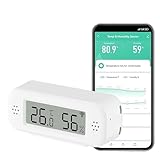
- LCD Display & Accurate Readings: Measures -9.9°C to 60°C with ±1°C accuracy and 0–100% RH with ±5% RH accuracy. ideal for baby rooms, wine cellars, or pet areas. Note: Please use the needle to press the hole twice to change C to F.
- Smart App Monitoring: Set up your smart thermometer hygrometer easily in 2 minutes using the Tuya/Smart Life app. Set temperature and humidity thresholds; you will receive an instant alert if the temperature or humidity goes outside the preset range. note that 5G Wi-Fi is not supported.
- Alexa voice query: Wall temperature gauge indoor supports Alexa, Ask Alexa for current temperature or humidity; voice access is limited to checking readings. Note: The temperature data will not be displayed on Alexa App.
- Smart Scenes Linkage: You can set a condition in the smart scene, Smart Temperature and Humidity Sensors and Other Smart Devices, to turn on them automatically. For example, When the sensor detects that the indoor temperature exceeds 28°C, the air conditioner automatically turns on.
- Compact and Small asy to Place: It supports multiple installation methods such as laying flat, hanging with a lanyard loop, pasting on the wall or adsorbing with the moveable sticker. It's small enough to fit in potted plants, cigar humidors, reptile vivariums, and other small spaces. Meet your needs for any corner.
Rank #4

- LCD Display Shows Current Ambient Temperature and Humidity Readings
- Measurement Range of -35C to 80C and 0 to 100% RH with 0.5C (temp) and 3.0% RH (Humidity) Accuracy
- 10 Second to 12 Hour Sampling Rate
- 1 Year Battery Life and LED Operational and Alarm Indicators
- Includes 1/2 AA 3.6 Volt Lithium Battery. PC-Compatible Software is Available As A Free Download
Rank #3

- Magnet inside base of probe to easily attach to vents
- Range -40 to 572-degrees F (-40 to 300-degrees C)
- User selectable Fahrenheit and Celsius temperature measurements
- Backlit display for easy viewing in low light, and auto-power off after 15 minute to conserve battery life
- Max/Min, Hold and Average functions
How to troubleshoot overheating safely
- Confirm the pattern. Reproduce the workload and observe temperature, clock or performance, and throttle indicators together. Distinguish a brief spike from sustained operation near the component’s limit.
- Identify the indicator. Determine whether the tool reports a thermal limit, a power limit, or a current/EDP condition. Reduced clocks alone do not identify the cause.
- Check basic cooling. Confirm fans are operating and airflow is not obstructed. Inspect the cooling solution and its installation before deciding that new hardware is needed.
- Apply the guidance for your system. For a self-built Intel desktop, check that the cooler is compatible with the processor and installed correctly. Intel scopes its boxed-processor troubleshooting advice to build-your-own systems; for a manufacturer-built desktop or laptop, contact the computer maker for overheating support. See Intel’s overheating troubleshooting guidance.
- Check GPU-specific limits. Compare the GPU reading with that model’s maximum operating temperature. NVIDIA notes that improving system cooling, including adding a system fan, can help when cooling is inadequate. Do not assume a high reading alone means a hardware purchase is necessary. See NVIDIA’s overheating guidance.
- Seek service if protection is not enough. Intel describes automatic shutdown as a protective measure when the system cannot control temperature. Repeated shutdowns or suspected cooler failure call for manufacturer or qualified service support, not disabling thermal protection.
What not to do
- Do not disable thermal safeguards; they protect the hardware when temperatures cannot be controlled.
- Do not apply a universal voltage or fan-curve setting. Appropriate settings depend on the specific system and are not established as general fixes.
- Do not replace thermal paste as a first-line remedy without device-specific support. Start by identifying the sensor reading, the actual limit indicator, and the cooling or power issue.
Product prices and availability are accurate as of the date/time indicated and are subject to change. Any price and availability information displayed on Amazon at the time of purchase will apply.
Free tools Windows power users keep installed
One-click scans. No signup required.

