
Crashes, No Sound, or Screen Glitches?
Random freezes, missing sound and display glitches usually trace back to one bad driver. Find and replace yours safely.Free scan · under a minuteWindows Errors? Fix Them Before They Spread
Repair common Windows errors and clear accumulated junk for a smoother, more stable PC - no reinstall needed.Free scan · no reinstalliTechGuides is reader-supported. When you buy through links on our site, we may earn an affiliate commission. As an Amazon Associate I earn from qualifying purchases. Learn more
To compare monthly mortgage payments at different interest rates, keep the loan amount and term the same, then recalculate principal and interest (P&I) using each rate. For a fixed-rate, fully amortizing loan, the formula below gives the scheduled monthly P&I payment—not the full cost of owning the home.
What you need to calculate a mortgage payment
The standard amortizing-payment formula uses three inputs: the amount borrowed, the monthly interest rate, and the total number of monthly payments. The Consumer Financial Protection Bureau (CFPB) identifies the loan amount, rate, and term as the key inputs; a typical fixed-rate mortgage is paid off at the end of its term when every scheduled payment is made. See the CFPB explanation of how lenders calculate monthly payments.
- P = principal borrowed. Use the financed loan amount, not the home’s purchase price unless the down payment is also accounted for.
- i = annual nominal interest rate written as a decimal. For example, 6% is 0.06.
- r = monthly interest rate, calculated as i ÷ 12.
- n = total number of monthly payments, calculated as loan term in years × 12.
For a positive interest rate, calculate monthly P&I with:
M = P × [r(1 + r)n] ÷ [(1 + r)n − 1]
For a zero-interest loan, divide the amount borrowed by the number of payments: M = P ÷ n. The formula assumes a fixed rate and regular payments that fully repay the balance over the stated term.
#1 Best Overall
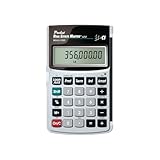
- Loan Amortization and Remaining Balances
- Instant Principal, Interest, Interest Only and Total Payments
- Future Values
- Date math function
How to compare payments at different rates
- Set the loan amount. Enter the amount you plan to borrow, after accounting for any down payment.
- Set the term. Convert the number of years to monthly payments by multiplying by 12. A 30-year term has 360 payments.
- Convert each annual rate to a monthly rate. Write the rate as a decimal and divide by 12. For example, 5% becomes 0.05 ÷ 12.
- Calculate P&I for each rate. Use the formula or enter the same loan amount and term with each rate in a mortgage calculator.
- Compare like with like. Label the results as P&I and do not mix an estimated total payment for one scenario with P&I alone for another.
For a convenient online calculation, Freddie Mac’s fixed-rate mortgage calculator accepts purchase price, down payment, term, rate, property tax, and homeowners insurance inputs, and includes payment-breakdown and amortization views. Its interface may change over time.
Worked comparison: same loan, two rates
The CFPB’s archived example compares a $200,000 loan over 30 years: monthly P&I is $955 at 4% and $1,074 at 5%. The loan amount and term stay constant, so the difference illustrates the effect of the rate alone. These are mathematical examples from an article published around 2017, not current rate offers or a personalized quote. See the CFPB’s archived rate-comparison example.
Rank #2

- SPEAKS YOUR LANGUAGE: Keys clearly labeled in residential mortgage finance terms like Loan AMT, Int, Term, PMT. This industry-standard calculator is super easy to use on all realty financing matters from finding a loan that works for your client to considering trust deeds investments, or finding remaining balances or balloon payments and much more
- CONFIDENTLY AND EASILY SOLVES: All your clients' financial questions whether they are buyers, sellers, investors or renters. Increase your perceived professionalism as a new agent, experienced broker or seasoned loan officer. Close more home sales and impress your clients with fast, accurate answers to all their real estate finance questions
- DEDICATED BUYER QUALIFYING KEYS: Enter client's income, debt and expenses to pre-qualify them to only show properties they can afford. Include tax, insurance and mortgage insurance then compare loan options and payment solutions to give your client choices before they make an offer to buy
- FIGURE OUT THE RIGHT LOAN: At the press of a button for jumbo, conventional, FHA/VA, or even 80:10:10 or 80:15:5 combo loans; check to see if ARMs or bi-weekly loans, quarterly payments or if interest-only payments are the answer; giving your client more choices; easily perform what if loan or tvm calculations Find loan amount, term, interest or PITI or PI payments
- BECOME AN INVALUABLE RESOURCE: Reduce your clients' confusion and uncertainty; ensuring they are able to make a purchase offer; knowing they can afford the down payment; and determining which is the right loan for them. Date-math for listings and contracts too. Comes with a protective slide cover, quick reference guide, pocket User's Guide, and long-life batteries
| Loan amount | Term | Annual rate | Monthly P&I |
|---|---|---|---|
| $200,000 | 30 years | 4% | $955 |
| $200,000 | 30 years | 5% | $1,074 |
Another CFPB example gives $477 in monthly P&I for $100,000 borrowed over 30 years at 4%. That example shows how the payment scales with the amount borrowed when the rate and term remain the same. The figures are examples, not market-rate data; see the CFPB payment-calculation guidance.
What’s actually slowing this PC down?
Pick the symptom - the matching free tool is one click away.
What changes inside a fixed monthly payment
With a fixed interest rate and a fully amortizing schedule, the combined P&I payment generally stays level, but the portion going to interest declines as the balance is paid down. More of later payments goes toward principal. The CFPB explains this process in its guide to paying down a mortgage.
Rank #3

- DEDICATED FUNCTION KEYS for Quick Financial Solutions: Clearly labeled function keys enable you to quickly and confidently provide financial answers and options for your clients, whether in the office, in the car or at an open house. Compare loan options and provide payment solutions to give your client choices
- INSTANT FINANCIAL PROBLEM SOLVING: Solve the financial questions your clients have whether they are buyers, investors or renters; increase your perceived professionalism and close more home sales by quickly answering real estate finance problems including remaining balances
- RESIDENTIAL REAL ESTATE FINANCE TERMS: Keys labeled in residential real estate finance terms like Loan AMT, Int, Term, PMT; Calculator is super easy to use to determine a mortgage loan that works for your client
- VERSATILE LOAN CALCULATION OPTIONS: Calculate 80:10:10 or 80:15:5 combo loans at the press of a button; check to see if ARMs or bi-weekly loans, quarterly payments or if interest-only payments are the answer; giving your client more choices
- COMES COMPLETE: Comes with a protective slide cover, quick reference guide, pocket user's guide, two long-life batteries, and 1-year warranty
Freddie Mac illustrates the changing split with a $135,000 loan over 30 years at 4.5%: the monthly payment is $684.03. In the first month, $506.25 goes to interest and $177.78 to principal, leaving a balance of $134,822.22. This is an amortization example; the page does not display a publication date. See Freddie Mac’s amortization example.
P&I is not necessarily your full monthly housing cost
A mortgage calculator’s P&I result may be only part of what you pay each month. The amount sent to a servicer can also include mortgage insurance, when applicable, and escrow for property taxes and homeowners insurance. HOA or condo dues are often paid separately. The CFPB’s Loan Estimate explainer notes that a typical total payment is more than P&I because of taxes and insurance.
Rank #4

- SPEAKS YOUR LANGUAGE: Keys clearly labeled in residential mortgage finance terms like Loan Amt, Int, Term, Pmt; this industry-standard calculator is super easy to use on all realty financing matters from finding a loan that works for your client to considering trust deeds investments, or finding remaining balances or balloon payments and more
- CONFIDENTLY AND EASILY SOLVE: Clients' financial questions whether they're buyers, sellers, investors or renters. Increase your perceived professionalism as a new agent, experienced broker or seasoned loan officer. Close more home sales and impress your clients with fast, accurate answers to all their real estate finance questions from PITI Payments to IRR, NPV and Cashflows
- DEDICATED BUYER QUALIFYING KEYS: Enter client's income, debt and expenses to pre-qualify them to only show properties they can afford. Include tax, insurance and mortgage insurance then compare loan options and payment solutions to give your client choices before they make an offer to buy
- FIGURE OUT THE RIGHT LOAN: For your client at the press of a button for jumbo, conventional, FHA/VA, or even 80:10:10 or 80:15:5 combo loans; check to see if ARMs or bi-weekly loans, quarterly payments or if interest-only payments are the answer; giving your client more choices; easily perform what if loan or TVM calculations find loan amount, term, interest or PITI or PI payments
- BECOME AN INVALUABLE RESOURCE: To your clients by reducing their confusion and uncertainty; ensuring they are able to make a purchase offer; knowing they can afford the down payment; and determining which is the right loan for them. Date-math for listings and contracts too. Comes with a protective slide cover, quick reference guide, pocket user's guide, and long-life battery
People sometimes call principal, interest, taxes, and insurance “PITI.” Mortgage insurance may be an additional cost. Escrowed taxes and insurance can change when those bills change, even while fixed-rate P&I remains level. When reviewing an offer, use the Loan Estimate’s projected payments and check which costs are not escrowed. The CFPB also cautions that calculator estimates may omit taxes, homeowners insurance, mortgage insurance, and condo or HOA dues.
Free tools Windows power users keep installed
One-click scans. No signup required.
Use a realistic rate when comparing loan offers
A rate comparison is useful only if the rates are plausible for the loan and borrower being considered. Advertised rates may not match an individual offer; pricing can depend on fees, points, borrower eligibility, the property, and geography. The CFPB’s home-budget guidance recommends using a realistic rate assumption.
Best Value

- Extra large 12-digit angled display.
- Loan Wizard.
- Automatic Tax Keys.
- Selectable decimal setting.
- Input any three loan variables to compute the fourth.
For actual offers, compare the Loan Estimates side by side. Keep the loan amount, term, and rate context clear, and compare the same type of payment—P&I with P&I, or estimated total payment with estimated total payment. Review taxes, insurance, mortgage insurance, and HOA or condo dues separately where they apply.
When this calculation does not describe the whole loan
Adjustable-rate mortgages
An adjustable-rate mortgage (ARM) can change after its initial period. The initial payment is generally calculated as if the starting rate continued for the full term; after an adjustment, the payment is usually recalculated using the new rate and remaining term. The contract’s adjustment limits and other terms affect what happens. See the CFPB’s ARM explanation.
Balloon loans
A balloon loan may calculate regular payments using a longer amortization schedule than the loan’s actual term, leaving a large balance due at the end. In the CFPB’s example, payments are based on a 30-year schedule, but a five-year balloon leaves $90,448 due at the end of year five. That is not a conventional fully amortizing 30-year payment comparison; see the CFPB payment-calculation guidance.
Quick wins for a faster PC:
Clear out junk files and repair common Windows errorsFree Scan →Scan for outdated or missing drivers - takes under a minuteDriver Scan →Quick Recap
Product prices and availability are accurate as of the date/time indicated and are subject to change. Any price and availability information displayed on Amazon at the time of purchase will apply.

