
Changing your Wi-Fi channel can help if nearby networks or other interference are causing slow transfers or dropped connections, but there is no single best channel for every home. Leave channel selection on automatic to start; if performance problems persist, test an available channel and keep it only if speed or reliability improves where you use Wi-Fi.
When changing the Wi-Fi channel can help
A channel is part of the radio spectrum a Wi-Fi network uses. Nearby networks competing on the same or overlapping channels can contribute to interference and contention. Trying a less congested option may help in that situation, but it will not fix every cause of slow Wi-Fi.
NETGEAR generally recommends leaving its routers on their default channel selection unless interference is a problem. Lost connections and slow file transfers are examples of symptoms for which trying another channel may be useful. Router behavior and menus vary by model and firmware, so use the settings available on your own device. NETGEAR Support
Which Wi-Fi channel should you use?
For 2.4 GHz in the United States
Channels 1, 6, and 11 are the three non-overlapping 2.4 GHz channels in the US, according to Cisco’s wireless RF reference. If your router offers them, compare these channels rather than choosing an overlapping channel at random. This is US-specific guidance, not a worldwide rule: regulatory requirements determine which channels are available, and your router’s allowed-channel list is the one to follow. Cisco Wireless RF Reference Guide
Quick wins for a faster PC:
Scan for outdated or missing drivers - takes under a minuteDriver Scan →Clear out junk files and repair common Windows errorsFree Scan →#1 Best Overall

- DUAL-BAND WIFI 6 ROUTER: Wi-Fi 6(802.11ax) technology achieves faster speeds, greater capacity and reduced network congestion compared to the previous gen. All WiFi routers require a separate modem. Dual-Band WiFi routers do not support the 6 GHz band.
- AX1800: Enjoy smoother and more stable streaming, gaming, downloading with 1.8 Gbps total bandwidth (up to 1200 Mbps on 5 GHz and up to 574 Mbps on 2.4 GHz). Performance varies by conditions, distance to devices, and obstacles such as walls.
- CONNECT MORE DEVICES: Wi-Fi 6 technology communicates more data to more devices simultaneously using revolutionary OFDMA technology
- EXTENSIVE COVERAGE: Achieve the strong, reliable WiFi coverage with Archer AX1800 as it focuses signal strength to your devices far away using Beamforming technology, 4 high-gain antennas and an advanced front-end module (FEM) chipset
- OUR CYBERSECURITY COMMITMENT: TP-Link is a signatory of the U.S. Cybersecurity and Infrastructure Security Agency’s (CISA) Secure-by-Design pledge. This device is designed, built, and maintained, with advanced security as a core requirement.
For 5 GHz and 6 GHz
There is no universally best channel in either band. Channel availability depends on the router, its regulatory settings, and client-device compatibility. A wider channel can offer more theoretical bandwidth, but it uses more spectrum and is not automatically a better choice in every environment.
Google’s guidance for enabling a 160 MHz channel in the 5.9 GHz UNII-4 band applies to the US and warns that some older 5 GHz-capable devices may perform worse or fail to connect. Treat that option as a compatibility-dependent setting, not a guaranteed speed boost. Google: Enable better performance with 160 MHz channel using 5.9 GHz (UNII-4) (US only)
Rank #2

- Dual-band Wi-Fi with 5 GHz speeds up to 867 Mbps and 2.4 GHz speeds up to 300 Mbps, delivering 1200 Mbps of total bandwidth¹. Dual-band routers do not support 6 GHz. Performance varies by conditions, distance to devices, and obstacles such as walls.
- Covers up to 1,000 sq. ft. with four external antennas for stable wireless connections and optimal coverage.
- Supports IGMP Proxy/Snooping, Bridge and Tag VLAN to optimize IPTV streaming
- Access Point Mode - Supports AP Mode to transform your wired connection into wireless network, an ideal wireless router for home
- Advanced Security with WPA3 - The latest Wi-Fi security protocol, WPA3, brings new capabilities to improve cybersecurity in personal networks
How to test a different channel
- Measure the current experience. In the room where you notice the problem, record a speed result and whether the connection drops or stalls. Keep the same device and test location for later comparisons.
- Check which band the device is using, if visible. A nearby 5 GHz or supported 6 GHz connection may be faster; 2.4 GHz generally reaches farther and may work with more devices. These are broad trade-offs, not guarantees for every router, client, or room. NETGEAR: Differences between 2.4 GHz, 5 GHz, and 6 GHz
- Start with automatic channel selection. If the router is already on automatic and you have recurring slow transfers or disconnections, open its wireless settings and find the channel control. The exact path and labels differ by manufacturer and model.
- Choose an available alternative. On a 2.4 GHz network in the US, compare 1, 6, and 11 if the router offers them. Elsewhere, use only the channels exposed by the router for your region; do not force a channel that is unavailable in its settings.
- Change one setting, then retest. Repeat the same speed and stability check from the same location. Keep the channel only if the result improves in the way that matters to you; otherwise, restore automatic selection or try another permitted option.
Why a good channel may not solve slow Wi-Fi
Channel selection addresses only one possible source of wireless contention. Google identifies distance, physical barriers, client capability, interference from nearby networks or other sources, and internet-service speed as factors that can affect Wi-Fi performance. A device at the edge of coverage, a wall-heavy route, or a busy home network can remain slow even on a less congested channel. Google: Improve Nest Wifi Pro, Nest Wifi, or Google Wifi speed and performance
- Test closer to the router. If performance improves nearby, distance or obstacles may matter more than the channel.
- Compare another device. A device with older or more limited Wi-Fi capabilities may not benefit from a channel or band that another client can use.
- Check the internet service path. A wired speed test can help distinguish a Wi-Fi issue from a limitation in the internet connection. For service speeds above 100 Mbps, Google recommends using a Cat 5e or Cat 6 Ethernet cable for this comparison. A cable is diagnostic; it does not make the wireless channel faster. Google: Troubleshoot slow internet on Google Nest Wifi or Google Wifi
- Consider band range. NETGEAR describes 2.4 GHz as offering more coverage and slower speeds, 5 GHz as shorter-range and faster, and 6 GHz as shortest-range and fastest among the three. The usable result depends on the router, client, and location; 6 GHz may not reach as far through a home. NETGEAR: Differences between 2.4 GHz, 5 GHz, and 6 GHz NETGEAR: Resolve poor wireless range or a weak WiFi signal
Choose based on the result, not the channel number
Use the channel that gives your devices the most reliable performance in their usual locations, within the options your router permits. If none of the available channels improves the repeated test, return to automatic selection and investigate coverage, device limitations, competing network traffic, or the internet service instead.
Quick Recap
Best Value

- 𝐅𝐮𝐭𝐮𝐫𝐞-𝐏𝐫𝐨𝐨𝐟 𝐘𝐨𝐮𝐫 𝐇𝐨𝐦𝐞 𝐖𝐢𝐭𝐡 𝐖𝐢-𝐅𝐢 𝟕: Powered by Wi-Fi 7 technology, enjoy faster speeds with Multi-Link Operation, increased reliability with Multi-RUs, and more data capacity with 4K-QAM, delivering enhanced performance for all your devices.
- 𝐁𝐄𝟑𝟔𝟎𝟎 𝐃𝐮𝐚𝐥-𝐁𝐚𝐧𝐝 𝐖𝐢-𝐅𝐢 𝟕 𝐑𝐨𝐮𝐭𝐞𝐫: Delivers up to 2882 Mbps (5 GHz), and 688 Mbps (2.4 GHz) speeds for 4K/8K streaming, AR/VR gaming & more. Dual-band routers do not support 6 GHz. Performance varies by conditions, distance, and obstacles like walls.
- 𝐔𝐧𝐥𝐞𝐚𝐬𝐡 𝐌𝐮𝐥𝐭𝐢-𝐆𝐢𝐠 𝐒𝐩𝐞𝐞𝐝𝐬 𝐰𝐢𝐭𝐡 𝐃𝐮𝐚𝐥 𝟐.𝟓 𝐆𝐛𝐩𝐬 𝐏𝐨𝐫𝐭𝐬 𝐚𝐧𝐝 𝟑×𝟏𝐆𝐛𝐩𝐬 𝐋𝐀𝐍 𝐏𝐨𝐫𝐭𝐬: Maximize Gigabitplus internet with one 2.5G WAN/LAN port, one 2.5 Gbps LAN port, plus three additional 1 Gbps LAN ports. Break the 1G barrier for seamless, high-speed connectivity from the internet to multiple LAN devices for enhanced performance.
- 𝐍𝐞𝐱𝐭-𝐆𝐞𝐧 𝟐.𝟎 𝐆𝐇𝐳 𝐐𝐮𝐚𝐝-𝐂𝐨𝐫𝐞 𝐏𝐫𝐨𝐜𝐞𝐬𝐬𝐨𝐫: Experience power and precision with a state-of-the-art processor that effortlessly manages high throughput. Eliminate lag and enjoy fast connections with minimal latency, even during heavy data transmissions.
- 𝐂𝐨𝐯𝐞𝐫𝐚𝐠𝐞 𝐟𝐨𝐫 𝐄𝐯𝐞𝐫𝐲 𝐂𝐨𝐫𝐧𝐞𝐫 - Covers up to 2,000 sq. ft. for up to 60 devices at a time. 4 internal antennas and beamforming technology focus Wi-Fi signals toward hard-to-reach areas. Seamlessly connect phones, TVs, and gaming consoles.
Rank #4
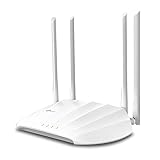
- Superior Speeds with MU-MIMO: Outfitted with the latest 802.11ac Wave 2 MU-MIMO technology, the TL-WA1201 easily delivers dual-band Wi-Fi speeds of up to 1200 Mbps to multiple devices at the same time
- Multi-Mode 4 in 1: Supports Client, Multi-SSID, Range Extender, and AP operation modes to enable various wireless applications to give users a more dynamic and comprehensive experience when using your AP
- PoE for Easy Installation: TL-WA1201 supports Passive PoE power supplies, can be powered by the provided PoE adapter, making deployment effortless and flexible
- Boosted Wi-Fi Coverage: Four external antennas equipped with Beamforming technology concentrate Wi-Fi signals towards your devices to extend reliable Wi-Fi to every corner of your home or office, even over long distances
- Gigabit Ethernet Port: Features a Gigabit Ethernet port that provides high-speed wired connectivity for devices requiring stable and fast network connections
Rank #3

- Dual band router upgrades to 1200 Mbps high speed internet (300mbps for 2.4GHz plus 900Mbps for 5GHz), reducing buffering and ideal for 4K stream
- Full Gigabit Ports - Gigabit Router with 4 Gigabit LAN ports, ideal for any internet plan and allow you to directly connect your wired devices
- Boosted Coverage - Four external antennas equipped with Beamforming technology extend and concentrate the Wi-Fi signals
- MU-MIMO technology - (5GHz band) allows high speeds for multiple devices simultaneously
- Access Point Mode - Supports AP Mode to transform your wired connection into wireless network, an ideal wireless router for home
Product prices and availability are accurate as of the date/time indicated and are subject to change. Any price and availability information displayed on Amazon at the time of purchase will apply.

