
HID says Amico integrates with access-control systems through an API, but the public product information reviewed does not define an Amico event-streaming contract or explain how face templates synchronize across readers. Treat real-time delivery and centralized face-template distribution as requirements to verify with HID—not as established Amico capabilities. A sound design starts by obtaining the Amico-specific API and template-management specifications, then choosing an integration pattern that those documents support.
What HID publicly specifies about Amico
HID describes Amico as a facial-recognition reader with two 1080p visible and infrared cameras. Its listed authentication methods are face, HF/LF credential, HID Mobile Access, QR code, and PIN; HID says methods can be combined for multifactor authentication. The product information gives useful interface and capacity figures, but those figures do not define event-delivery or template-synchronization behavior.

| Area | HID-published information | What it establishes—and what it does not |
|---|---|---|
| Network and reader interfaces | Native 10/100 Mbps Ethernet; OSDP V2.2; one RS-485 port for an external access module or OSDP. | Available communications interfaces, not an event transport, API schema, or subscription method. |
| Event log | Capacity of 200,000 events. | A device log capacity; it does not establish throughput, retention duration, continuous push, export, replay, ordering, or delivery guarantees. |
| Users and face credentials | Up to 200,000 users; 10,000 face credentials, extendable to 100,000 with an additional license or a specified pre-installed part number. | Manufacturer capacity figures, not a guarantee that every part number or license supports the higher face capacity. Confirm the target configuration with HID. |
| Display and intercom | 3.5-inch or 7-inch display options; HID lists a built-in SIP intercom on the 7-inch reader. | Product options; verify regional availability and exact part number before specifying hardware. |
| Integration statement | HID says Amico integrates with existing access-control systems through an API. | An API integration is described, but the public product page reviewed does not provide endpoint definitions, event payloads, authentication details, or operational semantics. |
These are HID manufacturer specifications, not independently tested performance results. The figures above are from HID Global’s Amico product page as accessed in 2026.
Does Amico support real-time event streaming?
The public Amico information establishes that the reader integrates through an API, but it does not say whether Amico events are pushed to a callback, retrieved by polling, exposed through an access-control platform or controller, or delivered another way. It also does not specify event types, schemas, latency, unique identifiers, ordering, acknowledgments, retry behavior, or recovery after a network interruption. Do not select a transport or promise real-time delivery until HID confirms the applicable Amico interface and version.
#1 Best Overall
| Candidate integration path | When it could fit | Amico-specific status |
|---|---|---|
| Documented push callback or subscription | When the Amico integration specification explicitly supports event notifications and describes authentication, retry, and acknowledgment behavior. | Not stated in the Amico public product information reviewed. |
| Polling a documented API or event log | When HID documents retrieval, pagination or cursors, event identifiers, and the behavior of the device log. | Not stated whether Amico exposes polling, log export, or replay. |
| Consuming an access-control system or controller feed | When the deployed access-control platform documents an event interface for Amico-generated events and the required event fields. | Depends on the platform and deployment; not specified by the Amico product page. |
HID Origo documentation describes on-demand event reads and near-real-time callbacks for Origo. That is a separate platform and does not establish that Amico readers expose Origo callbacks or webhooks. Likewise, HID documentation about Signo 25B transactions and biometric synchronization applies to that reader family, not Amico.
A conditional architecture for event processing
Once HID confirms a supported event interface, keep device-specific integration separate from downstream processing. The following is a design pattern, not a claim that Amico supports a particular broker, SDK, webhook, or cloud service.
Rank #2
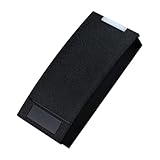
- 【 Communication format 】Wiegand 26~37, RS232, RS485, TTL frequency and other communication specifications meet your needs
- 【 Baud rate 】Communication baud rate 9600.N.8.1
- 【 Waterproof design 】With an outdoor protection rating of IP68, you can rest assured that this reader will withstand all outdoor conditions.
- 【 Wiegand format 】Wiegand26-37 adaptive format output.
- 【 Strong Anti-Interference Ability 】 Equipped with a strong anti-interference ability, this reader resists metal shielding and card reader interference.
- Confirm the source contract. Obtain the Amico API or SDK version and documentation for the reader firmware and access-control platform in scope. Establish how to authenticate, retrieve or receive events, identify them uniquely, and recover after interruption.
- Implement a narrow Amico adapter. Have one component handle the documented interface, validate incoming payloads, and record the source event identifier and reader identity when provided. Preserve the original payload securely if operational policy permits; do not assume fields or identifiers that HID has not documented.
- Make ingestion recoverable. Use the documented acknowledgment, retry, cursor, or replay mechanism. If none is specified, treat delivery guarantees as unresolved and ask HID how to detect and recover from missing or duplicated events before relying on the feed for audit or downstream action.
- Normalize only after capture. Map documented event types and fields into the organization’s event model. Keep source timestamps and identifiers distinct from processing timestamps so that ordering and deduplication rules can be applied only when their semantics are known.
- Forward to consumers through an approved internal interface. A broker or event bus may be appropriate for decoupling downstream systems, but it is an architectural choice beyond the Amico product claims. Define access controls, retention, monitoring, and failure handling for that layer.
- Test interruption and recovery. Validate what happens during reader disconnection, API-service outage, network recovery, and consumer slowdown. Do not infer replay or loss recovery from the 200,000-event log capacity; verify those behaviors with HID and the deployed access-control vendor.
How are face templates stored and synchronized?
HID describes optional Template on Card as storing biometric data on the user’s credential rather than in a centralized database. HID also lists face-credential capacity for Amico. The public information reviewed does not fully document enrollment, template formats, reader-to-reader distribution, update and revocation propagation, offline behavior, conflict handling, or recovery for either workflow. Therefore, it is not enough to assume that a centrally enrolled face template can be pushed to every Amico reader.
| Storage approach | What HID states | Important workflow details not stated in the public Amico information reviewed |
|---|---|---|
| Optional Template on Card | Biometric data is stored on the user’s credential rather than in a centralized database. | Face enrollment and credential personalization process; supported template format; credential replacement and lost-card recovery; revocation timing; offline operation; key-management boundaries. |
| Face credentials associated with reader capacity | Amico is listed with capacity for 10,000 face credentials, extendable to 100,000 with an additional license or a specified pre-installed part number. | Whether and how templates are centrally managed or distributed among multiple readers; synchronization timing and status; update, deletion, retry, conflict, and offline rules; license and part-number dependencies for a deployment. |
Neither option can be described as categorically more secure or operationally superior from the public information reviewed. The choice depends on the documented enrollment and lifecycle process, the credential and reader configuration, and the organization’s privacy and availability requirements.
Do these 3 things before closing this tab:
1Repair Windows errors before they cause bigger problems2Fix the driver behind crashes, sound loss and screen glitches3Clear out junk files and repair common Windows errorsRank #3

- [Card Support] The reader support EM/ID card.
- [Card Reader Only] The reader can’t work stand-alone,have to work with access control panel or access controller.
- [Wiegand Interface] The reader support 26/34bit Wiegand card.
- [LED Indicator] The reader have 2 color LED Indicators(Red and Green).
- [Waterproof] The reader design with IP68 waterproof grade,can be used indoor or outdoor.
Questions to resolve with HID before design approval
- Which Amico API or SDK version supports access-event retrieval or subscription, and where is its versioned specification?
- Are events delivered through push callbacks, polling, an access-control platform or controller, or another documented interface? Which event types and payload schemas are supported?
- What event ordering, identifiers, retry, buffering, replay, acknowledgment, and loss-recovery behaviors apply? Can the 200,000-event log be exported or replayed, and under what conditions?
- How are facial templates enrolled, stored, distributed, updated, and revoked across multiple Amico readers? Is centralized face-template synchronization supported, and what licenses or part numbers are required?
- For each storage mode, what template formats, cryptographic and key-management boundaries, offline behaviors, and audit records are supported?
- Which API authentication and network-security controls are supported, and which firmware and access-control platform versions are compatible?
- What exact capacity, display option, and part number apply in the deployment’s region?
Privacy, security, and deployment boundaries
HID says Amico meets applicable privacy and security controls in line with industry practices and regulatory requirements, and describes Template on Card as a way to keep biometric data on a user credential rather than in a centralized database. Those vendor statements do not establish legal compliance in a particular jurisdiction or define a complete threat model, encryption algorithm, retention schedule, or system-wide privacy outcome. Assess those matters for the full deployment, including the access-control platform and any event-processing services.
Regional availability also needs confirmation against current inventory and part numbers. HID’s product page says the 3.5-inch model is available in most countries across Asia, Europe, Latin America, and the Middle East, with North American availability planned for 2026; it says the 7-inch model is planned globally for early 2026. These roadmap statements do not guarantee current stock or availability for a specific deployment.
Quick Recap
Best Value

- Features a beeper and multicolor LED which can be host-and/or locally controlled
- Enables various beeper and LED configurations, depending on individual site requirements
- Designed for mounting directly onto metal with no change in read range performance
- Compatible with all standard access control systems
- Includes multilingual installation manual
Rank #4

- The card reader supports 125KHz HID card, please choose the card reader you need before purchasing.
- The normal specification of this product is DC 12V. Wiegand 26-37, RS232, RS485, TTL level communication options
- The reader will display excellent LED lights.
- The module comes with a single-chip microcomputer, serial communication, simple hardware connection, and can be used on any platform with a serial port.
Product prices and availability are accurate as of the date/time indicated and are subject to change. Any price and availability information displayed on Amazon at the time of purchase will apply.

