
Recommended Free Tools
The Gigatron works without a packaged microprocessor: its CPU is built from 7400-series TTL logic chips, while ROM and carefully timed software coordinate the logic, memory, display, sound, and I/O. That makes it a small computer whose operation is unusually visible—not a conventional CPU paired with a separate video card.
What makes the Gigatron different?
Most computers put the CPU in one packaged processor. The Gigatron instead assembles its CPU from classic 7400-series transistor-transistor logic (TTL) integrated circuits. Those chips provide building blocks such as logic gates, counters, and multiplexers. Together they hold and manipulate the state needed to execute instructions.
| # | Preview | Product | Price | |
|---|---|---|---|---|
| 1 |
|
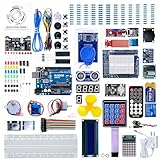
ELEGOO UNO R3 Project Most Complete Starter Kit, Compatible with Arduino | $59.99 | Buy on Amazon |
The official project describes the Gigatron as a computer for people interested in building a computer, looking inside a CPU, learning how ROM works, playing retro games, writing BASIC, or modifying the design. Its simplicity is relative: the circuitry is exposed and understandable in small pieces, but the complete machine depends on close coordination between hardware and software.
How does it work without a microprocessor?
“Without a microprocessor” means without a single packaged CPU chip; it does not mean without a CPU. The TTL chips collectively implement the CPU’s registers, data paths, and control logic. The assembly and user manual includes a short C simulator to illustrate the core state: a 16-bit program counter, plus 8-bit instruction/data, accumulator, X and Y, and output registers. The manual says the machine can be simulated in a few lines of C; that is an author’s description of the model, not a claim that the complete computer is only a few lines of hardware or software.
Quick wins for a faster PC:
Repair Windows errors before they cause bigger problemsFix Now →Scan for outdated or missing drivers - takes under a minuteDriver Scan →#1 Best Overall
- 30+ Guided Electronics Projects: Start with LEDs and build toward LCD1602 displays, RFID access, motion detection, distance sensing, motor control and environmental monitoring for STEM learning, coding clubs, classrooms and hobby projects
- 200+ Components Across 63 Types: Includes an ELEGOO UNO R3 controller, LCD1602, RC522 RFID, RTC, HC-SR501 PIR sensor, ultrasonic sensor, DHT11, GY-521, MAX7219, keypad, joystick, relay, SG90 servo, stepper motor, breadboard and more
- Begin Without Soldering: Pre-soldered modules, a solderless breadboard, organized storage case and small-parts box reduce setup time and help beginners move from lesson to lesson while keeping LEDs, ICs, wires and sensors easy to find
- Learn, Modify and Create: Program the ELEGOO UNO R3 board with Arduino IDE using the included PDF tutorial and example code, then adjust sensor thresholds, timing, display text and motor behavior to turn guided lessons into original projects
- Flexible Power and Project Setup: Includes a 9 V, 1 A power supply, breadboard power module, 9 V battery and USB cable to support controller, breadboard and module experiments without sourcing basic setup accessories separately
ROM guides instruction execution
The manual’s simulator illustrates the flow of an instruction. It fetches an instruction byte and a data byte from ROM using the program counter, decodes the instruction and addressing mode, selects an input for the bus, calculates an arithmetic or logic result, and updates a destination register or writes to RAM. The program counter then advances or changes according to the instruction. This is a useful conceptual model of how the machine operates; it should not be read as a complete board-level schematic or a verified account of every clock cycle.
ROM is therefore more than a store of game or application code: it also supplies control instructions and data that operate the machine. The official ROM repository contains the native system software as well as applications and development tools.
How do memory and the display fit together?
The Gigatron’s software takes on jobs commonly assigned to separate peripheral chips. Its video loop reads display data from RAM and drives output, so the memory map and timing are organized to support producing a picture as the rest of the system runs.
The official ROM repository documents a default video area of 160 × 120 pixels, represented as one byte per pixel in pages 8–127 of RAM. Multiplying the documented dimensions gives 19,200 bytes. That describes the documented memory organization, not a promise of compatibility with a modern monitor or a particular frame rate.
Do these 3 things before closing this tab:
1Scan for outdated or missing drivers - takes under a minute2Repair Windows errors before they cause bigger problems3Fix the driver behind crashes, sound loss and screen glitchesWhy does software handle video, sound, and I/O?
The project says the processor performs functions that other computers often assign to dedicated video, sound, and I/O chips. In the Gigatron, software loops and routines help generate video and audio and manage system functions. The ROM source documents functions for video modes, sprites, memory access, controller-port serial communication, SPI exchange, and serial input and output.
This division is the central architectural trade-off: using discrete logic keeps the hardware’s essential operation comparatively visible, but it gives software substantial work and requires careful coordination with timing. It is not a conventional CPU-plus-video-card design in which a separate display processor handles the graphics independently.
What is native Gigatron software, and what is emulated?
The TTL logic defines the Gigatron’s native machine. The ROM repository also includes a virtual CPU (vCPU) interpreter, applications, tooling, BASIC examples, a compiler, and an emulator. Those are software layers running within or alongside the Gigatron environment; they should not be confused with the physical TTL CPU.
ROM v4 added a function that executes MOS 6502 code until a BRK instruction, enabling compatibility work such as running Apple-1 software. This is software emulation of another instruction environment, not evidence that the Gigatron contains a 6502 processor.
Can you build your own Gigatron?
The original DIY kit was sold from 2018 through 2020, according to the assembly and user manual, version 20260623. The project later published the hardware design, software, manual, and bill of materials as open-source materials. These sources establish that a self-build is possible from the published design, but do not establish that a complete kit is currently available for purchase.
If sourcing parts, a 74LS or 7400-series TTL logic assortment is only a starting category, not a guaranteed compatible kit. Check the official bill of materials and the specific board revision before buying: logic subfamilies and included part numbers can differ. The official 2020 open-source announcement also records the creators’ then-stated support position: “If you decide to build your own Gigatron, we won’t provide support.” That statement is dated and should not be treated as a current support-policy update.
The manual specifies 5.0 V (±0.25 V) DC at 100 mA for operating conditions and separately advises using a reputable power adapter. Treat these as the manual’s specification for the Gigatron, not as a general recommendation for any adapter.
How can you explore the Gigatron without building one?
The official ROM repository includes an emulator, so software exploration does not require assembling the hardware. The distinction is practical: building the physical machine is the direct route to examining the TTL chips, wiring, and timing, while an emulator is a route to exploring the software environment. Neither route should be mistaken for evidence that the emulated display has modern monitor compatibility or reproduces every electrical detail of a physical board.
The Tool Desk
Outbyte Driver Updater FREEScan for outdated or missing drivers - takes under a minuteDriver Scan →Outbyte PC Repair FREEClear out junk files and repair common Windows errorsFree Scan →Quick Recap
- Gigatron Assembly and User Manual, version 20260623: hardware overview, build information, operating conditions, historical kit sales, and the simulator example.
- Official Gigatron ROM repository: ROM source, memory map, system functions, tools, and emulator.
- “Gigatron fully open source,” official project announcement: open-source publication information and the dated support statement.
- Official Gigatron project overview: the project’s description of the TTL computer and its intended activities.
Product prices and availability are accurate as of the date/time indicated and are subject to change. Any price and availability information displayed on Amazon at the time of purchase will apply.

