
Small Jurassic theropods such as Compsognathus and Ornitholestes were far shorter than large predators such as Allosaurus. Fossils give unusually direct evidence that Compsognathus ate small lizards, while evidence about how these dinosaurs hunted is mostly inferred from anatomy and fossil context. These examples also come from different places, so they should not be treated as one local predator-prey community.
How large were small theropods compared with Allosaurus?
Published museum estimates vary, especially for Compsognathus. The figures below are attributed to their sources; length is not body mass, and no mass comparison is available for all three dinosaurs.
| # | Preview | Product | Price | |
|---|---|---|---|---|
| 1 |
|
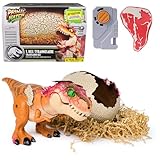
Primal Hatch Jurassic World Interactive T-Rex Toy Dinosaur Egg | Buy on Amazon |
| Dinosaur | Reported size | Place and context |
|---|---|---|
| Compsognathus | The Natural History Museum (NHM) lists 0.7 m and 3 kg. The French National Museum of Natural History describes it as up to 1.5 m and no more than 3.5 kg. | Europe; the French museum discusses a specimen from Canjuers. |
| Ornitholestes | NHM lists a length of 2.0 m; the cited entry does not state a mass. | North America. |
| Allosaurus fragilis | The U.S. National Park Service (NPS) gives a maximum length of 30 ft (8.5 m); the cited page does not state a mass. | North America’s Morrison Formation; NPS describes it as one of the formation’s largest predators. |
The different Compsognathus lengths are estimates from institutional profiles, not a settled exact adult measurement. Dinosaur bodies are reconstructed from preserved bones, and incomplete skeletons make size estimates uncertain. Nor does a length figure alone tell you how heavy or powerful an animal was.
The comparison is also geographic as well as anatomical: Compsognathus is known from Europe, while Ornitholestes and the Morrison Formation Allosaurus are North American examples. Their measurements illustrate a size range among theropods, not a lineup of animals sharing one habitat.
Windows Errors? Fix Them Before They Spread
Repair common Windows errors and clear accumulated junk for a smoother, more stable PC - no reinstall needed.Free scan · no reinstallOutdated Drivers Are Slowing You Down
One free scan finds every outdated or missing driver and matches the right update for your exact hardware.Free scan · exact hardware match#1 Best Overall
- Interactive Jurassic Dinosaur Toy: Hatch, train and play with your own ferocious interactive baby dinosaur, featuring 100+ sounds and reactions, as well as articulated features, for endless fun for fans of the Jurassic world
- Hatch a Real Dinosaur: Watch as your dinosaur egg cracks and splits open, while your reptilian friend emerges through the slime for an exciting and realistic hatching experience Repeatedly tap the egg to initiate the hatching, and make sure to clean up the goo after
- Train it if you can You decide if your dinosaur grows into a friendly T-Rex, or a fierce predator Use your clicker to grab its attention and feed, pet or startle it to decide if it will be a friend or foe
- So Many Ways to Play: Use your clicker and the meat accessory to grab Dino's attention and play all sorts of games with your new friend
- Birthday Toys for Boys & Girls: These dinosaur toys and toys for boys aged 4-6 are a fantastic gift for boys and girls who love dinosaurs and fossils Sure to be a top wish list gift, holiday gift or birthday toy
What did small Jurassic predators eat?
Compsognathus: direct evidence of small prey
The French National Museum of Natural History describes Compsognathus as carnivorous and reports that a specimen from Canjuers preserved remains of two small lizards among its ribs. This is direct evidence of what at least one individual had eaten. The museum also identifies small vertebrates and insects as suitable prey, but those broader possibilities are not equivalent to preserved stomach contents.
The lizard remains do not establish a precise hunting technique, speed, or group behavior. They show that small prey formed part of this dinosaur’s diet.
Allosaurus: a larger predator with larger potential prey
NPS says Allosaurus probably ate smaller dinosaurs. The Australian Museum discusses young herbivores as plausible prey for large theropods and notes fossil evidence of juvenile prey with bite marks or preserved in the guts of larger theropods. That supports a general picture of predation on vulnerable animals; it does not identify every Allosaurus meal or prove a specific kill.
Diet evidence from the Early Cretaceous compsognathid Sinocalliopteryx should not be transferred directly to Late Jurassic Compsognathus. A 2012 study of Sinocalliopteryx abdominal contents reported bird, dinosaur, and other remains, but it concerns a different genus and a later period.
Quick wins for a faster PC:
Repair Windows errors before they cause bigger problemsFix Now →Scan for outdated or missing drivers - takes under a minuteDriver Scan →Clear out junk files and repair common Windows errorsFree Scan →How might these theropods have hunted?
Allosaurus: overpowering prey, perhaps in groups
NPS reconstructs adult Allosaurus as hunting by overpowering prey, “possibly in small groups.” The qualification matters: group hunting is a possibility, not a directly observed behavior or a certainty established by that statement. NPS also describes juveniles as having relatively longer limb bones, which may have suited them to pursuing smaller vertebrates.
The Australian Museum points to strong hand and foot claws as possible tools for holding or subduing prey while the jaws and teeth inflicted fatal injuries. It also interprets Allosaurus teeth as relatively short and small compared with some other theropod tooth types, potentially helping them withstand impacts during attacks on large prey. These are anatomical interpretations, not a complete record of how a particular hunt unfolded.
Small predators: prey size is clearer than capture method
The preserved lizards in a Compsognathus specimen support feeding on small animals, but they do not reveal whether the dinosaur chased, ambushed, or hunted cooperatively. A fossil meal can establish prey more directly than it can establish behavior.
Theropods were not one uniform hunting guild. Differences in body size, limb proportions, skull shape, teeth, and claws suggest different ways of finding and handling food. Those features help form hypotheses, but they do not provide a precise behavioral script.
Why might large predators target vulnerable prey?
The Australian Museum argues that large theropods probably did not routinely attack large, healthy adult herbivores. Young, old, or sick animals would have been safer targets. This is an ecological inference, supported in part by evidence of juvenile prey in the broader fossil record; it should not be mistaken for proof that every large theropod avoided healthy adults.
Tooth shape offers clues to feeding mechanics: serrations can help cut flesh, while tooth construction may affect how teeth cope with force. But anatomy alone cannot establish which prey an individual attacked or whether a particular encounter ended in a kill.
What the fossils can—and cannot—tell us
- Most direct diet evidence: preserved lizard remains in a Compsognathus specimen.
- Evidence for possible feeding mechanics: teeth, skulls, limbs, and claws, interpreted in light of their form.
- Evidence for prey vulnerability: fossil bite traces and juvenile remains reported in association with larger theropods.
- More uncertain behavior: hunting in groups, precise attack methods, and the outcome of specific hunts.
The fossil record also filters what survives. NPS notes that Jurassic coelurosaurs are underrepresented partly because small size and thin-walled hollow bones make preservation less likely. As a result, the known fossils cannot support simple claims that small theropods were rare or unimportant in their ecosystems.
Sources: Natural History Museum: Compsognathus; Natural History Museum: Ornitholestes; Muséum national d’Histoire naturelle: Compsognathus; National Park Service: Allosaurus fragilis; National Park Service: Theropods; Australian Museum: Dinosaur attack and defence; Australian Museum: Teeth and diet; PLOS ONE (2012): study of abdominal contents in Sinocalliopteryx.
Quick Recap
Product prices and availability are accurate as of the date/time indicated and are subject to change. Any price and availability information displayed on Amazon at the time of purchase will apply.

