
What’s actually slowing this PC down?
Pick the symptom - the matching free tool is one click away.
iTechGuides is reader-supported. When you buy through links on our site, we may earn an affiliate commission. As an Amazon Associate I earn from qualifying purchases. Learn more
Scientists can search for life beyond Earth without listening for radio messages. They can study the light passing through distant exoplanet atmospheres, look for possible signs of technology at other wavelengths, and send spacecraft to investigate nearby worlds directly. These methods seek different kinds of evidence, and none turns a potentially habitable place or an intriguing signal into a confirmed discovery of life on its own.
What counts as evidence of life?
A biosignature is a substance, pattern, or other feature that could indicate biological activity. A biosignature is not proof by itself: nonliving processes can sometimes produce suggestive chemicals or patterns, so scientists assess possible explanations and the environment where the sign appears.
A technosignature is a possible sign of technology, such as an engineered light signal or an artificial chemical. NASA treats technosignatures as a kind of biosignature associated with advanced life, but the examples under consideration are search targets—not reported detections of extraterrestrial technology.
How can telescopes search distant planets?
Read the light in an exoplanet’s atmosphere
When an exoplanet passes in front of its star, some starlight can filter through the planet’s atmosphere. Scientists analyze the light’s spectrum—how its intensity varies with wavelength—to look for patterns associated with gases and other chemicals. NASA explains this approach in its overview of how researchers might find life.
#1 Best Overall
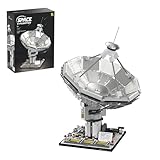
- 【Space Exploration Fun】 Build a detailed radio telescope and satellite communication base, ideal for space lovers and aspiring engineers.
- 【STEM Learning Tool】 This building set encourages STEM skills, enhancing creativity, problem-solving, and critical thinking in kids and adults alike.
- 【Perfect Holiday Gift】 A fantastic Christmas gift for kids (8+), teens, and adults who enjoy space-themed toys, puzzles, and architectural models.
- 【Realistic Design】 With intricate details, this model captures the essence of a space communication base, making it an impressive display piece once completed.
- 【Educational and Entertaining】 Not only fun to build, but also a great way to spark an interest in space exploration and science for all ages.
Some atmospheric chemicals, or combinations of them, could be relevant to a search for biology. But detecting a gas does not establish that life produced it. Interpretation depends on the planet’s broader context and on whether nonbiological processes could explain the observation. NASA describes the James Webb Space Telescope as capable of examining gases in exoplanet atmospheres; that is an observational capability, not a claim that Webb has confirmed life.
Look for possible technology beyond radio
Searches for technology need not be limited to radio waves. NASA’s July 11, 2023 overview of technosignatures discusses possible laser pulses or unusual transient light signals, artificial atmospheric chemicals, excess waste heat, and signs that might be associated with very large engineered structures or advanced energy use.
Rank #2

- Comprehensive Building Set: This Space Radio Telescope Building blocks set includes over 1053 blocks with a unique assembly method and exquisite stickers that showcase various details of the radio telescope
- Interactive Mechanical Features: This Space Radio Telescope Building blocks set includes a mechanical kit with a manual rotation system that controls the rotation of the radio telescope disk, making it more interesting for astronomy enthusiasts
- Impressive Display Dimensions: Measures over 15.43 inches (39.2cm) high, 10.08 inches (25.6cm) wide and 15.39 inches (39.1cm) deep with 1053 pieces, featuring a size ratio that showcases the Radio Telescope structure
- Educational Building Experience: This Space Radio Telescope Building blocks set requires hands-on ability and focus, allowing parents to accompany their children to build their own Radio Telescope and cultivate their patience and perseverance
- High Quality Construction Materials: Made with high quality plastics, the blocks have smooth surface finish ensuring tight fit with each other for long-lasting durability, with realistic and miniature design making this building model kit cost-effective
These are proposed ways to look for technology from afar, not evidence that such technology has been found. An unusual signal or atmospheric feature would need to be distinguished from natural phenomena and instrumental effects. As astronomer and longtime SETI leader Jill Tarter put it in NASA’s 2023 article, “We still want to look at all the sky all the time, at all wavelengths,” including laser light.
Quick wins for a faster PC:
Clear out junk files and repair common Windows errorsFree Scan →Scan for outdated or missing drivers - takes under a minuteDriver Scan →How does a non-radio search work in the solar system?
Investigate potentially habitable places up close
Spacecraft can characterize a world’s environment directly, and missions equipped to collect material can enable chemical analysis or microscopy. This is a different scale of search from observing a distant exoplanet: researchers may be able to examine samples rather than infer atmospheric contents from starlight.
Rank #3

- EDUCATIONAL KIT: Complete DIY FM radio assembly kit includes PCB board, speaker, antenna, wooden case, and all necessary components for hands-on learning
- ASSEMBLY COMPONENTS: Kit comes with circuit board, battery container, mounting screws, tools, and detailed assembly instructions
- DESIGN FEATURES: Attractive wooden case with flower speaker design, control buttons, and telescopic antenna for FM reception
- LEARNING VALUE: Perfect STEM project for understanding basic electronics, radio technology, and circuit assembly principles
- SPECIFICATIONS: Operates on battery power (batteries not included), features multiple control buttons and built-in speaker for clear sound output
Europa and Enceladus are compelling targets because evidence points to water beneath their icy surfaces. NASA says Europa’s evidence strongly suggests a hidden liquid-water ocean. Its overview of why Europa matters frames a habitability search around liquid water, energy, and chemical compounds. Those conditions make Europa scientifically interesting; they do not show that it is inhabited.
NASA describes Enceladus as having a global ocean and a plume of icy particles. If plume material can be sampled, it may offer a route to investigate material from the moon’s interior. The plume, ocean, chemical ingredients, and internal heat are relevant to assessing its potential, not proof of life. See NASA’s Enceladus overview.
Rank #4

- Telescope Kit for Astronomy Explorer: With this real refractor telescope for adults and kids beginners, you can observe the Moon, use seven-themed stickers to design your unique telescope, and learn moon fun facts with included moon learning booklet
- Moon Learning Booklet for Hands-On Discovery: Turn every Moon-viewing night into a simple learning activity. Kids can learn how the Moon formed, why its shape changes, what’s on the lunar surface, and record discoveries the Moon Observation Log
- Seven-themed Sticker Packs for Year-Round Creativity: Make the telescope feel new again for every season. You can personalize your own telescope with astronomy, Alphabet and planets, Christmas, Easter, Halloween and Thanksgiving themed stickers
- 80mm Aperture & 20X-150X High Powered Magnification: The 80mm aperture gathers more light for clear views of the Moon, distant landscapes and nature. The 500mm focal length offers a practical balance between magnification for first-time beginners
- Easy First Setup Telescope Kit with Backpack: The telescope kit is easy to setup. Includes telescope tube, 25mm & 10mm Eyepieces, Barlow Lens, Finderscope, AZ tripod, Phone Adapter, Backpack, Moon booklet, Sticker Packs and Telescope Guide Manual
Analyze samples with specialized instruments
NASA’s Jet Propulsion Laboratory describes the Ocean Worlds Life Surveyor (OWLS) as a concept for an integrated, autonomous instrument suite. It would combine chemical analysis and microscopy to examine water samples for evidence across molecular and cellular scales. OWLS is a concept, not a reported result from a completed life-detection mission.
Crashes, No Sound, or Screen Glitches?
Random freezes, missing sound and display glitches usually trace back to one bad driver. Find and replace yours safely.Free scan · under a minuteWindows Errors? Fix Them Before They Spread
Repair common Windows errors and clear accumulated junk for a smoother, more stable PC - no reinstall needed.Free scan · no reinstallGetting evidence directly is demanding: spacecraft must reach the target, access suitable material, and guard against contamination that could confuse the results. On Mars, reaching the subsurface is a particular challenge. NASA Astrobiology Program Director Mary Voytek said, “The best hope on Mars is the subsurface,” in NASA’s discussion of what comes next in the search for life. The remark concerns where a search might focus, not a discovery.
Best Value

- 【Excellent Optics】Astronomical telescope features 80mm aperture 600mm(f/6.7) focal length-The big aperture can capture more light; high transmission multi-fully coated optical lens can improve light transmittance, reduce the reflection of light. It will bring you more bright and clear images.
- 【Portable & Stable】Our refractor telescope has a backbag, an adjustable aluminum tripod and an upgraded phone adapter. All accessories can be packed into the bag, which is convenient for you to carry and storage for traveling. The tripod is stable and the height can adjust from 17.7" to 52", which is suitable for adults and kids. With the phone adapter, you can take amazing photos through your phone.
- 【Easy to Operate】 This telescope is easy to assemble even for astronomy beginners and kids. You can set up easily with the detail installation manual and video. No tools are required. It’s a great astronomy gift telescope for adults, astronomy enthusiasts, beginners and kids 8-12.
- 【Optimum Magnification】Our telescope for kids and adults is equipped with two replaceable excellent-quality eyepiecesa (20mm and 9mm) for 30X and 66X magnification. A moon filter transmits only 13 percent of the incoming light and improving contrast. Also with 5x24 finderscope, you can locate objects easily. A great option for astronomy lovers to explore the moon, Saturn and Jupiter.
- 【Satisfaction Service】We provide 3 years satisfaction service. If you have any questions about the product and service, please feel free to contact us to get 24-hour technical support from our expert team. Whether observing moon or viewing planets, our telescope can meet your all needs. It’s a great telescope for adults & 8-12 kids & astronomy beginners.
How do the methods compare?
| Approach | What it seeks | Where it applies | What it can offer | Main limitation |
|---|---|---|---|---|
| Atmospheric spectroscopy | Gases and chemical patterns that could be biosignatures | Exoplanets orbiting other stars | Remote observations can survey worlds that spacecraft cannot reach | A gas is not uniquely biological; interpretation requires planetary context and consideration of nonbiological explanations. |
| Optical or laser technosignatures | Laser pulses or other unusual light patterns that might be engineered | Distant planetary systems | Extends technology searches beyond radio wavelengths | Possible signals must be distinguished from natural and instrumental phenomena; NASA’s cited account reports no detection. |
| Atmospheric technosignatures | Possible artificial or industrial chemicals | Exoplanet atmospheres | Uses atmospheric observations to investigate a possible sign of technology | These are speculative targets that require interpretation in planetary context. |
| Waste heat or large-scale engineering | Possible excess heat, energy-use clues, or unusual transits | Distant stars and planets | Could point to technology without a received message | These are hypothesized signatures, not confirmed evidence of civilizations. |
| In-situ sample analysis | Organic molecules, chemical patterns, or possible cells | Mars and solar-system ocean worlds | Material can be examined directly with multiple techniques | Reaching and sampling remote sites is difficult; an instrument concept is not a mission result. |
The methods complement one another, but they are not interchangeable. Exoplanet observations can cover distant worlds but rely on interpreting light. Solar-system investigations can get closer to material, but depend on difficult missions and access to suitable samples. In both settings, researchers must distinguish a possible clue from evidence strong enough to support a conclusion about life.
Quick Recap
Product prices and availability are accurate as of the date/time indicated and are subject to change. Any price and availability information displayed on Amazon at the time of purchase will apply.

