
The Tool Desk
Outbyte Driver Updater FREEScan for outdated or missing drivers - takes under a minuteDriver Scan →Outbyte PC Repair FREERepair Windows errors before they cause bigger problemsFix Now →RoboRaise is a research prototype that uses muscle signals and gestures to guide a separate robot as a person lifts or assembles an object. Sensors on the user’s biceps and triceps let the system estimate arm movement and infer simple commands; they do not make RoboRaise a wearable exoskeleton or a proven workplace lifting system.
How RoboRaise works
RoboRaise uses electromyography (EMG) sensors attached to the user’s biceps and triceps. EMG detects electrical activity associated with muscle use. The system interprets that activity as a nonverbal signal about movement, then directs a robot to roughly mirror the person’s arm motion.
A slight increase or decrease in arm tension can signal the robot to move up or down. Hand gestures add finer commands: up-and-down movements can adjust the robot’s position, move it farther from the user, or tell it to hold a pose. A neural network recognizes gestures using activity from the biceps and triceps. The system infers motion and gestures; the MIT report does not describe it as measuring a person’s strength or determining safe lifting limits.
The sensors are noninvasive. MIT reported that a new user could be set up by fitting the sensors, tensing and relaxing the arms a few times, and lifting a light weight to several heights. The gesture-recognition network had been trained using data from previous users.
Do these 3 things before closing this tab:
1Fix the driver behind crashes, sound loss and screen glitches2Repair Windows errors before they cause bigger problems3Scan for outdated or missing drivers - takes under a minute#1 Best Overall

- Intro to Robotics & Circuits: The kit includes motors, PCB microcontroller boards, and wires, by assembling and operating this robotic arm, It offers a fantastic first-time opportunity for children to know how electronic circuits work and control mechanical movement. Combining 3D puzzle with electrical enginnering, it's Fun and entertaining robotic science experiment for kids ages 8-14 and up! Note: 6 AA batteries needed but not included.
- Spark Interest in Engineering: This mechanical arm perfectly combines education with fun. Kids gain hands-on experience in physics & engineering principles while enjoying the thrill of building and play, making learning exciting. It sparks interest in future engineering and science pursuits.
- Challenging & Cool Wood Building Set! With wooden pieces and precise assembly tutorial, this wood building kit offers a satisfyingly complex building experience that enhances problem-solving skills, patience.
- Perfect Gift Idea: Designed for people who love to build and create, this DIY electronics kit for kids makes a gift or basker stuffer for boys and girls, tweens, teens, adults on birthday, christmas, easter, valentine day, also works for students in educational institutions, school science classes like science summer camping toy, or as STEAM game for families. It provides hours of challenging fun and a great sense of accomplishment once completed.
- STEM Project & Fun Toy for All Ages: No solidering required, the robot arm toy comes with all accessories you need to assemble this. Developing a lifelong love for science, the mechanical engineering kit is good for kids, teens, adults, boys and girls 8,9,10,11,12,13,14 years old and up
What RoboRaise was tested doing
MIT reported tests with 10 users across three lifting conditions: the robot did not move; it responded to muscle signals without helping lift; or the person and robot lifted together. The team found that robot feedback improved users’ accuracy in reaching a desired height compared with having no feedback.
In reported lifting and assembly tasks, users guided the robot to within a few inches of desired heights by lifting and tensing their arms. Gestures made control more accurate, and the robot responded correctly to roughly 70 percent of gestures in those experiments. That result describes the prototype tests, not a general reliability rate for workplace use.
Rank #2
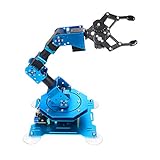
- Spark Your Creativity with Robotic Arm: Hiwonder-xArm1S is a high-quality desktop robot arm capable of remote-control grasping, object transportation, custom actions, graphical programming, and more. It serves as the ideal platform for building and showcasing creative projects and for learning about bionic robotics.
- Intelligent Servo: Hiwonder-xArm1S is equipped with 6 high-precision intelligent serial bus servos that provide position, voltage and temperature feedback. These powerful servos deliver strong torque, enabling the robot arm to grasp objects weighing up to 500g with ease.
- Premium Structure Design: The robot arm is constructed from an exquisite aluminum alloy bracket. The base is fortified with high-torque servos and industrial-grade bearings, guaranteeing exceptional stability.
- Various Control Methods: It supports PC, phone app, mouse, wireless PS2 Wireless Controller, and you can also control the robotic at your fingertips. With these control methods, xArm robotic Arm would bring more methods of play and study, perfect for realizing your innovative programming ideas and coding study.
- Versatile Action Editing: Hiwonder-xArm1S provides various action editing methods through a easy-to-use interface, including PC, app, and offline manual editing. This versatility allows you to easily create a wide range of robot applications.
The team also tried lifting a rubber sheet onto a base and picking up and assembling mock airplane components. MIT reported that the system lifted both rigid and flexible objects onto bases in these tasks. These were research demonstrations, not evidence of routine deployment in factories, construction sites, or homes.
How the robot’s role differs from an exoskeleton
RoboRaise directs a separate robot using a person’s muscle activity. A lifting exoskeleton, by contrast, is worn on the body and provides support through the device itself. Results from exoskeleton studies therefore do not establish RoboRaise’s safety or effectiveness.
Crashes, No Sound, or Screen Glitches?
Random freezes, missing sound and display glitches usually trace back to one bad driver. Find and replace yours safely.Free scan · under a minutePC Slower Than It Used to Be?
A free scan shows the junk files, broken settings and background clutter dragging Windows down - then fixes them in one click.Free scan · Windows 10 & 11Rank #3

- BUILD WORKING ROBOTS: Teach your kids mechanical engineering in a way they can't resist! Designed for kids 12+, this kit will guide your learner through the process of building real, working robots - taught in a way that they'll understand!
- POWERED BY WATER: Use the power of hydraulics to harness and control the Hydrobot! The arm includes 6 different axes and can rotate up to 270 degrees - no batteries required
- MOVES, ROTATES & GRABS: Use the levers to control the gripper which can open and close or be replaced with suction components to pick up objects
- NOT JUST ROBOTICS: With our Teach Tech Kits, the learning doesn't just stop at robotics. Teach Tech instructions are specifically designed to develop problem solving skills, analytical thinking and curiosity in young minds
- Hands-on Building: This is an in-depth STEM building project, not a pre-assembled toy. Follow the detailed step-by-step assembly instructions, take time to ensure proper assembly, and enjoy a true STEM experience. Expect multiple hours of build time.
For context, a 2018 study of a different active industrial exoskeleton tested 12 male participants lifting and lowering boxes weighing 7.5 kg and 15 kg. It reported reduced activity in some measured muscles, while noting pressure that could become uncomfortable during long use. A separate 2021 study of a passive industrial exoskeleton involved eight workers in simulated lifting tasks; it reported reductions in activity for certain muscles, but only 50% of participants rated usability acceptable. These studies concern their respective wearable devices, not RoboRaise, and should not be used to rank the systems against one another.
Independent reader supportYour contribution helps us test, update, and keep practical guides available for everyone.Prototype status and what remains unestablished
The MIT team implemented RoboRaise on a Baxter humanoid robot. The researchers suggested it could be adapted to other robotic platforms, and identified adding muscles or other sensors as a future direction. The reported work does not establish commercial availability, compatibility with other robots, or validated use in ordinary workplaces.
Rank #4

- Optimized AI Arm Kit for LeRobot & Hugging Face Projects – The SO-ARM101 is an upgraded low-cost robotic arm servo motor kit designed for AI robotics enthusiasts and developers. Fully compatible with LeRobot and Hugging Face frameworks, it supports imitation learning and reinforcement learning, making it ideal for real-world robotics applications. (3D-printed parts not included.)
- Enhanced Wiring & Performance – Compared to the SO-ARM100, the SO-ARM101 features improved wiring to prevent disconnection at joint 3 and eliminates range-of-motion limitations. The leader arm uses optimized gear ratio motors for smoother performance—no external gearboxes required.
- Real-Time Leader-Follower Functionality – New real-time tracking allows the leader arm to follow the follower arm, enabling human intervention and correction during reinforcement learning (RL) training. Perfect for hands-on AI robotics development and research.
- Open-Source, DIY-Friendly & Nvidia-Compatible – Developed by TheRobotStudio, this open-source AI Arm kit integrates seamlessly with the LeRobot platform, offering PyTorch-based datasets, simulation, training, and deployment tools. Fully compatible with Nvidia Jetson edge devices, including reComputer Mini J4012 Orin NX 16 GB.
- Comprehensive Learning Resources – Includes detailed open-source assembly and calibration guides, testing tutorials, and deployment instructions. From wiring to AI training, get everything you need to start building, teaching, and optimizing your robotic arm for grasping and placing tasks.
MIT describes the project as a way for a robot to adapt to a person rather than requiring the person to adapt to the robot. That is the design aim; the evidence presented is a prototype tested in lifting and assembly experiments. For the project overview, see MIT News’ report on RoboRaise and the MIT CSAIL project page.
Quick Recap
Best Value
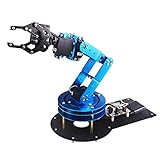
- Spark Your Creativity with LeArm Robotic Arm: LeArm is an elementary 6DOF desktop robot arm outfitted with 6 high-quality digital servos.It is capable of remote-control grasping, object transportation, custom actions, graphical programming, and more. It serves as the ideal platform for building and showcasing creative projects and for learning about bionic robotics.
- Anti-stall Protection: The robot arm end is equipped with 3 anti-blocking servos, complete with gear clutches that significantly extend the servos' lifespan.
- Premium Structure Design: The robot arm is constructed from exquisite metal bracket. The base is fortified with high-torque servos and industrial-grade bearings, guaranteeing exceptional stability.
- Various Control Methods: It supports PC, app, mouse and wireless handle control. Users can control the robot at your fingertips.
- Enjoy Robotic Arm Making: Enjoy the robot assembly process, LeArm is great for learning and building robot structures! Designed for students, engineers, university courses, and robot lovers. Comes with easy tutorials and simple programming software.
Product prices and availability are accurate as of the date/time indicated and are subject to change. Any price and availability information displayed on Amazon at the time of purchase will apply.
Quick wins for a faster PC:
Repair Windows errors before they cause bigger problemsFix Now →Fix the driver behind crashes, sound loss and screen glitchesFind Drivers →Clear out junk files and repair common Windows errorsFree Scan →
