
Do these 3 things before closing this tab:
1Clear out junk files and repair common Windows errors2Scan for outdated or missing drivers - takes under a minute3Repair Windows errors before they cause bigger problemsRadiocarbon and stable-isotope measurements in whale teeth can reveal when parts of an animal’s life occurred and offer clues about its feeding ecology. In a 2026 study of five whales stranded in Scotland, bomb-radiocarbon patterns supported annual tooth-layer formation in some animals and exposed a likely undercount in an older killer whale. The findings show the promise—and limits—of reading a whale’s life from its teeth.
How scientists read a whale’s life from its teeth
Whale teeth grow in layers of dentine. Researchers can sample those layers in sequence and analyze their chemical composition, treating the tooth as a biological archive. The 2026 study examined dentine growth-layer groups from two sperm whales (Physeter macrocephalus) and three killer whales (Orcinus orca), all of which had stranded in Scotland.
Radiocarbon tests the timeline
Atmospheric nuclear-weapons testing in the mid-20th century introduced a distinctive pulse of radiocarbon into the atmosphere and marine food webs. That historical rise and decline—the bomb-radiocarbon curve—can be compared with radiocarbon measured in successive tooth layers. If the layer sequence aligns with the marine reference curve, it helps establish when the layers formed and whether they accumulated annually.
Radiocarbon serves primarily as a chronology check: it can test the timing implied by visible layers. It is different from the stable-isotope measurements, which offer clues about feeding ecology.
Free tools Windows power users keep installed
One-click scans. No signup required.
#1 Best Overall
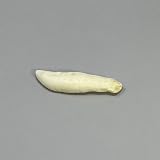
- 3.25 inches long
- Made from resin/fiberglass
- Museum quality replica
- Hand painted to look realistic
Stable isotopes offer ecological clues
The researchers also measured stable carbon-13 (δ¹³C) and nitrogen-15 (δ¹⁵N) in dentine. Patterns in these isotopes can indicate changes in an animal’s diet or feeding environment over time. They do not identify an exact meal or, by themselves, prove which prey species a whale ate.
Do whale teeth have annual growth rings?
In the study, radiocarbon profiles from both sperm whales and one killer whale aligned with marine bomb-radiocarbon reference curves, supporting annual growth-layer deposition during early and middle life. That is evidence for annual layering in those animals and periods—not a universal rule for every whale or every age.
Rank #2
![Sperm Whale Tooth Resin Replica - Realistic Fossil Decor for Home, Classroom & Collection [RS-8128]](https://m.media-amazon.com/images/I/51E0DsOOWUL._SL160_.jpg)
- LIFELIKE WHALE TOOTH REPLICA: Expertly crafted Sperm Whale Tooth made from premium resin with rea...
- ELEGANT DISPLAY STAND: Includes a sturdy metal and wood stand that showcases the tooth beautifull...
- PREMIUM QUALITY MATERIALS: Made from durable, non-toxic resin with a smooth, hand-painted finish ...
- NAUTICAL & EDUCATIONAL DECOR: Ideal for ocean-themed rooms, classrooms, museums, or marine biolog...
- UNIQUE GIFT IDEA: A memorable present for whale lovers, maritime collectors, nautical decor fans,...
A second killer whale illustrates why counting visible layers can become unreliable. Its tooth showed 52 growth layers, but the radiocarbon chronology was consistent with an age of 65 years or more. In this individual, the visible count therefore substantially understated the likely age. The study suggests layers may become compressed or less distinct in older animals, making chronology harder to read from layer counts alone.
What the teeth revealed about Moby and Lulu
Moby: at least 43 years old
Moby was a sperm whale found stranded in the Firth of Forth in 1997. Radiocarbon analysis indicated that he was at least 43 years old when he died. His tooth offered a way to investigate questions about his history—where he had come from and what kind of life he had led—using chemical evidence preserved across its growth layers.
Rank #3
![White Antique Sperm Whale Tooth Resin Replica - Realistic Fossil Decor for Home, Classroom & Collection [RS-8145]](https://m.media-amazon.com/images/I/31NBBhNrCyL._SL160_.jpg)
- LIFELIKE WHALE TOOTH REPLICA: Expertly crafted White Antique Sperm Whale Tooth made from premium ...
- ELEGANT DISPLAY STAND: Includes a sturdy metal and wood stand that showcases the tooth beautifull...
- PREMIUM QUALITY MATERIALS: Made from durable, non-toxic resin with a smooth, hand-painted finish ...
- NAUTICAL & EDUCATIONAL DECOR: Ideal for ocean-themed rooms, classrooms, museums, or marine biolog...
- UNIQUE GIFT IDEA: A memorable present for whale lovers, maritime collectors, nautical decor fans,...
Lulu: a Sellafield-associated radiocarbon signature
Lulu belonged to the West Coast Community of killer whales. Her tooth contained a distinct radiocarbon fingerprint associated with discharges from the Sellafield nuclear reprocessing facility. Researchers interpreted it as evidence that she foraged for a long time in the west of Scotland marine environment.
This civil nuclear reprocessing signal is distinct from bomb radiocarbon left by weapons testing. The finding concerns a trace chemical signature; it does not mean the sampled whales were dangerously radioactive.
Rank #4

- Resin Cast Replica
- 5.5 inches
Diet clues, not a menu
Carbon and nitrogen isotope profiles differed among the whales. The University of Glasgow’s account says Lulu’s higher nitrogen values point to a larger marine-mammal component in her diet, while lower values in two males suggest greater contributions from fish. These are ecological interpretations, not proof of specific meals or exact prey species.
Across the study samples, the reported δ¹³C values ranged from approximately −14.0‰ to −11.7‰ for sperm whales and −15.4‰ to −12.4‰ for killer whales. Reported δ¹⁵N ranges were 11.3‰ to 17.1‰ for sperm whales and 12.4‰ to 19.2‰ for killer whales. These are measurements from the five studied animals, not population-wide ranges.
Best Value

- IT FROM XUQCAH MATERIAL AND FOIMOJSK PAR ENT AND Thurder LOVER
- Museum Quality Replica
- Please thoroughly read discription
What the findings do—and do not—establish
- They support a method: bomb-radiocarbon chronology can test whether tooth growth layers correspond to annual increments.
- They show an age-counting limitation: at least one older killer whale’s 52 visible layers did not capture its likely full age, estimated from radiocarbon as potentially 65 years or more.
- They provide ecological evidence: stable isotopes and the Sellafield-associated signal help distinguish aspects of individual life histories, but do not yield a complete migration map or exact diet.
- The sample is small: the study covered five stranded whales in Scotland, so its results should not be treated as a universal calibration for all whales.
Lead author Dr Kieran Tierney of the Scottish Universities Environmental Research Centre said the evidence indicates that tooth layers are deposited annually, “but this is perhaps only reliable up to a certain point in their lives.” He also noted that the five-whale scope is limited, while the method may provide information useful to future conservation efforts.
Study details
The findings were reported by Tierney and colleagues in “Integrating radiocarbon and stable isotopes in odontocete teeth to reveal life histories,” published in Frontiers in Marine Science 13, article 1934180 (2026). The paper first appeared online on 1 October 2026. The University of Glasgow published its account on 7 October 2026.
Quick Recap
Product prices and availability are accurate as of the date/time indicated and are subject to change. Any price and availability information displayed on Amazon at the time of purchase will apply.

