
The Tool Desk
Outbyte Driver Updater FREEScan for outdated or missing drivers - takes under a minuteDriver Scan →Outbyte PC Repair FREERepair Windows errors before they cause bigger problemsFix Now →A public starting benchmark is $350,000 to send about 50 kg to sun-synchronous orbit on SpaceX’s Falcon 9 rideshare program, with $7,000 per additional kilogram listed by SpaceX. That is a launch-service price, not a universal quote or the total cost of building and operating a satellite. Your price depends on the spacecraft’s mass and dimensions, its destination orbit, schedule flexibility, and the integration and deployment services it needs.
How much does it cost to launch a small satellite?
SpaceX’s public rideshare page, accessed October 7, 2026, lists a starting price of $350,000 for about 50 kg to sun-synchronous orbit, plus $7,000/kg for additional mass. Treat this as an advertised starting fare, not a guaranteed quote: confirm current pricing, availability, and terms with the provider for your mission.
Dedicated small-launch vehicles have substantially different price benchmarks. In a 2025 International Astronautical Congress survey, Erik Kulu reported approximately $7.5–8 million for a 200 kg Electron payload and roughly $12 million for a 630 kg Firefly Alpha payload. These are broad, dated benchmarks—not quotes for a particular orbit, launch date, or customer. NASA’s 2026 smallsat chapter lists Electron performance to low Earth orbit (LEO) as 200 kg; that is a capacity figure, not a price.
| Launch option or figure | Public price or capacity | What the figure means |
|---|---|---|
| SpaceX Falcon 9 rideshare | $350,000 for about 50 kg to sun-synchronous orbit; $7,000/kg for additional mass | SpaceX advertised starting fare, accessed October 7, 2026. Check the provider’s current terms and obtain a mission-specific quote. |
| Rocket Lab Electron dedicated-launch benchmark | About $7.5–8 million for a 200 kg payload | Erik Kulu’s 2025 IAC survey; approximate benchmark, not a customer quote. NASA lists Electron performance to LEO as 200 kg in 2026, which is capacity context rather than a price. |
| Firefly Alpha dedicated-launch benchmark | Roughly $12 million for a 630 kg payload | Erik Kulu’s 2025 IAC survey; approximate benchmark, not a customer quote for a specified orbit or mission. |
Per-kilogram comparisons are only rough guides. As Kulu cautions, adapters, volume limits, and unused vehicle capacity can all distort the calculation. Compare total quotes for the same orbit, payload geometry, integration and deployment services, schedule, and contract assumptions—not a market-wide price per kilogram multiplied by satellite mass.
Recommended Free Tools
#1 Best Overall

- 🛰️Solar - Powered Fun with Rotating Satellite🛰️The rotating satellite in this 3D wooden puzzle adds an exciting element to the toy. Without the need for batteries,this assembly building kit can rotate smoothly and quickly even in weak light. Kids can enjoy the fun of seeing the satellite spinning after they complete the assembly.
- 🛠️DIY Assembly for Kids' Skill Development🛠️The solar science kit offers a great DIY experience for kids. As they assemble the rotating satellite model, it helps to develop their hands - on ability, their patience、concentration and logical thinking are also improved during the assembly.Through this process, kids can gain a sense of accomplishment, and it's a great way for them to explore and learn about science.
- ✨Educational and Scientific Value✨This STEM Educational science model kit is a great educational tool. Kids can learn basic science concepts while assembling. It promotes understanding of solar power in a hands - on way, stimulating kids' interest in science and technology, and laying a foundation for future learning.
- 🛸Parent-Child Bonding Space Mission🛸Team up for cosmic connection! This STEM toy kit becomes family quality time – parents guide young engineers to assemble the satellite model 🚀👨👩👧👦. Watch teamwork orbit around solar science learning and 3D puzzle solving!
- 🌟Multi - Scenario Applications🌟This Assembly 3D Building Toy has multiple uses. It's a wonderful source of entertainment, providing hours of fun. This 3D craft kit also doubles as a home decor item. In the classroom, it serves as a practical tool for teaching science concepts, making learning more interesting.Even on the car's dashboard as a front - end decoration, it looks great.
Is rideshare cheaper than a dedicated launch?
Usually, rideshare lowers the launch fare by sharing vehicle capacity with a larger mission. In return, the primary mission and shared flight can constrain the rideshare payload’s orbit, timing, and conditions of deployment. NASA’s Small Spacecraft Systems Virtual Institute describes “do no harm” requirements that can limit transmitters, mechanical deployments after separation, or hazardous materials.
A dedicated launch can offer more control and may fit a mission that needs a particular orbit, uses much of the vehicle’s performance, follows an interplanetary trajectory, requires precisely timed rendezvous, or has special environmental needs. It generally costs more: dedicated flights have smaller manifests and lower launch frequency, according to NASA.
Rank #2
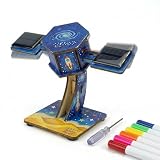
- Space Science & Alternative Energy Module Designed as an interactive science practice apparatus, this wooden solar satellite model bridges aerospace structural engineering with renewable energy. It serves as essential laboratory equipment for advanced science, allowing students to investigate sustainable power applications through a rigorous hands-on fabrication process.
- Photovoltaic Energy Conversion This educational apparatus facilitates the direct observation of energy transformation. Physics students can actively analyze how integrated photovoltaic cells capture solar power and convert it into electrical energy, which then drives the internal motor to create perpetual kinetic motion.
- Closed-Loop Circuitry & Troubleshooting Utilizing precision building supplies and micro-fasteners, learners must construct functional closed-loop circuitry connecting the solar panel to the mechatronics module. This practical engineering experiment demands systematic troubleshooting, teaching core signal routing and structural modeling required in professional settings.
- Structural Design & Kinetic Artistry Elevating standard science projects, this learning model seamlessly integrates mechanical linkage with advanced color theory. By personalizing the raw wooden components during self-assembly, educators can combine aesthetic visual design with applied physics demonstrations, resulting in a fully functional kinetic art piece.
- Professional STEM & Homeschool Resources Developed specifically as science project supplies and reliable classroom materials, this module actively fosters environmental awareness. It is a definitive science classroom must-have and an invaluable homeschool curriculum supplement for educators seeking serious, professional-grade teaching supplies for rigorous academic instruction.
| Decision factor | Rideshare | Dedicated launch |
|---|---|---|
| Launch price | Often lower because capacity is shared; confirm what the quote includes. | Generally higher; public benchmarks are approximate and mission-dependent. |
| Orbit and timing | Constrained by the shared mission and available deployment conditions. | Can provide greater control when the mission requires it, subject to vehicle and provider capabilities. |
| Payload fit and operating constraints | Must fit physical interfaces and satisfy shared-flight safety and “do no harm” conditions. | May better accommodate unusual mission requirements; verify specific capabilities with the provider. |
| Best fit | A mission that can accept the offered orbit, schedule, and deployment arrangement. | A mission for which orbit, timing, performance use, or special conditions justify the higher cost. |
What affects a small-satellite launch price?
- Mass and dimensions: Providers sell capacity subject to mass and physical-interface or volume limits. A lightweight but bulky spacecraft may not fit a simple per-kilogram price calculation.
- Target orbit: Altitude, inclination, and whether the mission needs sun-synchronous or another orbit affect which launches are suitable. Required delivery precision can also change the service needed.
- Schedule and control: Rideshare customers accept shared mission timing and constraints. A mission that needs more control may require a dedicated option, which typically costs more.
- Integration and safety work: Compatibility analyses, launch-site coordination, safety reviews, interface hardware, and dispenser or separation systems can affect cost and readiness. Determine which are included in a quote and which are separate.
- Orbit after deployment: If the launch vehicle’s deployment orbit differs from the desired orbit, an orbital transport or maneuvering vehicle may provide “last-mile” delivery. This is an additional, mission-specific service.
- Spacecraft development: The satellite itself is a separate part of the budget. A NASA-hosted CubeSat mission review identifies spacecraft size, complexity—including material, power, and bandwidth choices—technology readiness and design maturity, and development schedule as typical cost drivers. It does not establish a universal build-cost estimate.
What does a satellite launch price include?
Do not assume an advertised launch fare is an all-in mission price. The scope of each provider’s quote matters. Ask whether it covers the launch service alone or also addresses integration, interface hardware, dispenser and separation arrangements, safety work, and deployment conditions. Orbital delivery beyond the initial deployment orbit may be another service. Spacecraft development and mission operations are separate budget categories, not launch-provider line items in the cited NASA cost review.
For help evaluating a mission, NASA distinguishes launch brokers, who match spacecraft with launch opportunities and may support scheduling, integration, safety testing, and cost discussions, from integrators, who work on compatibility and physical integration and may provide dispensers, separation systems, or other hardware. These roles can help navigate a quote, but do not make a generic market price a substitute for a mission-specific offer.
PC Slower Than It Used to Be?
A free scan shows the junk files, broken settings and background clutter dragging Windows down - then fixes them in one click.Free scan · Windows 10 & 11Crashes, No Sound, or Screen Glitches?
Random freezes, missing sound and display glitches usually trace back to one bad driver. Find and replace yours safely.Free scan · under a minuteRank #3

- This is the 1/25 Scale 1965 Plymouth Satellite Plastic Model Kit by Moebius. Suitable for Ages 15 & Older.
- Features: Highly detailed plastic pieces molded in white and clear Engine bay with optional open hood Detailed interior Commando V-8 426 cu. in. engine Chrome parts Waterslide decals Illustrated instruction
- Includes: One plastic model
- Specs: Scale: 1:25 Skill level: 3 Parts: 100+
- Part number(s) included (in factory packaging): 1215
How to compare quotes for a CubeSat or other small satellite
- Specify the payload: Give providers the satellite’s mass, dimensions, and relevant interface details. A CubeSat label alone does not establish a launch price.
- Define the destination: State the required altitude, inclination, orbit type, and delivery accuracy. Note whether an alternate deployment orbit or later orbital transfer is acceptable.
- Set schedule constraints: Identify the required launch window and how much flexibility the mission can tolerate. Ask what happens if a shared flight is delayed; SpaceX describes a rebooking arrangement subject to a fee, so confirm the current terms directly.
- List services and constraints: Ask what integration, safety review, interface hardware, deployment, and orbital-delivery work is included. Disclose any transmitters, post-separation mechanical deployments, or hazardous materials relevant to rideshare review.
- Compare like with like: Evaluate total quoted cost alongside orbit and delivery accuracy, launch-window control, mass and volume limits, integration and safety work, deployment conditions, and the provider’s supported reliability and mission requirements. A per-kilogram figure by itself does not capture these differences.
Does NASA’s VADR contract set a public launch price?
No. NASA’s Venture-Class Acquisition of Dedicated and Rideshare (VADR) contract is for NASA and NASA-sponsored risk-tolerant missions. NASA describes it as a vehicle for firm-fixed-price task orders with a roster of providers—not a public fare card available to every commercial satellite operator. Its $300 million maximum total contract value, on a NASA page last updated in 2025, is a ceiling across VADR awards, not the price of an individual launch.
Availability and schedules are time-sensitive. NASA’s 2026 smallsat launch chapter reported that Rocket Lab had completed 10 Electron rideshare missions in 2025 and planned launches in 2026; that is report-era context, not a guarantee of current availability.
Quick Recap
Rank #4

- The newest Fire TV experience (2026) – Our biggest update to Fire TV has a new, modern design that gets you to your entertainment fast. Browse dedicated content categories, pin more of your favorite apps, and get personalized recommendations from Alexa+. Spend less time scrolling, and more time watching.
- Elevate your entertainment experience with a powerful processor for lightning-fast app starts and fluid navigation.
- Smarter picks with Alexa+ – Getting to what you love has never been easier. Press the voice remote button and talk naturally to find what to watch across your apps, manage your smart home, or dive into virtually any topic.
- Enjoy the show in 4K Ultra HD, with support for Dolby Vision, HDR10+, and immersive Dolby Atmos audio.
- Fire TV Ambient Experience lets you display over 2,000 pieces of museum-quality art and photography.
Product prices and availability are accurate as of the date/time indicated and are subject to change. Any price and availability information displayed on Amazon at the time of purchase will apply.

