
Recommended Free Tools
Real-time payment fraud detection happens mainly at the financial institutions sending and receiving a payment—not as a single fraud decision made by the payment rail. Before submitting a payment, a bank or payment provider can assess the customer’s session, account activity, transaction details and recipient information. Rules and risk models may help it allow, block, hold, warn about or refer the payment for review. The decision window can be only seconds: FedNow settles individual payments within seconds, and the receiving institution makes funds available after settlement notification.
How does real-time payment fraud detection work?
The process is a set of checks around a payment instruction. The precise data, rules and decision thresholds vary by institution; there is no single universal fraud score or model that every bank uses.


- The customer initiates a payment. The sending institution authenticates the customer and may assess session security, device or login changes, account maintenance and how a recipient was added. Federal banking agencies’ guidance recommends risk assessment and stronger authentication when access or a transaction presents higher risk; it also discusses transaction-value and daily limits and restrictions on devices used to add recipients. Federal banking agencies’ authentication and access guidance.
- The payment is evaluated in context. The institution can compare the amount, timing, frequency and velocity of the payment with the account’s prior activity or relevant customer-segment thresholds. Unusual activity is a reason to look more closely, not proof that a payment is fraudulent.
- Recipient information may be checked. A pre-validation service can compare a supplied beneficiary name with account details. Confirmation of Payee is one UK example; it is not a US rule or a feature that should be assumed to exist on every payment rail. A match helps with certain errors and mismatches, but does not establish that the recipient is trustworthy.
- The sending institution chooses an action. Depending on its controls and the signals available, it may let the payment proceed, stop it, hold it, warn the customer or send it for additional review. The Federal Reserve describes FedNow network intelligence as information participants can combine with their own data when deciding whether to proceed, hold or seek review.
- The payment rail processes and settles the instruction. For FedNow, the Federal Reserve says individual payments are processed and settled within seconds, 24 hours a day, every day of the year. Participating institutions are required to make funds available to customers immediately after settlement notification. See the Federal Reserve’s FedNow FAQ.
- Institutions monitor and respond. Logs and anomaly monitoring can support investigation and detection of unauthorized activity. Once a payment has settled, the chance to stop it before sending may have passed; response and recovery depend on the circumstances, institutions and applicable rules. There is no universal recovery guarantee.
What information can banks use to flag suspicious instant payments?
Available information varies by institution, product and payment system. Commonly described risk inputs and controls include:
- Identity and session signals: authentication results, login patterns, device changes and account maintenance activity. An institution may require stronger authentication for a higher-risk transaction.
- Payment behavior: amount, frequency, timing and transaction velocity compared with the customer’s history or a relevant segment’s thresholds. A customer who suddenly sends payments much more frequently may warrant scrutiny, but that pattern alone does not establish fraud.
- Payee details: whether the beneficiary’s name and account identifiers appear to correspond. Pre-validation can catch some mismatches and may help with certain scam patterns, but a match is not a safety certification. The UK Payment Systems Regulator describes Confirmation of Payee as checking whether a payee’s name matches account details: its Confirmation of Payee material. BIS/CPMI also discusses payment pre-validation as a way to spot issues before money moves: BIS/CPMI’s pre-validation brief.
- Network observations: FedNow’s network-intelligence API offers participants receiver-account-level information observed on the service, based on historical data, to supplement internal risk information. This is an input to a participant’s decision, not a verdict that a particular payment is fraudulent. The Federal Reserve Financial Services announced the API in May 2026: FedNow network-intelligence API announcement.
- Customer-segment controls: Federal Reserve Financial Services activated FedNow account activity thresholds in June 2025, allowing institutions to configure dollar-value and transaction-velocity parameters for customer segments. The feature gives participants another control; it does not mean all banks set the same thresholds. See the June 2025 announcement.
These inputs help an institution make a risk decision; none proves fraud on its own. A legitimate payment can differ from a customer’s usual behavior, while a scam payment can look like one the customer intentionally authorized.
#1 Best Overall
Can a bank stop an instant payment?
Sometimes, if its checks flag the payment while the institution can still act. Possible responses include blocking it, holding it, warning the customer or referring it for additional review. Whether a particular bank can use a specific response, and at what point, depends on its systems and procedures.
The timing matters. FedNow payments settle within seconds, so screening and decision-making take place in a narrow window. If a payment has already settled, stopping it before submission is no longer an option; any subsequent response or recovery depends on the case and applicable rules. The reviewed official sources do not establish one recovery outcome for every settled payment.
Rank #2

- ALL-IN-ONE SCAM DETECTION – Texts, emails, videos, and QR codes all get checked automatically. Sorting real from fake stops being your job.
- KEEP SCAMMERS OUT OF YOUR WALLET – Every click is no longer a gamble. Our scam detection spots suspicious texts, email scams, SMS phishing, and fake alerts before you click.
- QR CODE SCANNING – Point the app at any code and see where it actually leads before you scan it.
- DEEPFAKE DETECTION – When a video sounds like someone you know but isn't, you hear it from us first.
- ON-DEMAND CHECKS – Got a message you're unsure about? Run it through the app and know in seconds, wherever it came from.
How do banks detect authorized push-payment scams?
Authorized push-payment (APP) scams differ from account takeover. In an account takeover, a fraudster gains access or uses compromised credentials to make a payment the customer did not intend to make. In an APP scam, the customer initiates the payment after being deceived about who will receive it. The UK Payment Systems Regulator describes APP scams as cases where people are tricked into sending money to a fraudster posing as a genuine payee: PSR material on consumer protection in real-time payments.
Authentication can help address unauthorized access, but it cannot by itself show that the customer’s reason for paying is genuine. A payee-name check may reveal a mismatch; transaction context, warnings and additional review may help with other suspicious patterns. Neither authentication nor name matching prevents every APP scam.
What’s actually slowing this PC down?
Pick the symptom - the matching free tool is one click away.
What FedNow examples show—and what they do not
FedNow illustrates how rail-level tools and institution-level decisions can complement each other in the United States. FedNow is a payment and settlement service for eligible depository institutions; consumers and merchants use it through their financial institutions. Banks configure their own controls, while optional participant tools can add information or thresholds. The UK Confirmation of Payee example belongs to a different jurisdiction and should not be treated as a FedNow or US requirement.
In its May 2026 network-intelligence announcement, Federal Reserve Financial Services said real-time payee-name verification was being explored. That wording describes exploration, not a deployed FedNow payee-verification feature. The announcement’s established API function is to provide receiver-account-level network information for participants to consider alongside internal data.
Rank #4
The Federal Reserve Board’s 2025 annual report recorded 1.5 million FedNow transactions in 2024 and an average daily transaction value of approximately $104.1 million that year. These are service-activity figures, not fraud-loss totals, fraud incidence, detection rates or evidence of model accuracy. The annual report is available at Federal Reserve Board: Payment System and Reserve Bank Oversight. The cited official sources do not establish an industrywide real-time fraud detection rate or false-positive rate.
Quick Recap
Best Value
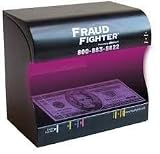
- Counterfeit Detection Scanner
- Instantly distinguish fake from real
- Cash, credit cards, driver's licenses, identification cards, passports, and many other important documents
What a fraud alert does—and does not—tell you
- A flag means the institution’s checks found a reason for scrutiny; it does not necessarily mean the customer or recipient committed fraud.
- A payment that passes screening is not guaranteed to be safe. Risk checks cannot establish from one signal that the customer has not been deceived.
- Rules, models, payee checks and network information are complementary tools. The evidence does not establish a universal formula or show that one approach always outperforms another.
Product prices and availability are accurate as of the date/time indicated and are subject to change. Any price and availability information displayed on Amazon at the time of purchase will apply.

