
Formula 1 practice sessions give teams time to check their cars, learn the circuit and prepare for qualifying and the race. FP1 results show the order of the quickest recorded laps in that session—not a race result or a reliable prediction of who will qualify fastest.
What is FP1 in Formula 1?
FP1 means Free Practice 1, the first scheduled practice session of a Grand Prix weekend. Drivers and teams use it as working time: they check that the car is functioning, build familiarity with the circuit, share feedback and begin adjusting the setup. Teams may also evaluate new aerodynamic parts.
Practice is not a race. Its classification does not award championship points; it records the session’s lap-time order. Formula 1’s beginner’s guide to the F1 weekend explains the typical purpose and pattern of the sessions.
How the practice schedule works
Standard Grand Prix weekend
Usually, Friday has FP1 and FP2, each scheduled for one hour. Saturday starts with FP3, also usually one hour, followed by qualifying later that day. FP3 is the final practice before parc fermé conditions begin, when most work on the car is banned. The exact scope and timing of those restrictions are governed by event regulations.
#1 Best Overall
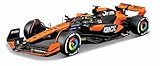
- Authentic Formula 1 Styling – Realistic race-inspired design and proportions
- Authentic Race Car and Driver's Helmet Details
- Collector-Scale Model – 1:24 scale ideal for shelves, desks, and displays. Includes Acrylic Box with Decorative Sleeve
- Authentic Race Car and Driver's Helmet Details for #4 Lando Norris
- Free-Rolling Wheels – Smooth-rolling wheels for display or light play
Sprint weekend
A Sprint weekend usually has one practice session before Sprint Qualifying, rather than the three-session practice schedule of a standard weekend. Formula 1’s beginner’s guide describes that practice session as one hour, but event schedules can change: the sole FP1 at the 2026 Miami Sprint weekend was extended to 90 minutes, as Formula 1 reported. Check the schedule for the specific Grand Prix rather than assuming every weekend follows the usual pattern.
What teams typically do in each session
| Session | Typical focus |
|---|---|
| FP1 | Check car systems, help drivers learn the circuit, collect feedback, start setup work and sometimes evaluate new parts. |
| FP2 | Often longer runs to prepare for the race; qualifying simulations may also feature when conditions allow. |
| FP3 | Often shorter runs as drivers prepare for qualifying. |
These are common programs, not mandatory procedures. Teams can prioritize different tasks depending on the weekend format, conditions and what they need to learn.
Rank #2
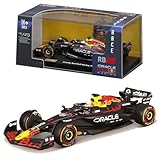
- Officially Licensed Replica – Authentic styling and branding from the original manufacturer
- Die-Cast Metal Construction – Durable metal body with detailed plastic components
- Highly Detailed Design – Realistic exterior styling and interior details
- Free-Rolling Wheels – Smooth movement for display or play
- Perfect for Collectors & Kids – Great gift for automotive fans
How to read an FP1 results page
A Formula 1 session classification typically lists each driver’s position, team, lap time or gap to the leader, and completed laps. For instance, the 2026 Bahrain FP1 results page ranks drivers by their recorded session times and shows their lap counts. The fastest listed time identifies who topped that session; the lap count gives basic context about how much each driver ran.
Neither field reveals the complete run plan. A driver who completed fewer laps may have had less opportunity to set a time, while a large lap count does not by itself establish that the driver was pushing for a quick lap. The public classification is a useful snapshot, not a full account of what each team was testing.
What’s actually slowing this PC down?
Pick the symptom - the matching free tool is one click away.
Rank #3
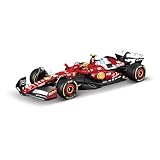
- Ferrari Die-Cast Race Vehicle in 1/43 scale
- Authentic Race Car and Driver's Helmet Details
- Acrylic Box with Decorative Sleeve
- 2025 Season Car
Why an FP1 result does not predict the race order
Teams do not necessarily make their laps under comparable conditions. They can use different fuel loads and tyre compounds, run at different times as conditions change, and pursue different tasks. Formula 1 cautions: “Cars carry different fuel loads and drivers use different tyre compounds in varying conditions over the three practice sessions, so it’s not always easy to determine who’s going to be fast solely by using practice times.”
So treat the top of the FP1 leaderboard as an early clue, not a dependable forecast of qualifying or Grand Prix pace. When comparing drivers, consider position and time gap alongside lap count and running context. A meaningful pace comparison requires comparable tyre, fuel, track conditions and run purpose—details that the public classification alone does not provide.
Quick Recap
Rank #4

- FERRARI F1 TOY CAR – Boys and girls ages 10 and up and Ferrari fans can build, display and race the LEGO Speed Champions Ferrari SF-24 F1 Race Car and driver set
- 1 DRIVER MINIFIGURE – This vehicle set includes a driver minifigure wearing a special Ferrari outfit and a winged helmet for kids to place inside the cockpit and role-play thrilling race action
- AUTHENTIC DETAILS – F1 race car with design details from the real-life 2024 version, including a rear wing, a halo bar, sponsor stickers and wider rear tires imprinted with “Pirelli”
- F1 FUN FOR THE WHOLE FAMILY – Race for the checkered flag alongside the whole family with other building sets (sold separately) in the LEGO F1 range
- BUILD & DISPLAY – After kids have enjoyed playing out racing stories with the Ferrari F1 toy, they can display it on a shelf or bedside table
What to watch for after FP1
- Use the time order to see who set the quickest recorded lap in that session, not to declare a race favourite.
- Check the gaps and lap counts together; a time without running context can give an incomplete impression.
- Look to later practice and qualifying for stronger evidence of competitive pace, while remembering that practice programs and conditions can still differ.
Product prices and availability are accurate as of the date/time indicated and are subject to change. Any price and availability information displayed on Amazon at the time of purchase will apply.

