
What’s actually slowing this PC down?
Pick the symptom - the matching free tool is one click away.
Data center cooling moves heat from servers through air or liquid systems and ultimately rejects it outside the building. Water use varies because facilities differ in cooling design, heat load, climate, operating settings, and how often they can use efficient cooling modes. Evaporative cooling towers consume water chiefly by evaporation, but not every cooling system depends on them.
How heat leaves a data center
Servers use electricity, and nearly all of that electrical energy ends up as heat. Cooling equipment must carry that heat away from IT equipment and release it outdoors. In a common air-cooled design, the path looks like this:
- Servers to room air: Fans move air through server equipment, picking up heat.
- Room air to chilled water: Computer-room air-conditioning equipment transfers heat from the air into a chilled-water loop.
- Chilled water to condenser water: A chiller transfers heat to a separate condenser-water loop.
- Condenser water to the atmosphere: A cooling tower rejects heat outdoors, chiefly by evaporating water. The U.S. Department of Energy describes cooling tower management and water losses.
That is a common arrangement, not a universal blueprint. Facilities can change or bypass parts of the chain depending on outdoor conditions and system design.
Cooling approaches and what they mean for water
| Approach | How it moves heat | Water and operating considerations |
|---|---|---|
| Air-side economizing | Uses suitable outdoor air to cool the facility, reducing the need for mechanical cooling. | Can cut mechanical cooling hours when outdoor temperature and air quality allow. Availability depends on climate and design. DOE guidance covers data center cooling systems and economizing. |
| Water-side economizing | Uses a heat exchanger and cooling-tower capacity to cool the chilled-water loop, reducing or bypassing chiller operation when conditions permit. | Can reduce chiller load, but may still rely on a cooling tower and its evaporative water use. Feasibility depends on climate and system configuration. DOE guidance covers data center cooling systems and economizing. |
| Direct liquid cooling | Transfers heat to fluid close to the IT equipment rather than relying only on room air. | Can improve heat transport and support higher heat densities, but does not by itself determine whether the facility consumes evaporative water. That depends on the downstream heat-rejection system. DOE guidance discusses cooling system configurations. |
A system that captures heat close to the server may still send that heat to an evaporative tower. Conversely, a facility may reduce tower use during suitable conditions by using economizing. The cooling method near the IT equipment and the method that ultimately releases heat outdoors are related but distinct design choices.
Free tools Windows power users keep installed
One-click scans. No signup required.
#1 Best Overall

- Condition: 100% Brand New and in Perfect package to ensure you receive a perfect product
- Model: DV4600-492
- Bearing Type: Ball; Fan Diameter: 120mm; Maximum Fan Speed: 2650/3100 RPM; Material: Plastic; Type: Axial cooling fan
- Packaging: Carton; Power Connection: 2-Pin; Voltage: 115VAC
- Fan size: 120*120*38MM
Why water use varies between facilities
There is no fixed amount of water inherent to every data center. The amount depends on how much heat needs to be removed, how efficiently each stage transfers it, and which heat-rejection equipment the site uses. DOE cooling-system guidance and its cooling-tower management guidance identify several interacting factors:
- IT heat load: More server energy generally means more heat to remove. A facility running below full load may use less cooling than its full-load design suggests.
- Climate and ambient conditions: Outdoor temperature and air quality determine when air-side economizing is practical; outdoor conditions also affect whether water-side economizing can reduce chiller operation.
- Cooling design: The number and efficiency of transfer stages, the presence of chillers and towers, and the use of air or liquid near equipment affect the system’s water demand.
- Operating settings: Temperature and humidity set points influence cooling demand. Equipment limits and operating requirements constrain how far settings can be adjusted.
- Tower management: Evaporation is the main water loss in an evaporative tower and is part of how it rejects heat. Blowdown removes water to control mineral concentration; drift and leaks add further losses.
- Operating hours and controls: Weather, actual load, maintenance, and control strategies affect how long each cooling mode operates and how much water a tower uses.
DOE guidance states, “Therefore, by design, cooling towers use significant amounts of water.” That statement applies to cooling towers, not to every data center cooling design. The guidance explains tower water use and management.
Rank #2

- APPLICATION: USB computer fans cool off gaming systems, routers, amplifiers, and receivers. 120mm case fan keep entertainment centers' stereos and cables cool and help with air flow in various spaces
- PLAY AND PLUG: Just plug this server fan into any USB source—like a charger, power bank, phone adapter, game console, or USB outlet. It's a breeze to use
- PACKAGE INCLUDING: This usb cooling fan set comes with two USB fans, one USB cable to control two fans (high speed medium speed low speed), and a metal shield to protect your hands. Easy to use, safe and reliable
- Variable Speed Fan: It has a variable-speed controller so you can adjust the pc fan for the best mix of quiet operation and airflow
- Specification: 120 x 120x 25 mm ( 4.72 x 4.72 x 0.98 in. ) | Rated Voltage : 5V | Rated Current: 0.25A | Airflow: 77 x 2 CFM | Noise: 32dBA | Speed: 2000 RPM (MAX)
How to interpret WUE
Water usage effectiveness (WUE) expresses annual site water use in liters divided by annual IT equipment energy use in kilowatt-hours, giving a value in liters per kWh. It can help normalize site water use against IT energy, but it does not reveal the cooling design or the local water context by itself. DOE’s data center cooling guidance describes WUE.
For a meaningful comparison, check that the figures cover the same reporting period and use the same site boundary. Also ask what water is counted and where it is consumed: a WUE ratio alone does not show whether local water supplies are stressed or how much water is used beyond the reported boundary.
The Tool Desk
Outbyte PC Repair FREEClear out junk files and repair common Windows errorsFree Scan →Outbyte Driver Updater FREEScan for outdated or missing drivers - takes under a minuteDriver Scan →Rank #3

- An ultra-quiet UL-certified fan system designed for cooling cabinets that requires minimal noise.
- Features a multi-speed controller to set the fan’s speed to optimal noise and airflow levels.
- Contains a CNC machined aluminum frame with a modern brushed black finish.
- Powered by wall outlet or USB port, included Turbo Adapter increases performance by 25%.
- Dimensions: 8.5 x 4.4 x 1.3 in. | Total Airflow: 52 CFM | Total Noise: 18 dBa | Bearings: Dual Ball
Ways to reduce cooling demand or tower water
Review temperature and humidity settings
The Federal Energy Management Program (FEMP) describes raising overly conservative temperature set points and widening unnecessarily narrow humidity controls, where equipment and operations permit, as ways to reduce cooling demand. Its 2019 guidance cites the potential for a bundle of practices that enable higher chilled-water temperatures and reduced airflow to cut chiller energy consumption by 20%. This is a guidance estimate, not a universal measured saving. FEMP’s operating temperature and humidity guidance discusses the practices.
Use economizing when conditions allow
Air-side economizing can reduce mechanical cooling when outdoor air conditions and air quality are suitable. Water-side economizing can reduce chiller load when the climate and system configuration support it. Neither option has the same benefit at every site: the useful operating hours depend on local conditions and equipment design. FEMP’s cooling-systems guidance describes these approaches.
Rank #4
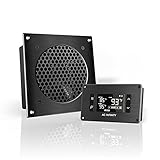
- An ultra quiet UL-certified fan system designed for cooling cabinets that requires minimal noise.
- Features an on board processor that provides a digital read-out of the cabinets temperatures.
- Programming includes thermostat control, fan speed control, and SMART energy saving mode.
- Dimensions: 6.3 x 6.3 x 1.3 in. | Airflow: 52 CFM | Noise: 18 dBA | Bearings: Dual Ball
Manage cooling tower concentration carefully
In its 2019 guidance, FEMP cites a comparison in which increasing a tower’s cycles of concentration from three to six lowers makeup water by 20% and blowdown by 50%. These are conditional guidance figures, not guaranteed savings for any tower; water chemistry, treatment, and equipment constraints determine whether the change is appropriate. FEMP’s tower-management guidance covers this practice.
Independent reader supportYour contribution helps us test, update, and keep practical guides available for everyone.Why headline numbers need context
DOE guidance also provides illustrative daily cooling-tower water-use estimates based on chiller tonnage and cycles of concentration for a system operating at full load. Those estimates are not universal consumption figures: actual load, operating hours, weather, and system management change the result. Compare figures only when their operating assumptions and site boundaries are clear. The tower-management guidance provides the estimates and their operating context.
Windows Errors? Fix Them Before They Spread
Repair common Windows errors and clear accumulated junk for a smoother, more stable PC - no reinstall needed.Free scan · no reinstallCrashes, No Sound, or Screen Glitches?
Random freezes, missing sound and display glitches usually trace back to one bad driver. Find and replace yours safely.Free scan · under a minuteBest Value
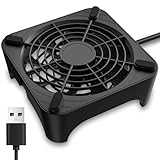
- 【Universal Compatibility】This USB cooling fan works seamlessly with Mini PC, PS5, routers, Apple TV, modems, PlayStation, receivers, Rokus, T-Mobile 5G Home Internet, Xbox Series, and other audio-video electronics. Whether cooling a gaming console, router, or streaming device, it eliminates overheating worries across your digital ecosystem.
- 【Powerful Cooling Performance】Equipped with a 120mm fan boasting 55.8 CFM airflow and 850RPM±10% speed, this USB PC fan delivers rapid cooling—dropping device temperatures by 20% in seconds. The 9-blade design ensures powerful airflow to tackle heat buildup in routers, mini PCs, and gaming consoles, preventing lag and performance drops caused by overheating.
- 【Ultra-Quiet Operation & Scratch-Proof Protection】 Designed for ultra-quiet and scratch-resistant cooling needs, this USB computer fan comes with 4 shock-absorbing pads and operates at just 18dB(A)±10% noise—whisper-quiet, quieter than library silence (30dB) and close to the sound of rustling leaves (20dB). It enables efficient device cooling without noise interference or surface scratches, letting you fully immerse in video, audio, and gaming. It’s perfect for home offices, living rooms, and gaming setups.
- 【USB-Powered & Space-Saving Setup】This USB powered fan features an integrated 530mm (20.87-inch) USB cable, connecting easily to chargers, mobile power banks, or laptops—no extra wires needed. With dimensions of 130mm×130mm×48.6mm (5.12×5.12×1.91 inches), it can be placed flat or upright, making it perfect for narrow spaces while keeping your setup tidy.
- 【Sturdy & Long-Lasting Durability】Made from premium eco-friendly ABS material, this USB fan (with a box fan-like structure) supports heavy-duty use and can withstand weights up to 11LB. With a lifespan of 40000 hours, it offers long-term cooling for your devices, ensuring stable performance and protection against overheating for years to come.
Likewise, FEMP’s 2019 account of a National Laboratory of the Rockies data center reports PUE of 1.06 and WUE of 0.7 for that facility example. Those figures describe that site, not a typical industry result. The account also notes that its hybrid system involved added control loops and operational requirements. FEMP’s facility case study gives the example and its context.
When assessing a cooling option, consider where heat is captured, whether the final heat-rejection system evaporates water, how local climate affects economizer hours, and what control and maintenance work the design requires. No single approach is best for every facility.
Quick Recap
Product prices and availability are accurate as of the date/time indicated and are subject to change. Any price and availability information displayed on Amazon at the time of purchase will apply.

