
The Tool Desk
Outbyte Driver Updater FREEScan for outdated or missing drivers - takes under a minuteDriver Scan →Outbyte PC Repair FREEClear out junk files and repair common Windows errorsFree Scan →Choose Hostinger if you want a packaged VPS plan with more RAM and storage at the displayed entry level, included snapshots and weekly backups, and you are comfortable committing to a two-year term. Choose Vultr if you need hourly billing, cloud services such as object or block storage and load balancing, or a particular deployment region. The lowest advertised prices are not an apples-to-apples comparison: Hostinger’s listed entry plan has 4 GB of RAM, while Vultr’s has 500 MB.
Hostinger vs Vultr at a glance
| What matters | Hostinger VPS | Vultr cloud compute |
|---|---|---|
| Displayed entry offer | $6.49/month for a two-year term; 1 vCPU, 4 GB RAM, 50 GB NVMe storage, and 4 TB bandwidth. The comparison lists prices before VAT. | US$2.50/month; 1 vCPU, 500 MB RAM, and 10 GB NVMe storage. The comparison lists prices before VAT. |
| Billing model in the cited comparisons | Term-based offer; hourly billing is marked unavailable by VPSBenchmarks. | Hourly billing is listed by VPSBenchmarks. Check the selected instance’s current rate and billing terms. |
| Additional infrastructure | The comparisons describe a bundled VPS feature set. VPSBenchmarks marks block storage, object storage, and load balancing as unavailable. | VPSBenchmarks lists block storage, object storage, and a load balancer. |
| Locations | Both sources report 8 data centers. | Hostinger’s comparison reports 32; VPSBenchmarks reports 31. Counts conflict, so verify the specific region and plan availability. |
These are claims in Hostinger’s comparison dated October 1, 2026, and VPSBenchmarks’ comparison last updated September 17, 2026. Provider prices, plan details, and feature availability can change; check the current plan page and final checkout terms before committing.



Compare the actual plan cost, not just the starting price
The advertised starting rates buy notably different resource bundles. Hostinger’s lowest displayed offer costs more but includes eight times the RAM and five times the storage of the listed Vultr entry configuration. That does not establish which provider is cheaper for a workload: the plans are not matched, and the Vultr figure is an entry point for a much smaller configuration.
| Hostinger plan shown in the 2026 comparison | Displayed price and term | Renewal price and term | Included resources |
|---|---|---|---|
| KVM 1 | $6.49/month for two years; $155.76 for 24 months at that monthly rate. | $11.99/month for two years; $287.76 for 24 months at that monthly rate. | 1 vCPU, 4 GB RAM, 50 GB NVMe, 4 TB bandwidth |
| KVM 2 | $8.99/month for two years; $215.76 for 24 months at that monthly rate. | $14.99/month for two years; $359.76 for 24 months at that monthly rate. | 2 vCPU, 8 GB RAM, 100 GB NVMe, 8 TB bandwidth |
The 24-month totals above are arithmetic from the monthly rates shown by Hostinger, not separate quoted prices; Hostinger’s comparison says the displayed rates exclude VAT. The promotional and renewal rates are both tied to two-year terms. Compare the full commitment and renewal cost against the exact Vultr instance, expected runtime, storage, bandwidth, and any additional services you need. An hourly rate can suit short-lived or variable workloads, but the cited comparison does not provide a matched Vultr plan price for either Hostinger configuration.
#1 Best Overall
Which provider’s features fit your setup?
Hostinger: a more bundled VPS offer
Hostinger’s comparison describes free snapshots, free weekly backups, a 30-day money-back guarantee, free DDoS protection, and malware scanning. These can be useful if you want several common protections and recovery features presented with the VPS offer rather than assembling infrastructure products separately.
There is a backup-cadence ambiguity in the same comparison: it separately promotes free weekly backups while its feature table marks daily backups for both Hostinger and Vultr. Do not assume the cadence, retention, or coverage for a particular plan from that summary; confirm the current backup terms before relying on them. The comparison also lists a public API and managed firewall for both providers, while marking no free snapshot, money-back guarantee, free DDoS protection, or malware scanner for Vultr. These are the publisher’s comparison claims, not a substitute for checking current plan terms.
Vultr: more cloud-service components
VPSBenchmarks lists block storage, object storage, and a load balancer for Vultr, plus hourly billing. These options matter when you want to attach storage independently, serve or retain objects outside a single VPS, distribute traffic, or create and remove compute instances as needed. The feature labels alone do not establish a specific service’s limits, price, or suitability; check the current service documentation and region availability.
Choose a plan around the workload
- Small website or development environment: Start with the application’s actual memory and disk requirements. Vultr’s listed 500 MB entry configuration is much smaller than Hostinger KVM 1’s 4 GB, so do not compare their starting prices as equivalent options.
- Application or database that needs more memory: Compare the required RAM, CPU, disk capacity, and transfer allowance together. Hostinger KVM 2’s listed bundle is 2 vCPU, 8 GB RAM, 100 GB NVMe, and 8 TB bandwidth; select a Vultr configuration with comparable resources before weighing price.
- Automation or temporary environments: Vultr’s hourly billing may fit a workload that is created and removed or runs for irregular periods. Estimate actual runtime and include storage and other cloud services in the cost rather than treating the compute rate as the total.
- Storage or traffic architecture beyond one VPS: Vultr’s listed block storage, object storage, and load balancer may be useful if you need those components. Hostinger’s comparison emphasizes a packaged VPS offer and does not list those three products.
- CPU-sensitive, network-heavy, or reliability-critical service: Neither provider is a universal winner on the evidence available. Match the tested plan and benchmark metric to your workload, and run your own representative tests before moving a critical service.
What the performance evidence does—and does not—show
VPSBenchmarks says it tested 16 plans using web, Sysbench, endurance, Geekbench, fio, iperf3, and network-transfer tests. Its grades compare the tested plans within that test set; they are not guarantees for every customer’s application. The site says its default performance grades do not include price, so they should not be read as a value-for-money ranking.
Rank #3
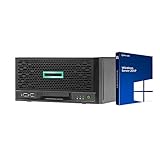
- HP MicroServer Gen10 Plus Tower Server for Business with Microsoft Windows Server 2019 OS!
- Intel Xeon E-2224 Quad-Core 3.4GHz 8MB CPU, Up To 4.6GHz Turbo
- 32GB (2 x 16GB) DDR4 PC4-21300 2666MHz Unbuffered Memory
- 16TB (4 x 4TB) 7.2K 6Gb/s SATA 3.5" HDDs in RAID
- Hard drives and memory upgrades included separately NOT installed, installation required.
For the tested Hostinger KVM 2 configuration, VPSBenchmarks reports grades of B for web performance, D for raw CPU, A for performance stability, B for disk I/O, and E for network performance. The variation between categories is a reason to consider the metric that matters for your workload, not to treat one grade as an overall verdict.
VPSBenchmarks also reports average provisioning times of 137 seconds for Hostinger and 80 seconds for Vultr, based on 12 instance creations per provider. This is a small, publisher-specific sample; it may be relevant if provisioning speed is important, but it does not establish general performance or a guaranteed deployment time.
Rank #4
Check the deployment region you actually need
Location counts differ by source: Hostinger’s October 1, 2026 comparison reports 8 Hostinger and 32 Vultr data centers, while VPSBenchmarks’ page updated September 17, 2026 reports 8 and 31, respectively, spanning 3 and 5 continents. Since the Vultr totals conflict and a total does not tell you whether a suitable instance is available near your users, check the exact region for the plan and services you intend to use.
Independent reader supportYour contribution helps us test, update, and keep practical guides available for everyone.How to make the final choice
- Set resource requirements. Estimate peak RAM, CPU demand, storage, and data transfer for the application rather than choosing by provider starting price.
- Price the full period. For Hostinger, include the two-year introductory term and the stated renewal rate; for Vultr, estimate the expected runtime and account for any storage or additional cloud services.
- Confirm operational needs. Check backup cadence and retention, snapshots, security features, API access, and any management or support requirements against the exact current plan.
- Verify the region. Confirm the instance and any dependent services are available where they need to run.
- Validate performance where it matters. Use benchmarks that match the workload or test with your own representative application, especially for CPU-, network-, or reliability-sensitive systems.
Hostinger is the more straightforward fit when its packaged resources and included features suit the job and the two-year commitment works for your budget. Vultr is the stronger fit when hourly billing or its separately listed cloud components and a specific location are central to the design. If those distinctions do not settle the choice, compare resource-matched plans and total operating cost rather than relying on the entry price or an aggregate benchmark grade.
What’s actually slowing this PC down?
Pick the symptom - the matching free tool is one click away.
Quick Recap
Best Value
Product prices and availability are accurate as of the date/time indicated and are subject to change. Any price and availability information displayed on Amazon at the time of purchase will apply.

