
Windows Errors? Fix Them Before They Spread
Repair common Windows errors and clear accumulated junk for a smoother, more stable PC - no reinstall needed.Free scan · no reinstallCrashes, No Sound, or Screen Glitches?
Random freezes, missing sound and display glitches usually trace back to one bad driver. Find and replace yours safely.Free scan · under a minuteNeither a flat fixed usage rate nor a time-of-use (TOU) plan is automatically better when electricity demand rises. A flat rate keeps the usage price the same throughout the day; TOU prices electricity by preset time bands, so it can reward households that can shift substantial use to cheaper periods—and cost more if essential use remains in peak hours. Compare the full local tariff against your actual usage by time, not just the advertised rate.
What “fixed-rate” and “time-of-use” mean
“Fixed-rate” can refer to a stable per-kilowatt-hour (kWh) usage rate or to a contract price held for a set term. The label alone does not show which bill components can change. A flat or single-rate tariff charges the same usage rate at every hour. A TOU tariff sets different rates for defined periods, commonly a higher peak rate and a lower off-peak rate; some tariffs also have shoulder periods or separate weekend and seasonal schedules. The Australian Government explains the basic structure in its electricity pricing guidance.
TOU is not the same as dynamic or real-time pricing. TOU rates apply to preset windows. Dynamic contracts can change hourly or every 15 minutes with wholesale conditions, exposing customers more directly to price movements. Dynamic pricing may create low-price opportunities, but it is most useful to people who can monitor or automate flexible use. The European Commission and U.S. Department of Energy describe these distinctions in their consumer guidance on electricity contracts and time-variable pricing.
Which plan is better for your household?
| Decision point | Flat fixed usage rate | Time-of-use | What to check |
|---|---|---|---|
| When the usage rate applies | The same rate at all times | Rates vary by defined time band | Peak, shoulder, off-peak, weekend and seasonal schedules |
| Potential benefit from shifting use | No timing-based change to the usage rate | Possible savings if flexible use moves to cheaper periods | Your interval data and realistic daily routines |
| Peak-period exposure | Peak use does not change the per-kWh rate | Peak use may cost more per kWh | How much use must stay in peak hours |
| Predictability | Simpler usage-rate calculation | Bill depends more on when electricity is used | Whether rates and time windows are fixed for the contract term |
| Other bill components | Supply or standing charges still apply | Supply or standing charges still apply; some plans also have demand charges | All charges, not only the usage rate |
| Solar | Export credits and self-consumption still matter | Export timing and variable feed-in rates may matter | Local feed-in terms and battery use |
A TOU plan may suit a household with schedulable loads—such as EV charging, electric hot water or laundry—if the cheaper periods align with when those loads can actually run. A flat rate may suit a household that values a simpler usage calculation or cannot move much consumption out of peak hours. Neither option guarantees a lower total bill: the supply charge, any demand charge, contract term, discounts, exit conditions and solar credits can change the comparison.
Free tools Windows power users keep installed
One-click scans. No signup required.
#1 Best Overall

- Various Monitoring Parameters: The power meter plug can monitor the power (W), energy (kWh), volts, amps, hertz, power factor, cost, minimum and maximum power (W), cumulative days and time of your appliances. By switching 7 display modes, you can easily know the various parameters while the appliance is working. The home energy monitor can also calculate and display how much power your appliance uses and how much electricity bill it cost in cumulative time
- Upgraded LCD Display: With large screen size 2.36 inch x 1.85 inch, clearer monitor backlit, our electrical usage monitor can display the data clearer and more visible no matter day or night. 180°full wide viewing angles is great for reading and recording the data in any angles. No need to stand on the front of the display and bend over to read the numbers
- Adjustable Backlight Time: Our upgraded watt meter has 5 options of backlight time. The default backlight time duration is 10 minutes(bL-0). If you want to change the backlight time, you can press and hold "UP" and "DOWN" button at the same time to enter backlight time setting, then press "UP" and "DOWN" to select the backlight time (bL-0 =10 minutes, bL-1=1 hour, bL-2=4 hours, bL-3=8 hours, bL-4=always on), finally press the "COST" to save the backlight time settings
- Overload protection: When the power of the appliance exceeds the overload power, the LCD will display “OVERLOAD” to warn the user. All the buttons will quit working and can only be workable when you lower or remove the load power. The default overload power is 3680W and is adjustable from 0 to 3680W. In general, you need to set the overload power to 1800W before using. Just press the "function" button for more than 3 seconds to enter the setting
- Data Memory Function: The wattage meter will record your power consumption data when you remove it from socket, or remove appliances from the electricity monitor. You can directly see the last data when you use it next time. This function can also automatically save the data when there is a sudden power failure
What rising electricity demand changes
Electricity costs and availability can vary over time. A TOU tariff makes that difference visible through preset time bands; demand-response programs may separately encourage customers to reduce or move use during periods of system stress. A standard TOU plan does not, by itself, predict future prices or guarantee that a household will save. The U.S. Department of Energy describes both TOU and demand-response programs, which may be voluntary and triggered by reliability concerns or high wholesale prices.
Where and how much you use matters as much as the tariff label. For example, the Australian Energy Regulator’s 2026–27 Default Market Offer comparisons vary by distribution zone and benchmark consumption. The regulator cautions that a benchmark is not a cap on an individual bill; actual costs depend on consumption and retailer rates. Those Australian figures should not be treated as prices for other countries or as a prediction of an individual household’s bill. See the AER Default Market Offer information for the applicable zone and assumptions.
Rank #2

- Multi-function power monitor: Our electric usage monitor can monitor the power (W), electricity(kWh), voltage(V), frequency(Hz), current(A), power factor(PF), unit price($/kWh), total cost($) of your appliances. By switching 8 display modes, you can easily know the various parameters while the appliance is working. The “electricity” mode can calculate and display how much power your appliance uses. And the “total cost” mode will show how much electricity bill it cost in cumulative time
- Overload protection: When the loading power of the appliance is over the default overload threshold 1800W, the whole display with backlight and the word “OVERLOAD” will keep flashing to warn the users. Please turn off the appliance for safety concern
- Premium Material: The whole body of our energy meter is made of high-quality ABS material. It makes our home electricity usage monitor more long lasting, fireproof and anti-drop. The standard US socket and plug is suitable for all US standard appliances
- Backlight Display: With white backlight and black words, the LCD display of our home power monitor can display the data clearer and help you to read the data easier no matter day or night. The backlight will only lights up when the device is connected to AC power. If no button is pressed, the backlight turns off automatically after 10 minutes. You can also press the "UP" button to turn off the backlight manually, and press any button to turn on backlight again
- Easy to reset: No reset tool needed, our appliance power usage meter is easy to reset. You can press the “M” button for 5 seconds directly to reset the device. After reset, all cumulative data (electricity quantity, cost) will be cleared, and all settings will be restored to factory settings
How to compare the plans using your own usage
Use recent bills or interval data to estimate each plan against the same consumption profile. If you expect to shift some usage, model that as a separate, realistic scenario rather than assuming every flexible appliance will move.
Estimated plan cost = daily supply charges + sum of (kWh used in each time band × that band’s rate) + demand charges, if any − applicable credits.
Rank #3
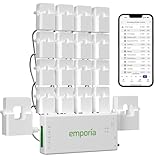
- SAFETY YOU CAN TRUST WITH UL CERTIFICATION: With Emporia Energy, your home energy monitoring is safe, reliable, and certified. The Emporia Vue is UL Listed, meaning it has met rigorous safety standards for electrical products in the U.S. and Canada. This certification ensures that every component has been thoroughly tested to prevent hazards, such as overheating, short-circuiting, or fire, offering you peace of mind as you manage your home’s energy consumption.
- INSTALLS IN CIRCUIT PANEL of most homes with clamp-on sensors. Supports Single phase, Single-split phase, and 2-wire systems. 3-wire systems; 3-phase, 4-wire Wye systems with earthed (TN or TT) neutral (no-Delta) are supported with an additional 200A sensor (sold separately).
- 24/7 ENERGY MANAGEMENT AND MONITORING: Automate, manage and control your home's real power anywhere, anytime to prevent costly repairs, conserve energy, and save costs. Monitor solar / net metering. PROTECTED BY A 1-YEAR WARRANTY.
- LOWER YOUR ELECTRIC BILL: Configure settings in the Emporia Energy App to automate energy management for time of use, peak demand, excess solar, and rewards programs. You can even see live reporting and invaluable savings opportunities instantly. Gauge real-time spending and get actionable notifications and automated energy management to help you reduce costs.
- REAL-TIME ENERGY DATA: REQUIRES 2.4 GHz WIFI WITH AN INTERNET CONNECTION to monitor energy use with iPhone / Android / Web app. Vue sensors collect energy data and are accurate from ±2%. The Vue is UL and CE Listed for your safety. 1 second data is only available in the app (when actively open) and retained 3 hours. Minute and hour data are retained in the cloud. 1 minute data is retained 7 days, 1 hour data is retained indefinitely. Export cloud data whenever you want in the app.
- Get your usage by time. Use interval data if your retailer or meter provides it. Otherwise, start with available bill information, recognizing that a monthly total cannot show exactly how much use fell in peak periods.
- Write down every tariff component. Record the daily supply or standing charge, each applicable usage rate, the time windows, any demand charge, solar feed-in terms and relevant discounts or credits.
- Apply the same usage profile to each offer. Multiply the kWh in each time band by that band’s rate, add fixed and demand charges, then subtract eligible credits.
- Model only feasible shifts. Estimate which loads can move, when they can run and how much electricity they use. Compare this scenario with your current routine.
- Check the contract conditions. Include the contract duration, any rate or window changes, discounts that expire and published exit fees. Compare offers available in your area.
Demand charges are separate from TOU usage rates: they may be based on the highest power draw during a defined interval or period. Check how a particular plan measures demand before estimating that component. Solar households should include both self-consumption and export credits; the plan with the highest export rate is not necessarily the least expensive overall. The Australian Government’s tariff guidance recommends comparing the applicable charges and feed-in terms.
Can people reliably shift electricity use?
Some customers respond to incentives, but shifting is not automatic. In two randomized controlled trials involving more than 43,000 British Gas and ScottishPower customers, Ofgem found that standing-charge rebates modestly reduced peak-time use in one trial; doubling the maximum rebate produced only a small additional reduction. Ofgem identified household commitments and forgetting peak times as barriers. These findings concern those specific rebate interventions, not every TOU tariff. Read Ofgem’s trial summary.
Rank #4

- Various Monitoring Parameters: The power meter plug can monitor the power (W), energy (kWh), volts, amps, hertz, power factor, cost, minimum and maximum power (W), cumulative days and time of your appliances. By switching 7 display modes, you can easily know the various parameters while the appliance is working. The home energy monitor can also calculate and display how much power your appliance uses and how much electricity bill it cost in cumulative time
- Upgraded LCD display: With large screen size 2.36 inch x 1.85 inch, clearer monitor backlit, our electrical usage monitor can display the data clearer and more visible no matter day or night. 180°full wide viewing angles is great for reading and recording the data in any angles. No need to stand on the front of the display and bend over to read the numbers
- Adjustable Backlight Time: Our upgraded watt meter has 5 options of backlight time. The default backlight time duration is 10 minutes(bL-0). If you want to change the backlight time, you can press and hold "UP" and "DOWN" button at the same time to enter backlight time setting, then press "UP" and "DOWN" to select the backlight time (bL-0 =10 minutes, bL-1=1 hour, bL-2=4 hours, bL-3=8 hours, bL-4=always on), finally press the "COST" to save the backlight time settings
- Overload protection: When the power of the appliance exceeds the overload power, the LCD will display “OVERLOAD” to warn the user. All the buttons will quit working and can only be workable when you lower or remove the load power. The default overload power is 3680W and is adjustable from 0 to 3680W. In general, you need to set the overload power to 1800W before using. Just press the "function" button for more than 3 seconds to enter the setting
- Data Memory Function: The wattage meter will record your power consumption data when you remove it from socket, or remove appliances from the electricity monitor. You can directly see the last data when you use it next time. This function can also automatically save the data when there is a sudden power failure
Automation can make a TOU schedule easier to follow when appliances support delayed operation, but the expected savings still depend on the plan’s actual rates and your household’s usage. The UK Department for Energy Security and Net Zero discusses voluntary load shifting, automation and consumer protections in its July 2026 clean flexibility roadmap update.
Independent reader supportYour contribution helps us test, update, and keep practical guides available for everyone.Should you switch to a time-of-use plan?
Consider switching only after comparing the complete local tariff with your usage profile. TOU is more promising when meaningful flexible consumption can run in cheaper windows and the rate difference outweighs any additional peak costs or charges. A flat rate is easier to calculate, but that simplicity does not establish that it is cheaper. If most of your use is unavoidable during peak periods, calculate that exposure before switching; if you have solar, include export and self-consumption terms. The best choice is the plan with the lower expected total cost under a schedule your household can realistically maintain.
Quick Recap
Best Value

- ✓ Backlit LCD Display: The watt meter features an upgraded backlit LCD display with a 160° wide viewing angle, providing clear and distinct data readings from any angle, day or night. (Note: To conserve energy, the backlight will automatically turn off after 15 seconds of continuous use.)
- ✓ 9 Types of Data Display: This energy meter plug accurately monitors a wide range of electrical parameters, including power (W), apparent power (VA), energy consumption (kWh), usage time (hours), power frequency (Hz), power factor (PF), voltage (V), current (A), and electricity cost. The user-friendly interface allows you to easily read and navigate through 9 types of data with a single button.
- ✓ Save Money and Energy: By toggling through the 9 display modes, you can gain insights into various operational parameters of your devices. The home energy monitor also calculates and displays the electricity consumption and cost over time, helping you save on your electricity bills by monitoring and managing energy usage.
- ✓ Data Storage: The plug-in electricity meter stores all non-real-time data, ensuring no information is lost in the event of a sudden power outage. If data exceeds the screen’s maximum display range, the screen will flash as a reminder. Pressing and holding the reset button for 3 seconds will reset the cumulative data to zero.
- ✓ Safe to Use: Rated voltage 125VAC, 60Hz, 15A maximum 1875W resistor and tungsten wire, 1/2HP. Clean and tidy interface, very simple to use.
Product prices and availability are accurate as of the date/time indicated and are subject to change. Any price and availability information displayed on Amazon at the time of purchase will apply.

