
Liquid cooling is not a new response to AI: it was used in mainframe-era computing by roughly the late 1960s or early 1970s. What is new is the scale and breadth of its deployment in modern data centers, where rising chip and rack heat densities are putting air cooling under pressure. The shift is an expansion of an established engineering approach, not a simple replacement of air cooling or a single technology taking over.
What does liquid cooling mean in a data center?
Liquid cooling moves heat away from IT equipment through a circulating liquid rather than relying only on room air to carry heat from components to the facility cooling system. “Water cooling” is often used as shorthand, but the term liquid cooling covers different designs and points of heat transfer. The liquid may collect heat at the rack, circulate through equipment, or reach cooling hardware at the electronics themselves.
A facility may use a cooling distribution unit (CDU) to transfer heat between the technology cooling system serving IT equipment and facility water. That interface matters: liquid at a server or rack does not, by itself, describe how heat ultimately leaves the building.
Why is liquid cooling attracting renewed attention?
Modern electronics are concentrating more heat into equipment and smaller areas. ASHRAE’s 2023 handbook chapter on data centers and telecommunication facilities describes increasing heat density as making it harder for air to cool electronics. Liquid can move waste heat into facility loops and reduce the amount of air that must flow through a rack, but the right design still depends on equipment compatibility, facility infrastructure, and the way heat is rejected.
#1 Best Overall

- CONTACT FRAME FOR INTEL LGA1851 | LGA1700: Optimized contact pressure distribution for longer CPU life and better heat dissipation
- ARCTIC's P12 PRO FAN: More power at any speed - more powerful and quieter than the P12, especially at low speeds. Higher maximum speed for optimal cooling performance under high load
- NATIVE OFFSET MOUNTING FOR INTEL AND AMD: Shifting the cold plate center towards the CPU hotspot ensures more efficient heat transfer
- INTEGRATED VRM FAN: PWM-controlled fan that lowers the temperature of the voltage converters and thus ensures reliable performance
- INTEGRATED CABLE MANAGEMENT: The PWM cables of the radiator fans are integrated in the sheathing of the hoses so that only a single visible cable is connected to the motherboard
AI workloads are an important driver of the current scale-up, but liquid cooling is not required for every data center or every device. Air and liquid systems can coexist; the decision depends on heat density and what the installed equipment and facility can support.
How the main liquid-cooling approaches differ
ASHRAE distinguishes cooling at the rack, at the datacom equipment, and at the electronics. These approaches differ mainly in where liquid enters the heat-transfer chain.
Rank #2

- CONTACT FRAME FOR INTEL LGA1851 | LGA1700: Optimized contact pressure distribution for longer CPU life and better heat dissipation
- ARCTIC's P12 PRO FAN: More power at any speed - more powerful and quieter than the P12, especially at low speeds. Higher maximum speed for optimal cooling performance under high load
- NATIVE OFFSET MOUNTING FOR INTEL AND AMD: Shifting the cold plate center towards the CPU hotspot ensures more efficient heat transfer
- INTEGRATED VRM FAN: PWM-controlled fan that lowers the temperature of the voltage converters and thus ensures reliable performance
- INTEGRATED CABLE MANAGEMENT: The PWM cables of the radiator fans are integrated in the sheathing of the hoses so that only a single visible cable is connected to the motherboard
| Approach | Where heat is collected | What the distinction means |
|---|---|---|
| Liquid-cooled rack | At rack or cabinet level | A heat exchanger transfers heat from air to liquid at the rack or cabinet. The equipment may still use air internally to move heat to that exchanger. |
| Liquid-cooled datacom equipment | Within the equipment | Liquid circulates within the IT equipment to carry heat away. |
| Liquid-cooled electronics | At the electronics | Liquid is delivered to the electronics without another heat-transfer mechanism between the electronics and the liquid. |
These categories are not interchangeable labels for one universal system. A useful design comparison asks where liquid is introduced, how heat passes from the technology loop to facility heat rejection, how much heat the equipment produces, and what airflow remains necessary.
What does “fifty years” mean in this history?
The half-century framing describes an established approach returning at greater scale; it should not be read as a precise, continuous adoption timeline. In ASHRAE Journal Podcast Episode 44, David Quirk said, “liquid cooling is really nothing new. It’s been in the industry, going back to the mainframe days, but what is new is the scale that it’s now being deployed in the industry, and largely driven by artificial intelligence software applications.” In the same episode, Dustin Demetriou described the technology as having been around “since the-probably late-1960s, early-1970s with mainframe computers.”
Rank #3
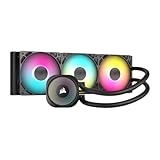
- Simple, High-Performance All-in-One CPU Cooling: Renowned CORSAIR engineering delivers strong, low-noise cooling that helps your CPU reach its full potential
- Efficient, Low-Noise Pump: Keeps your coolant circulating at a high flow rate while generating a whisper-quiet 20 dBA
- Convex Cold Plate with Pre-Applied Thermal Paste: The slightly convex shape ensures maximum contact with your CPU’s integrated heat spreader, with thermal paste applied in an optimised pattern to speed up installation
- RS120 ARGB Fans: RS ARGB fans create strong airflow and high static pressure, with easy ARGB control via a compatible motherboard. CORSAIR AirGuide technology and Magnetic Dome bearings ensure great cooling performance and low noise
- Easy Daisy-Chained Connections: Reduce the wiring in your system by daisy-chaining your RS ARGB fans and connecting them to just one 4-pin PWM fan header and one +5V ARGB header
Those remarks support a broad account of mainframe-era use and present-day expansion, not a year-by-year history. The available sources do not establish a complete chronology, adoption rate, or market share across the intervening decades. ASHRAE’s 2021 white paper connects rising IT power and lower package case-temperature requirements with future liquid-cooling needs, and recommends designing future data centers so that liquid cooling can be added. That is a recommendation in a white paper, not a binding standard.
Does liquid cooling improve efficiency or reduce water use?
Neither result is guaranteed by the presence of liquid. The U.S. Department of Energy’s Federal Energy Management Program (FEMP) describes direct liquid cooling as transferring heat from IT equipment directly to a recirculating chilled-water loop instead of first transferring it to room air. FEMP says some direct liquid-cooling systems show promise for reducing power usage effectiveness (PUE) and water usage effectiveness (WUE), but also notes that added control loops and a detailed operations-and-maintenance plan are important.
Rank #4

- CONTACT FRAME FOR INTEL LGA1851 | LGA1700: Optimized contact pressure distribution for longer CPU life and better heat dissipation
- ARCTIC's P12 PRO FAN: More power at any speed - more powerful and quieter than the P12, especially at low speeds. Higher maximum speed for optimal cooling performance under high load
- NATIVE OFFSET MOUNTING FOR INTEL AND AMD: Shifting the cold plate center towards the CPU hotspot ensures more efficient heat transfer
- INTEGRATED VRM FAN: PWM-controlled fan that lowers the temperature of the voltage converters and thus ensures reliable performance
- INTEGRATED CABLE MANAGEMENT: The PWM cables of the radiator fans are integrated in the sheathing of the hoses so that only a single visible cable is connected to the motherboard
Water use depends on the complete facility, including its heat-rejection method, climate, controls, and operating practices. A recirculating loop describes how heat is carried from equipment; it does not, by itself, establish how much water the facility consumes overall. Nor does a lower PUE automatically prove lower water use: PUE and WUE describe different aspects of performance.
FEMP reported a case example for the National Laboratory of the Rockies data center with a PUE of 1.06 and WUE of 0.7 in its January 9, 2019 guidance. Those figures describe that specific facility example, not a typical result or a guarantee for liquid-cooled data centers generally.
What’s actually slowing this PC down?
Pick the symptom - the matching free tool is one click away.
Best Value
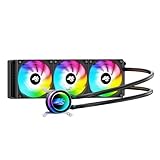
- High-Speed Ceramic Bearing Pump: Our 360mm AIO is equipped with a premium ceramic bearing water pump running at 3000 RPM, ensuring ultra-long lifespan and stable operation, offering higher lift and faster flow for maximum cooling efficiency. Our CPU cooler delivers reliable performance even under heavy workloads, keeping your system cool and stable.
- Industrial-Grade Motor for Elite Cooling: Our AIO cooler 360mm is powered by an advanced 3-phase, 4-pole motor that minimizes vibration and noise for ultra-smooth, silent operation. Our cpu water cooler accelerates heat transfer and boosts coolant flow to maximize thermal performance, ensuring greater efficiency and long-term reliability.
- Smart PWM Fan Control for Quiet Efficiency: Our water cooler CPU is equipped with PWM-controlled fans that automatically adjust their speed based on your system’s temperature, delivering optimal airflow only when needed. Running at up to 1600 RPM, these fans offer a perfect balance of high airflow and low noise, making our cpu liquid cooler ideal for gamers, creators, and power users alike.
- Exclusive 12-Channel Radiator for Superior Heat Dissipation: Our CPU liquid cooler features a 12-path water-cooled radiator with a low-resistance hydraulic design and optimized fin density, maximizing surface contact for faster heat transfer and enhanced cooling performance.
- Daisy-Chained Fans for Cleaner, Simpler Cable Management: Our 360mm aio cooler comes with pre-installed 120mm fans featuring a daisy-chain design, allowing all fans to connect through a single 4-pin PWM and 5V ARGB header—dramatically reducing cable clutter and simplifying installation.
What are ASHRAE’s liquid-cooling water classes?
ASHRAE’s 2021 white paper lists W17, W27, W32, W40, W45, and W+ as liquid-cooling water classes. In that guidance, the number indicates the class’s upper temperature limit; all listed classes share a lower limit of 2°C (35.6°F), and W+ means beyond W45.
These classes are design guidance, not a universal rating of a cooling product or a promise that every system can use every class. Temperature capability must be considered with the equipment and facility design. Because ASHRAE guidance can be updated, facilities making a current design decision should check the latest applicable ASHRAE reference rather than relying on the 2021 list alone.
What should a facility compare before choosing a cooling design?
- Point of liquid introduction: Determine whether the design cools at rack level, within equipment, or directly at electronics.
- Heat-transfer path: Map how heat moves from IT equipment through the technology loop and any CDU to facility water and final heat rejection.
- Heat density and airflow: Compare the equipment’s heat load with available rack airflow; liquid may reduce airflow needs without eliminating air cooling everywhere.
- Energy and water performance: Evaluate PUE and WUE for the specific facility, climate, heat-rejection method, controls, and operating plan rather than assuming liquid cooling is inherently more efficient or uses less water.
- Reliability and maintenance: Account for control loops, operational procedures, maintenance capability, and compatibility with installed equipment.
ASHRAE’s 2023 handbook discusses Standard 90.4 as a data-center efficiency standard developed to balance efficiency with reliability. Applicable requirements depend on the project and current standards material; this overview is not compliance advice.
Quick Recap
Product prices and availability are accurate as of the date/time indicated and are subject to change. Any price and availability information displayed on Amazon at the time of purchase will apply.
Free tools Windows power users keep installed
One-click scans. No signup required.

