
iTechGuides is reader-supported. When you buy through links on our site, we may earn an affiliate commission. As an Amazon Associate I earn from qualifying purchases. Learn more
Everything you need to know about lithium ion batteries for motorcycles starts with one distinction: most motorcycle starter batteries marketed as lithium-ion are 12.8–13.2-volt lithium iron phosphate (LiFePO4) batteries. They can save substantial weight and deliver strong cranking power, but only when fitment, charging voltage, charger type, temperature, and storage are compatible.
A LiFePO4 battery can be an excellent replacement for an AGM battery on a well-maintained sport, adventure, dirt, cruiser, or race motorcycle. It is not an automatic upgrade for every bike. A conventional AGM battery may be the better choice when the motorcycle has an uncertain charging system, substantial parasitic drain, prolonged unattended storage, frequent freezing-weather use, or an owner who does not want lithium-specific charging and storage rules.
Key takeaways
- Most lithium motorcycle starter batteries use LiFePO4 chemistry, not lithium-polymer or an unspecified consumer-electronics lithium-ion pack.
- Exact case dimensions, terminal polarity, terminal position, CCA, actual amp-hours, and charging-system voltage matter more than a battery’s advertised lead-acid-equivalent capacity.
- Use a charger explicitly designed for 12.8–13.2-volt LiFePO4 starter batteries, and avoid uncontrollable desulfation, repair, recondition, equalization, or recovery modes.
- Shorai specifies at least 13.1 volts at idle and no more than 15.2 volts at maximum charging output for its batteries; those limits are Shorai-specific, not universal.
- LiFePO4 batteries can perform poorly when cold and should not be charged below 32°F/0°C under Shorai’s published guidance.
- AGM remains the lower-complexity choice for many commuters, touring riders, cold-climate owners, and motorcycles that may be neglected during storage.
What kind of lithium ion battery is used in motorcycles?
Most motorcycle starter batteries described as lithium-ion are lithium iron phosphate batteries, abbreviated LiFePO4 or LFP. LiFePO4 is one rechargeable lithium-ion chemistry, while lithium-ion is the broader family name. Lithium-polymer, or LiPo, batteries are a different category and should not automatically be treated as interchangeable with a LiFePO4 motorcycle starter battery.
The Tool Desk
Outbyte PC Repair FREERepair Windows errors before they cause bigger problemsFix Now →Outbyte Driver Updater FREEScan for outdated or missing drivers - takes under a minuteDriver Scan →A motorcycle starter battery is a relatively low-voltage pack designed to supply high current to a starter motor. A typical LiFePO4 powersports battery is described as a 12.8-volt or 13.2-volt battery, depending on the manufacturer and the way the nominal voltage is stated. Shorai identifies its powersports batteries as LiFePO4 products, and Antigravity’s manual specifies chargers designed for 12.8-volt LiFePO4 starter batteries.
Popular on Amazon
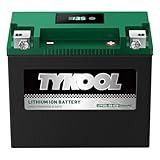
- SUPERIOR CRANKING PERFORMANCE: Engineered with a robust 480CCA to provide rapid cold starts for large V-Twin engines. At just 3.3 lbs (1.50 kg), it is 75% lighter than the 14lb lead-acid YTX20L-BS, significantly lowering your motorcycle's center of gravity for improved flickability, easier cornering, and reduced suspension component wear.
- PRECISE PHYSICAL SPECS & FITMENT: Dimensions: 6.89x3.43x6.10in (175x87x155mm). Direct drop-in replacement for YTX20L-BS, 65989-97C,GYZ20HL,GYZ20L and ETX20L. Polarity: [- +]. Features vibration-isolated terminals and a rugged casing designed to withstand the heavy mechanical thumping and engine heat of high-performance American cruisers.
- INTELLIGENT BMS & DIGITAL MONITORING: Integrated Battery Management System features an onboard Digital Readout LCD screen. Access real-time voltage telemetry and State-of-Charge (SOC) with a single touch. The BMS actively manages cell balancing while protecting against over-charge and deep discharge, ensuring a stable 2500+ cycle life.
- HARLEY CRUISER APPLICATIONS: Specifically optimized for Harley-Davidson models including Softail, Fat Boy, V-Rod, Heritage Softail Classic, and Night Train. The ultra-low self-discharge rate (<1% per month) ensures your bike remains road-ready even after several months of unattended winter storage, outlasting traditional AGM batteries.
- IP66 WATERPROOF & RUGGED DURABILITY: Fully sealed, shock-proof housing with an IP66 rating provides total protection against torrential rain and road debris. Essential for long-distance touring on models like the Road King and Deluxe, ensuring your electrical heart remains bone-dry and functional in all-weather environments and high-vibration conditions.
Many lithium starter batteries include a battery-management system, or BMS. A BMS may provide some combination of cell balancing, overcharge protection, over-discharge protection, short-circuit protection, temperature protection, and a restart or wake-up function. BMS designs differ between manufacturers, product families, and generations. A BMS is useful protection, but it does not make an incompatible charger, an overvoltage regulator/rectifier, physical damage, or severe cold harmless. Shorai’s FAQ and Antigravity’s starter-battery brochure illustrate why the exact model’s features must be checked.
Is a lithium motorcycle battery better than an AGM battery?
A lithium motorcycle battery is better than AGM when weight, cranking output relative to mass, and performance-oriented packaging matter more than simplicity, cold-weather tolerance, and low purchase cost. AGM is better when the motorcycle needs a forgiving, widely available battery that can tolerate less attentive ownership.
| Factor | LiFePO4 starter battery | AGM battery |
|---|---|---|
| Weight | Usually much lighter; some manufacturers advertise reductions of up to 70% versus lead-acid. | Heavier, but the weight is rarely a fitment problem. |
| Cranking output | High cranking output relative to battery mass. | Strong starting performance when correctly sized and charged. |
| Actual capacity | Can be substantially lower than the advertised Pb-equivalent amp-hour figure. | Capacity ratings are generally easier to compare within the lead-acid category. |
| Cold weather | Initial cranking performance can be reduced; charging below freezing may be prohibited. | Also loses performance in cold weather, but is generally less complicated to manage. |
| Charging | Requires a compatible LiFePO4 charging profile and a healthy regulator/rectifier. | Uses established lead-acid charging procedures. |
| Storage | Low self-discharge helps, but vehicle parasitic drain can still discharge the battery; indefinite tender use is not universally required. | Often easier for owners who use conventional maintainers and established storage routines. |
| Price | Usually costs more, especially when BMS or restart functions are included. | Often costs less and is easier to replace locally. |
| Best use | Weight-conscious sport, race, dirt, dual-sport, and performance builds. | Commuters, touring motorcycles, cold climates, and low-maintenance ownership. |
Lithium batteries offer clear benefits. A lighter battery can improve weight distribution, particularly on a sport, dirt, or race motorcycle. Lithium batteries also avoid liquid-acid spills and are commonly designed to resist vibration. Antigravity advertises up to a 70% weight reduction over lead-acid for its RE-START powersports batteries, while Shorai fitment listings provide model-specific weights and comparisons with equivalent lead-acid batteries.
Do these 3 things before closing this tab:
1Scan for outdated or missing drivers - takes under a minute2Clear out junk files and repair common Windows errors3Fix the driver behind crashes, sound loss and screen glitchesAGM batteries remain attractive because they are generally cheaper, easier to source, more tolerant of ordinary storage mistakes, and simpler to charge. Yuasa advises checking the application guide and charging-system compatibility before changing battery technology. That advice is important: a battery being labeled “12 volt” does not prove that a motorcycle’s charging system is suitable for a lithium replacement.
When should you choose lithium, and when should you choose AGM?
Choose LiFePO4 when the motorcycle is correctly listed in the manufacturer’s fitment database, the charging system has been tested, and the owner will follow the battery’s charger and temperature requirements.
- Choose lithium for: performance motorcycles, race bikes, lightweight builds, riders who value weight reduction, frequently used motorcycles, and owners willing to monitor the battery.
- Choose AGM for: daily commuters, touring motorcycles, cold-climate use, motorcycles with uncertain electrical systems, bikes with significant accessory loads, long unattended storage, and buyers prioritizing availability and simplicity.
- Think carefully before choosing lithium for: a motorcycle with an alarm, immobilizer, GPS tracker, keyless-entry module, USB adapter, or other accessory that may create continuous parasitic drain.
A lithium battery’s lower self-discharge does not cancel the motorcycle’s own electrical drain. A small battery can be discharged during storage by an alarm, tracker, heated-gear controller, faulty relay, or incorrectly wired lighting circuit.
How do you choose the correct lithium motorcycle battery?
Choose the battery by exact motorcycle fitment first, then compare electrical specifications and features. Do not choose solely by weight, advertised CCA, or a “same size” claim.
- Record the motorcycle’s make, model, engine, and model year.
- Find the OEM battery number in the motorcycle service manual or a reputable application guide.
- Confirm the replacement battery’s case designation and dimensions: length, width, and height.
- Check terminal polarity, terminal position, bolt arrangement, and terminal type.
- Confirm the required CCA and select a manufacturer-approved higher-output version when the engine, compression ratio, climate, or accessories justify it.
- Check whether the battery must be installed upright and whether supplied foam spacers are required.
- Verify the motorcycle’s charging voltage against the lithium battery manufacturer’s limits.
- Check actual amp-hours, warranty terms, BMS functions, low-temperature protection, and charger requirements.
Yuasa’s battery selection guide recommends checking the application rather than changing battery types by assumption. Individual Shorai fitment pages show why the details matter: listings can include case type, dimensions, polarity, voltage, amp-hours, and cranking output.
Why are CCA and actual amp-hours more useful than marketing amp-hours?
CCA describes starting-current capability under a specified test method and temperature, while amp-hours describe capacity. Watt-hours estimate stored energy using volts multiplied by amp-hours. Neither CCA nor Ah alone tells the whole story, but CCA is usually the more relevant number when comparing batteries for starting a motorcycle.
Be especially careful with “Pb Eq,” “lead-acid equivalent,” or similar labels. A lead-acid-equivalent figure may be a comparison or marketing value rather than the battery’s actual stored capacity. Antigravity’s official specification sheet lists the ATZ10-RS at 12 Ah Pb-equivalent but 6.1 Ah actual capacity, along with 360 CA and 78 Wh. Those figures are not interchangeable: a battery labeled 12 Ah Pb-equivalent does not necessarily contain 12 Ah of actual capacity.
| Specification | What it tells you | What it does not tell you |
|---|---|---|
| CCA or CA | Starting-current capability under the manufacturer’s stated test conditions. | How long the battery can power accessories with the engine off. |
| Actual Ah | Approximate rated capacity of the battery. | Guaranteed usable capacity in every temperature and discharge condition. |
| Pb-equivalent Ah | A manufacturer’s comparison with a lead-acid battery. | The battery’s actual stored capacity. |
| Wh | Approximate energy rating; voltage multiplied by amp-hours. | Starting performance by itself. |
| Weight | Potential weight-saving benefit. | Physical or electrical compatibility. |
Do not oversize blindly. A higher-CCA battery may not fit, may place terminals in the wrong location, may cost more without a useful benefit, or may encourage the buyer to ignore the manufacturer’s application list. High-compression engines, large twins, modified engines, and heavily accessorized motorcycles should use the manufacturer’s specified high-output option where one exists.
How do you check motorcycle charging-system compatibility?
Measure the motorcycle’s charging system before installing a lithium battery. The alternator, stator, and regulator/rectifier must keep voltage within the battery manufacturer’s specified range.
- Charge the battery with the correct charger.
- Let the battery rest, then measure voltage directly at the battery terminals with a digital multimeter.
- Start the motorcycle and measure voltage at idle.
- Raise engine speed to approximately 3,000–5,000 rpm.
- Watch whether voltage rises appropriately and remains stable within the battery manufacturer’s limit.
- Stop testing and repair the system if voltage is excessive, unstable, or continues climbing abnormally.
For a specific Shorai application, the manufacturer specifies at least 13.1 volts at idle and no more than 15.2 volts at maximum charging output. Shorai’s fitment guidance makes clear that those are Shorai requirements for its batteries, not universal limits for every LiFePO4 brand. Always use the limit printed in the battery’s manual.
Repair these faults before installing a new battery:
- Failed or incorrectly wired regulator/rectifier.
- Stator or charging-wiring damage.
- Loose, dirty, or corroded terminals.
- High-resistance ground connections.
- Excessive parasitic draw.
- Reverse-polarity wiring.
- Accessory circuits with inadequate grounding or incorrect fusing.
- Aftermarket modifications that cause overvoltage.
What charger is safe for a lithium motorcycle battery?
Use a charger explicitly approved for 12.8-volt or 12.8–13.2-volt LiFePO4 motorcycle starter batteries. The phrase “lithium-ion charger” alone is not specific enough because chargers for other lithium chemistries or cell counts may use the wrong voltage and charging profile.
Also popular on Amazon

- 🔋【Motorcycle Battery Specifications】YTX4L-BS is a 12.8V 2.5Ah 32WH,MAX CCA 250A motorcycle battery.Dimensions: 4.45"*2.76"*3.35". It weighs only 0.99 pounds, 1/3 the weight of a lead-acid agm battery, and has an energy density 3-5 times greater. Operating temperatures range from -20℃-85℃. Right Is Positive, And Left Is Negative.
- 🔋【Upgrade to Lithium Battery】A perfect replacement for lead-acid batteries. You will have 2X cranking amps to start the vehicles more fast; 1/3 light of a lead acid battery. longer life to save the battery cost (2000 discharge cycles instead of 300 cycles with lead acid battery)
- 🔋【Safe Intelligent Design】Our 12 volt lithium motorcycle battery features a built-in BMS that safeguards against overcharging, over discharging, short circuiting, and overheating. The BMS automatically cuts off the circuit when it detects these hazards to protect the battery from long-term damage and extend battery life. The YTX4L-BS charger uses a 14.6V DC lithium battery charger, with a recommended charging speed of 14.6V 1A.
- 🔋【Wide Compatibility】This 12V 3ah motorcycle battery can replace the following motorcycle lithium battery models: YTX4L-BS, It can also suitable for atvs, utvs, pwcs, quads, 4 wheelers, jet skis, waverunners, scooters, generators, snowmobile and more.(As long as the installation space matches, the starting power, positive and negative poles correspond, all can be compatible with this battery)
- 🔋【Two Years Warranty】If you have any questions or concerns regarding the product, please contact us directly. Within two years from the date of purchase, if the product has defects not caused by human error, we will make it right for you. We provide 24/7 customer support.
Shorai’s charging guidance and Antigravity’s powersports manual both direct owners toward chargers designed specifically for LiFePO4 starter batteries. Battery Tender likewise says that lithium-capable chargers use a separate LiFePO4 profile.
Do not use a charger with an unavoidable:
- Desulfation or pulse-desulfation mode.
- Repair, recondition, or recovery cycle.
- Equalization mode.
- High-voltage boost or engine-start mode.
- Automatic program that cannot be switched to the correct LiFePO4 profile.
- LiPo hobby-pack charging profile.
Shorai warns against chargers with uncontrollable desulfation or similar modes. Shorai also notes that some lead-acid chargers may be acceptable in limited circumstances if those modes are absent, but that exception is not a universal rule. Because charger behavior varies, follow the battery maker’s instructions rather than assuming that every “automatic” tender is safe.
What happens when a smart charger will not recognize the battery?
A smart charger may refuse to start when a lithium battery’s voltage is extremely low because the charger interprets the battery as disconnected or defective. Shorai notes that a Battery Tender-style smart charger may fail to begin charging when voltage is near zero.
Do not repeatedly force-charge a battery whose condition is unknown. Check the battery manual for a BMS wake-up or recovery procedure. Use only a manufacturer-approved recovery method when the BMS has isolated the cells. Replace or obtain professional manufacturer support for a battery that is swollen, physically damaged, unusually hot, leaking, or repeatedly entering protection.
Outdated Drivers Are Slowing You Down
One free scan finds every outdated or missing driver and matches the right update for your exact hardware.Free scan · exact hardware matchPC Slower Than It Used to Be?
A free scan shows the junk files, broken settings and background clutter dragging Windows down - then fixes them in one click.Free scan · Windows 10 & 11How does cold weather affect LiFePO4 motorcycle batteries?
Cold weather can reduce the initial cranking performance of a LiFePO4 battery, although a short electrical load may warm the cells enough to improve starting in moderate cold. Cold-weather discharge and below-freezing charging are separate issues: a battery may be used in cold conditions, but charging a cold battery can be prohibited.
Battery Tender describes applying the motorcycle’s headlight or another suitable electrical load for approximately 30–60 seconds before attempting to start. The technique is a manufacturer recommendation, not a guaranteed procedure for every motorcycle or BMS design.
- Turn on the ignition or a suitable electrical load.
- Allow the battery to power the load briefly, following the battery maker’s recommended time.
- Turn the load off or attempt to start the motorcycle.
- Stop if cranking becomes slow rather than repeatedly draining the battery.
Do not charge a frozen or below-freezing LiFePO4 battery unless the manufacturer explicitly allows it. Shorai’s safety guidance says not to charge its batteries below 32°F/0°C. Store the motorcycle or battery in accordance with the product manual, and do not assume that warming a battery for starting makes below-freezing charging safe.
How do you install a lithium motorcycle battery?
Use the motorcycle service manual as the primary authority, but the general installation sequence is negative cable off first and positive cable on first.
- Switch off the ignition and remove the key.
- Photograph the existing battery, cable routing, and terminal positions.
- Disconnect the negative terminal first, then disconnect the positive terminal.
- Remove the old battery and inspect the tray, hold-down, cables, terminals, and ground connection.
- Confirm the lithium battery’s polarity, orientation, case dimensions, and terminal positions.
- Install the supplied foam spacers if the replacement battery is smaller than the original case.
- Make sure the battery cannot move inside the tray.
- Connect the positive cable first, then the negative cable.
- Tighten the terminals to the battery manufacturer’s specified torque.
- Route the cables so they cannot chafe against the case or become pinched under the seat.
- Secure the hold-down and check that no conductive object can bridge the terminals.
- Measure resting voltage and charging-system output after installation.
Yuasa’s motorcycle battery material also specifies disconnecting the negative terminal first. A smaller lithium battery that fits the tray can still be unsafe if spacers are omitted, the hold-down is loose, or the terminal orientation forces the cables into a strained position. Reversed polarity can damage the battery, motorcycle electronics, or both.
How should you store and maintain a lithium motorcycle battery?
Follow the battery maker’s storage instructions, eliminate vehicle parasitic drain, and do not automatically leave every lithium battery connected to a tender for the entire winter.
- Charge the battery to the manufacturer’s recommended storage condition.
- Disconnect the negative cable or remove the battery when the motorcycle has meaningful standby drain.
- Store the battery in a cool, dry place protected from accidental short circuits.
- Keep conductive tools and loose metal objects away from the terminals.
- Inspect the battery periodically during long storage.
- Do not store a swollen, hot, leaking, punctured, or physically damaged battery indoors.
Yuasa recommends disconnecting a battery during long storage to eliminate vehicle drain and advises fully charging before storage. Shorai says its modern BMS-equipped batteries generally do not need to remain connected to a tender indefinitely, although charging must still follow the product’s temperature and charger requirements.
Measure parasitic draw if the motorcycle contains an alarm, immobilizer, keyless ignition, GPS tracker, USB adapter, heated-gear controller, aftermarket lighting controller, or other accessory. Frequent short trips can also leave a battery undercharged because starting consumes energy that low-speed riding may not replace.
What’s actually slowing this PC down?
Pick the symptom - the matching free tool is one click away.
How do you test a failing or discharged lithium battery?
Diagnose the terminals, battery voltage, voltage sag, charging system, and parasitic draw before declaring the battery defective.
- Inspect the positive terminal, negative terminal, engine ground, and chassis ground for looseness or corrosion.
- Measure resting voltage with a digital multimeter.
- Attempt a start while observing voltage behavior and listening for a click or slow starter.
- Test charging voltage at idle and at approximately 3,000–5,000 rpm.
- Measure parasitic draw with the motorcycle switched off and secured according to the service manual.
- Check the manufacturer’s BMS wake-up or restart procedure.
- Use a load tester only when the battery maker permits it and the tester is suitable for lithium starter batteries.
Common symptoms include a clicking starter relay, slow cranking, instrument-cluster resets, ABS or traction-control warnings during startup, voltage collapse under load, a charger that refuses to begin, BMS protection, or a motorcycle that starts with assistance but fails again after shutdown.
Voltage alone is an imperfect state-of-charge indicator for LiFePO4 batteries because the discharge curve is relatively flat. Do not use a universal “good lithium battery voltage” chart without accounting for the exact model, temperature, state of charge, and whether the BMS is active.
Also popular on Amazon

- Product Dimensions: (L) 5.91 inch x (W) 3.43 inch x (H) 3.66 inch, Item Weight: 3.2 Pounds, CCA: 480A. PRE-CHARGED & READY TO GO: This battery features a power display and pure copper terminals to support high current discharge and better conductivity. NO NEED for a CHARGER to start up the vehicle. Note: The orange light indicates a full charge.
- ADJUSTABLE SPACERS & THREADED TERMINALS: Features 2 threaded-lug posts, so no nuts are needed during installation. Comes with 5 adjustable universal-fit EVA spacers to ensure broad compatibility, perfectly fitting YTX14-BS, YTX9-BS, YTX12-BS, YT12A-B2, YTZ10S-BS, YTZ12S-BS, YTZ14-BS, YTX16-BS, YTX14S, and YTZ10S models.
- LONG-LASTING LITHIUM LiFePO₄ BATTERY: A perfect replacement for lead-acid batteries – 3x lighter, 2x more powerful, 8–10x longer service life, and 5x faster charging. Compared to common lithium batteries, this tractor battery offers 4x longer cycle life, reaching 3000 cycles with full depth of discharge (DOD). No need to worry about draining it.
- EASY INSTALLATION & SMART BMS: The package includes 1 battery, 2 screws, 5 EVA spacers, and 1 user manual. Features 3 installation methods to ensure a quick and easy setup. Thanks to the built-in BMS, the battery will cut out instantly if the temperature falls below -2°F for 6 hours or rises above 172°F.
- UNIVERSAL MOUNTING: The 12 v motorcycle battery is also ideal as four wheeler battery, electric scooter battery, riding lawn mower battery, tractor battery, trailer battery, atv battery, jet ski battery, quad battery, kayak battery, go kart battery, UTV battery, snowmobile battery and PWC battery. The powersports battery is compatible with most brands
Can you jump-start a lithium motorcycle battery?
Use the battery manufacturer’s jump-start instructions, and do not treat a LiFePO4 battery exactly like an AGM battery in every emergency.
Recommended Free Tools
Normal jump-starting
Use an approved motorcycle jump procedure and a suitable donor source. Avoid using a running automobile as the donor unless the battery manufacturer explicitly permits it; a car’s charging system can expose the motorcycle to damaging current or voltage conditions.
Deep discharge
Do not assume that a generic jump pack can safely recover a deeply discharged lithium battery. Shorai specifically warns against lithium jump packs or boost packs for starting or unlocking a deeply discharged battery because of possible BMS or cell damage.
Internal failure
Stop attempting recovery if the battery is swollen, hot, damaged, leaking, smells abnormal, or repeatedly trips its BMS. Replace the battery or contact the manufacturer’s support and warranty service.
Are lithium motorcycle batteries safe?
LiFePO4 is a comparatively stable lithium chemistry, but a LiFePO4 motorcycle battery can still deliver dangerous short-circuit current, overheat, vent, or fail when abused. The principal motorcycle risks are overcharging, incorrect polarity, short circuits, physical damage, charging below freezing, and a defective charging system.
Quick wins for a faster PC:
Scan for outdated or missing drivers - takes under a minuteDriver Scan →Clear out junk files and repair common Windows errorsFree Scan →- Never puncture, crush, open, modify, or disassemble the battery.
- Never use a visibly swollen, cracked, leaking, hot, or damaged battery.
- Keep sparks and flames away from battery and charging areas.
- Do not place tools or other conductive objects across the terminals.
- Protect accessory circuits with correctly rated fuses.
- Repair an overvoltage charging system before installing a replacement battery.
- Follow the manufacturer’s disposal and warranty instructions.
LiFePO4 should not be confused with the more energy-dense lithium chemistries used in some consumer electronics or electric-vehicle traction packs. That distinction does not make a motorcycle starter battery risk-free. Shorai’s safety precautions cover charger selection, temperature limits, jump-starting, and prohibited charging modes.
Which battery type suits each kind of rider?
| Rider or motorcycle | Most sensible starting point | Reason |
|---|---|---|
| Budget commuter | AGM | Lower cost, broad availability, and fewer lithium-specific rules. |
| Sport-bike owner | LiFePO4 if fitment and charging are verified | Weight reduction and high cranking output can be worthwhile. |
| Adventure rider | Either; compare actual capacity, CCA, support, and accessory load | Long trips and accessories may favor capacity and easy replacement over minimum weight. |
| Touring rider | Usually AGM, unless a well-supported lithium model is clearly suitable | Touring bikes may carry accessories and need predictable availability. |
| Race-bike owner | LiFePO4 | Weight savings are valuable, and external starting support may be available. |
| Cold-climate rider | Usually AGM | LiFePO4 requires more careful cold-weather starting and charging management. |
| Seasonal-storage owner | AGM for simplicity, or lithium with disciplined storage | Either chemistry can fail if parasitic drain and storage conditions are ignored. |
Race-bike owners may accept a battery without a restart function when external jump-start support is always available. Other riders may prefer an RE-START-style design when the additional cost is justified by the intended use. Antigravity distinguishes RE-START products with built-in restart capability from other starter-battery models, so compare the exact model rather than assuming all products in a range have identical protection.
What should you compare before buying?
Compare the following specifications in the manufacturer’s current product and fitment information:
- Exact OEM-equivalent case and dimensions.
- Terminal orientation and mounting arrangement.
- CCA and the stated test standard.
- Actual Ah, separately from Pb-equivalent Ah.
- Weight.
- BMS presence and specific functions.
- Low-temperature charging protection.
- Restart or wake-up capability.
- Maximum charging-system voltage.
- Charger requirements and prohibited modes.
- Warranty duration, exclusions, and support arrangements.
- Included spacers, leads, or terminal hardware.
- Regional replacement availability.
As an example of why model-level comparison matters, the official Antigravity pricing and specification sheet lists the ATZ10-RS at 360 CA, 12 Ah Pb-equivalent, 6.1 Ah actual, 78 Wh, and a $224.99 MSRP/MAP. The same sheet lists the AT12BS-RS at $249.99 and the HD version at $289.99; the AT12BS-HD-RS is listed at 480 CA, 8 Ah actual, and 102 Wh. Those are manufacturer-listed figures from the sheet’s August 2026 pricing context, not universal lithium-battery specifications or guaranteed street prices. Check the official Antigravity specification and pricing sheet for the exact model and region before buying.
Free tools Windows power users keep installed
One-click scans. No signup required.
Final pre-purchase and installation checklist
- Exact motorcycle make, model, engine, and year confirmed.
- OEM battery number and replacement case verified.
- Length, width, height, polarity, and terminal location checked.
- CCA is appropriate for the engine, climate, and accessories.
- Actual amp-hours understood; Pb-equivalent capacity is not being treated as actual capacity.
- Motorcycle charging voltage tested at idle and elevated rpm.
- Parasitic drain measured or known accessories disconnected for storage.
- Charger explicitly supports 12.8–13.2-volt LiFePO4 starter batteries.
- Desulfation, repair, recondition, equalization, and boost modes are disabled or absent.
- Below-freezing charging rules understood.
- Foam spacers installed and battery hold-down secured.
- Positive cable connected first during installation and negative cable disconnected first during removal.
- Warranty, support, and replacement availability checked.
Frequently Asked Questions
Can I use a regular motorcycle battery tender with a lithium motorcycle battery?
Use a regular tender only if the lithium battery manufacturer explicitly permits that charger and the charger has no unsuitable desulfation, repair, recondition, equalization, or recovery mode. The safer default is a charger with a dedicated 12.8–13.2-volt LiFePO4 profile.
Can a lithium motorcycle battery be charged below freezing?
Do not charge a LiFePO4 motorcycle battery below freezing unless the manufacturer explicitly permits it. Shorai’s published guidance prohibits charging its batteries below 32°F/0°C, even though a battery may sometimes be used for starting in cold weather.
Is a 12 Ah lithium motorcycle battery really 12 Ah?
Not necessarily. A lithium battery may be labeled as 12 Ah lead-acid equivalent while having a lower actual capacity. Antigravity lists one ATZ10-RS example as 12 Ah Pb-equivalent but 6.1 Ah actual, so buyers should compare actual Ah, CCA, and Wh separately.
Should I choose AGM or lithium for a motorcycle that sits all winter?
AGM is usually the simpler choice for a motorcycle that sits for months with minimal supervision. Lithium can work when stored according to the manufacturer’s instructions, disconnected from parasitic loads, and charged with an approved LiFePO4 charger, but low self-discharge does not eliminate the motorcycle’s standby drain.
What should I do if my lithium motorcycle battery is swollen or hot?
Stop charging and stop using a lithium motorcycle battery that is swollen, unusually hot, leaking, punctured, or otherwise damaged. Do not attempt repeated jump-starts or improvised recovery; follow the manufacturer’s safety, support, warranty, and disposal instructions.
The Bottom Line
A LiFePO4 motorcycle starter battery is a strong choice when verified fitment, weight reduction, and high cranking output justify the higher price and stricter maintenance rules. Test the motorcycle’s charging system, compare actual capacity rather than Pb-equivalent Ah, use the correct charger, respect cold-weather limits, and control parasitic drain. If those steps are inconvenient—or if the motorcycle is neglected, heavily accessorized, or regularly used in freezing conditions—AGM is often the more dependable and economical choice.

