
What’s actually slowing this PC down?
Pick the symptom - the matching free tool is one click away.
ATI introduced unified-shader architecture in a console GPU before bringing the design approach to its PC graphics-card lineup. The Xbox 360’s Xenos was an early implementation; Radeon HD 2000, built around the R600 generation, carried unified shaders into ATI’s desktop products in 2007. They share architectural lineage, but the evidence does not establish that they were the same GPU.
What is a unified-shader GPU?
A unified-shader GPU uses programmable execution resources that can handle work from more than one traditional shader stage. That contrasts with earlier designs that allocated separate resources to vertex shaders and pixel shaders.
The distinction matters because a scene does not always need the same amount of work in each stage. A shared pool can assign more capacity to the kind of shader work currently in demand, rather than leaving capacity fixed in a stage-specific pool. This is an architectural motivation, not a guarantee of higher performance: results depend on the GPU’s implementation, scheduling, software, and workload.
How did ATI move from Xbox 360 to Radeon?
Xenos: an early console implementation
ATI developed Xenos for Microsoft’s Xbox 360. The IEEE Computer Society’s retrospective identifies it as a unified-shader GPU and reports that it was delivered in 2004. That date refers to the retrospective’s reported GPU milestone, not the Xbox 360’s retail launch.
Free tools Windows power users keep installed
One-click scans. No signup required.
#1 Best Overall

- Powered by Radeon RX 9070 XT
- WINDFORCE Cooling System
- Hawk Fan
- Server-grade Thermal Conductive Gel
- RGB Lighting
Radeon HD 2000: unified shaders reach ATI’s PC lineup
ATI brought the unified-shader generation to its PC graphics-card lineup with Radeon HD 2000 in 2007. Ars Technica’s May 2007 launch coverage connects the family’s unified-shader architecture with the Xbox 360 GPU. The sequence is best understood as console work preceding and informing desktop productization—not as evidence that a console chip was simply reused as a desktop card.
AMD’s R600 Family Instruction Set Architecture provides a primary technical reference for R600-era instruction-set context. It is not, by itself, a basis for inferring unreported hardware block counts or comparing performance with Xenos.
Rank #2

- AMD Radeon RX 550 Chipset, Silver plated PCB & all solid capacitors provide lower temperature, higher efficiency & stability
- 9CM unique fan provide low noise and huge airflow for your GPU
- GPU Boost Clock / Memory Speed : up to 1183 MHz / 4GB GDDR5 / 6000 MHz Memory, Stream Processors 512, Perfect for 3D CAD/CAM working, video and photo editing, Video Games @1080p
- Support: DirectX 12, Shader Model 5.0, OpenGL 4.6/4.5, 4K Video Decode
Was Xenos the same GPU as Radeon HD 2000?
No identity claim is established by the historical sources here. Xenos was a GPU developed for a console; Radeon HD 2000 was a desktop graphics-card family. The supportable connection is architectural lineage: ATI’s console graphics work preceded the unified-shader Radeon generation, and contemporary launch coverage associated the two. That does not prove identical implementation, interchangeable chips, or transistor-level equivalence.
| Question | Xenos | Radeon HD 2000 / R600 generation |
|---|---|---|
| Product context | GPU for Microsoft’s Xbox 360 | ATI PC graphics-card lineup |
| Historical role | Early console unified-shader implementation; IEEE retrospective reports delivery in 2004 | Unified-shader generation brought to Radeon graphics cards in 2007 |
| Relationship | Related architectural lineage; the cited historical record does not establish identical implementations | |
| Comparative performance | No numerical comparison is established by these sources | |
What happened to the architecture after R600?
“Unified shader” describes a broad architectural approach, not one design that stayed unchanged. AMD’s later Vega architecture announcement, dated January 5, 2017, is a reminder that GPU architectures continued to evolve beyond the R600 era. The term alone does not specify a particular execution layout, capability, or performance level.
Quick Recap
Best Value

- ATI Radeon X1300 256 MB DDR2 PCI Express Low Profile Video Card General Features: Low profile PCB
- Powered by ATI Radeon X1300 chipset Four pixel shaders Two vertex shaders 600 MHz core clock
- 256 MB DDR2 memory 128-bit memory interface PCI Express x16 interface
- Ultra-Threaded Shader engine High Performance Memory Controller Up to 6x anti-aliasing
- Up to 16x anisotropic filtering
Rank #4
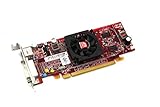
- HP ATI Radeon HD4550 PCIe x16 Video Card
- SP# 584217-001
- AS# 584081-001
- Memory: 512MB DDR3
- Outputs: DMS-59, S-Video
Rank #3

- ATI Radeon HD 3450 256 MB GDDR2 PCI Express Low Profile Video Card General Features:
- Low profile PCB ATI Radeon HD 3450 graphics processing unit (GPU) 40 stream processing units
- 256 MB GDDR2 memory 64-bit memory interface PCI Express x16 interface
- Superscalar unified shader architecture High-speed 128-bit HDR (High Dynamic Range) rendering
- Custom Filter Anti-Aliasing
Why the transition mattered—and what it does not prove
- It changed resource allocation: programmable resources could serve work from multiple traditional shader stages instead of being permanently assigned to only vertex or pixel work.
- It marks a product sequence: Xenos is the early console example in ATI’s history; Radeon HD 2000 marks the approach’s arrival in the company’s PC graphics-card lineup.
- It is not a performance ranking: the available historical and technical references do not establish benchmark results or prove that unified shaders make every workload faster.
- It is not a claim of identical chips: shared lineage does not mean Xenos and R600 were interchangeable or the same GPU.
Product prices and availability are accurate as of the date/time indicated and are subject to change. Any price and availability information displayed on Amazon at the time of purchase will apply.

