
The Tool Desk
Outbyte Driver Updater FREEFix the driver behind crashes, sound loss and screen glitchesFind Drivers →Outbyte PC Repair FREERepair Windows errors before they cause bigger problemsFix Now →Yes, but not as a single published Cortex price increase. In its Q2 2012 results, Arm said higher royalty percentages on chips incorporating Cortex-A helped lift average royalty revenue per chip to 4.8 cents from 4.5 cents a year earlier. Arm also pointed to product mix: more chips combined multiple Arm processors, and more shipments included Mali graphics.
What Arm reported in 2012
Arm’s Q2 2012 results, published July 25, 2012, reported average royalty revenue of 4.8 cents per chip, up from 4.5 cents one year earlier. That is an average revenue figure across chips in the period—not a published universal royalty rate for Cortex-A or a customer-specific price schedule.
The distinction matters because a royalty rate is one input into revenue, while average royalty revenue per chip is an aggregate outcome. It can shift as contractual rates, chip values, the number of Arm products integrated into a chip, and the mix of chips shipped change.
Why Cortex-A mattered—and why it was not the only cause
Arm identified higher royalty percentages on chips incorporating Cortex-A as one contributor to the increase. It also cited chips integrating multiple Arm processors and increased shipments of chips containing Mali graphics. The reported change therefore reflected both rates and the types of products being shipped.
Free tools Windows power users keep installed
One-click scans. No signup required.
#1 Best Overall

- 【High-Performance Dual-Core Architecture】 Dual-core Cortex M0+ processor; 133MHz clock speed; 16MB onboard flash memory; Suitable for complex embedded systems and real-time applications
- 【Easy Integration with Popular Tools】 Compatible with for Arduino IDE; supports for Raspberry Pi and STM32 development boards; simple setup for rapid prototyping and project development
- 【Low-Power Design with Reliable Power Options】 3.3V operating voltage; 2000mAh battery support; micro USB interface for programming and power; recommended external 3.3V supply for high-power usage
- 【Robust Connectivity and Expandability】 Includes GPIO pins; 3V3 output for peripheral devices; USB-C compatible for stable and fast data transfer
- 【Engineered for Stability and Longevity】 Designed for continuous operation; low power consumption in sleep mode; suitable for educational projects and hobbyist electronics
Arm said Cortex-A shipments were nearly double year over year in Q2 2012 and represented 8% of processor units shipped, compared with 4% a year earlier. Cortex-A chips were typically higher-value products and commanded a higher royalty percentage, according to the results release. A growing share of those chips could raise the average even without one across-the-board rate change applying to every Arm chip.
How Arm royalties work
Arm’s current Form 20-F for the year ended March 31, 2026 describes royalties as typically based either on a percentage of a chip’s average selling price (ASP) or on a fixed fee per unit. The filing says the royalty typically increases as more Arm products are included in a chip. Licensing fees are a separate part of Arm’s business model; royalty revenue is associated with chips sold under licensing arrangements.
Rank #2

- The Raspberry Pi Pico is a beginner-friendly microcontroller board that uses MicroPython to give you a taste of the Internet of Things and microcontrollers. The RP2040 is a well-designed microprocessor that can be utilized in almost any Internet of Things project. It has enough power to complete the task quickly.
- 【Raspberry Pi RP2040 Microcontroller】Raspberry Pi Pico features Dual-core ARM Cortex M0+ processor, flexible clock running up to 133 MHz. With 264KB of SRAM, and 2MB of on-board Flash memory.Supports up to 16 MB of off chip flash memory via a dedicated QSPI bus
- 【Multiple Software Support】Pico has rich and complete software support, it comes with a complete Rasberry Pi official C/C++ SDK, Micropython SDK.The programming and burning of Pico need to be carried out on the computer. Supported operating systems and computers include:Raspberry Pie with Raspberry Pi OS,Other platforms equipped with Debian based Linux system Computer with MacOS, Computers with Windows, etc.
- 【Rich Hardware Interface】Raspberry Pi Pico has 30 GPIO pins, 4 pins for analog signal input and 26 × multi-function GPIO pins, 2 × SPI, 2 × I2C, 2 × UART, 3 × 12-bit ADC, 16 × controllable PWM channels.USB 1.1 supported by host and device, The installation mode can be flexibly selected by users to facilitate welding with other development boards.
- 【Build Project in Tiny Size】Only 2.1cm*5.1cm ( as small as your thumb). Pico has been designed to use either soldered 0.1" pin-headers or can be used as a surface-mountable 'module'.
Arm does not publish customer-specific Cortex-A royalty schedules in that filing. The public figures support an explanation of average revenue and reported drivers, not a calculation of the rate paid by a particular licensee.
Mind the reporting lag in the Q2 2012 figures
The quarter label can be misleading. Arm said it sold 2 billion Arm-technology-based chips in Q2 2012, a record at the time, but the royalty revenue reported in that quarter reflected earlier chip shipments from Q1 2012. The 4.8-cent average should therefore be understood as revenue recognized in Q2 against the relevant prior-period shipments, not as a measure of all chips sold during Q2.
Recommended Free Tools
Rank #3

- with pre-soldered header Raspberry Pi Pico. RP2040 microcontroller chip designed by Raspberry Pi in the United Kingdom
- Dual-core Arm Cortex M0+ processor, flexible clock running up to 133 MHz. 264KB of SRAM, and 2MB of on-board Flash memory.
- Castellated module allows soldering direct to carrier boards. USB 1.1 with device and host support. Low-power sleep and dormant modes. Drag-and-drop programming using mass storage over USB. 26 × multi-function GPIO pins.
- 2 × SPI, 2 × I2C, 2 × UART, 3 × 12-bit ADC, 16 × controllable PWM channels.Accurate clock and timer on-chip.Temperature sensor.
- Accelerated floating-point libraries on-chip.8 × Programmable I/O (PIO) state machines for custom peripheral support
What later disclosures say about royalty growth
The underlying mechanism remains visible in current reporting, but aggregate royalty growth still cannot be attributed to rates alone.
| Period and source | Reported royalty result | What Arm identified |
|---|---|---|
| Q2 2012, July 25, 2012 results | 4.8 cents average royalty revenue per chip, versus 4.5 cents a year earlier | Higher royalty percentages on Cortex-A chips, multiple Arm processors per chip, and more chips with Mali graphics; Cortex-A’s share of processor units shipped rose to 8% from 4%. |
| Q2 FY2026, November 5, 2025 results | $620 million in royalty revenue, up 21% year over year | Arm cited Armv9 and Compute Subsystems among technologies associated with higher per-chip rates. |
| Q1 FY2027, July 29, 2026 results | $715 million in royalty revenue, up 22% year over year | Arm attributed growth in part to adoption of higher-rate technologies, including Armv9 and Compute Subsystems. |
Arm’s FY2026 annual report says royalty growth was driven primarily by higher chip shipments and improved mix of products with higher rates, such as Armv9. That qualification applies when interpreting the later quarterly figures too: company-reported growth is not an isolated measurement of a rate increase.
Quick Recap
Best Value
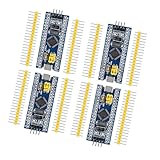
- Complete I/O Resources: Compatible withSTM32F103C8T6 development board with full GPIO ports for versatile project applications.
- Essential Circuit Components: Compatible with MCU-based design including 8MHz crystal oscillator, USB 2.0 interface and power management circuits.
- Smart Micro USB Port: Compatible with standard Micro USB connection (Type-B) supporting both power supply and serial communication.
- Premium 2.54mm Pin Headers: Compatible with high-quality 1×40 pin headers (2.54mm pitch) ensuring reliable circuit connections.
- Efficient SWD Debugging: Compatible with Serial Wire Debug (SWD) interface requiring only 3-wire connection for programming.
Rank #4

- Ample Memory and Non-Welding Design** featuring 64KB Flash and 20KB SRAM, this smallest system microcontroller is ideal for a wide range of applications, from simple to advanced embedded systems
- High-Performance STM32F103C8T6 Development Board** with ARM 32-bit Cortex-M3 MCU, running at 72MHz, perfect for complex and demanding projects, offering robust performance and reliability
- Easy USB Connectivity and Power Supply** via Micro USB, this ARM 32-bit MCU development board simplifies communication and power, making it highly compatible with modern devices and easy to integrate into your projects
- Robust I/O Resources and Debugging Support** with essential circuits including a crystal oscillator and SWD debugging, this learning module ensures reliable operation and efficient troubleshooting, perfect for both beginners and experienced developers
- ersatile and Ideal for Arduino Projects** this STM32F103C8T6 development board supports rapid prototyping and DIY projects, making it an excellent choice for students, hobbyists, and professionals looking to build and test their ideas quickly
What the headline claim does—and does not—establish
- Established: Arm said higher royalty percentages on Cortex-A chips contributed to the higher average royalty revenue per chip in Q2 2012.
- Also established: Cortex-A shipments grew as a share of shipped units, and Arm named other product and integration mix factors.
- Not established: a single Cortex-A royalty rate, a universal increase for all licensees, or the specific terms of any customer contract.
Product prices and availability are accurate as of the date/time indicated and are subject to change. Any price and availability information displayed on Amazon at the time of purchase will apply.

