
What’s actually slowing this PC down?
Pick the symptom - the matching free tool is one click away.
Data lakes have not been replaced; they have evolved. Lakehouse architectures add table operations, catalogs, query engines, and governance to the flexible, scalable storage of a lake. Those additions can make diverse data easier to find, update, and analyze—but they do not guarantee better AI results or make a lakehouse the right choice for every organization.
Why data lakes evolved
Early data lakes offered a practical way to keep large volumes of structured, semi-structured, and unstructured data, often in relatively inexpensive object storage. Their flexibility came with a cost: data could be difficult to locate, interpret, update consistently, or protect. When stored files lacked clear descriptions, ownership, and access rules, a lake risked becoming what critics called a “data swamp.”


The problem was not that flexible storage had stopped being useful. It was that storage alone did not provide the management and analysis capabilities teams expected from a database or warehouse. Lakehouse designs respond by putting more structure and controls around the lake rather than discarding it. In a September 12, 2024, Data Center Knowledge article, analyst Sanjeev Mohan put the continuity succinctly: “Data lakes have not gone away. Long live data lakes!”
What is a data lakehouse?
A lakehouse is an architecture that combines lake-style storage with capabilities commonly associated with data warehouses. The term is used in different ways by vendors, so it is more useful to look at the components than to treat “lakehouse” as one standardized product or specification.
#1 Best Overall
A common arrangement has several layers:
- Object storage holds data files, often in a cloud storage service.
- File formats such as Parquet organize data within files and can support efficient compression and reading.
- Table formats track how files make up tables and can support operations such as transactions and schema changes. Iceberg and Delta Lake are examples; the features available depend on the engines and versions in use.
- A catalog records information about tables and can help users discover data and trace its lineage.
- Query engines let users analyze data, often with SQL, across supported formats and locations.
- Governance and security tools define and audit who can access data and what they can do with it.
An AWS Partner Network example combines Parquet files on Amazon S3, Iceberg tables, AWS Glue as a catalog, Dremio as a query engine, and Lake Formation for governance. That is one implementation, not a required blueprint or independent proof of performance. Components and feature support vary across platforms; teams should confirm that the specific engines they plan to use support the table operations and controls they need.
What changes when a lake gains table and catalog capabilities?
Updates and transactions
With uncoordinated files, changing data safely can be awkward: readers may encounter inconsistent results while a process writes or replaces files. Table formats such as Iceberg and Delta Lake add transaction and table-management capabilities to data-processing systems. Their documented features include capabilities such as schema evolution; AWS’s Iceberg guide also describes partition evolution and snapshot time travel. These features can help teams manage changing datasets, but their exact behavior is not identical across formats, query engines, or platform configurations.
Discovery and querying
A catalog gives tables names and metadata that people and tools can use to locate and understand them. Query engines make it possible to analyze data in supported formats and locations without requiring every dataset to be loaded into one conventional warehouse first. Neither function makes poorly documented or low-quality data trustworthy by itself: metadata still needs to be maintained, and users still need to know what a field means and whether it is appropriate for their task.
Refining data for different uses
Databricks documentation describes a “medallion” pattern with bronze, silver, and gold layers: raw data lands in bronze; silver contains integrated and curated data; and gold serves presentation or data-mart needs. It is a platform-documented design pattern, not a mandatory lakehouse standard. The broader idea is to preserve source data while making progressively more usable datasets available for reporting and other workloads.
Free tools Windows power users keep installed
One-click scans. No signup required.
ETL and ELT
Lake architectures are often associated with ELT—extract, load, then transform—because teams can land data before deciding how to process it. That is a shift from the conventional ETL sequence, in which data is transformed before loading into its destination. The choice depends on the workload, governance needs, and available compute; either sequence can be appropriate.
How does a lakehouse differ from a data lake or data warehouse?
The distinction is about emphasis, not a universal boundary. McKinsey’s cloud-platform discussion describes these as architecture archetypes, while also cautioning that there is no single standardized cloud data architecture.
Rank #3
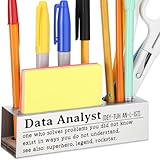
- Perfect Gift for Data Analysts – A fun and unique desk sign for business intelligence experts, data scientists, and analytics professionals.
- Bold & Readable Design – High-contrast lettering ensures visibility on any desk, making it an instant conversation starter.
- Compact & Lightweight – Small enough to fit any workspace without taking up too much room but big enough to make an impact.
- Durable & Long-Lasting Material – Made with premium materials to withstand daily office use while maintaining its sleek look.
- Great for Any Occasion – Ideal for birthdays, work anniversaries, promotions, or just a fun appreciation gift for number crunchers
| Architecture | Typical emphasis | Trade-off to consider |
|---|---|---|
| Data lake | Scalable storage for structured and unstructured data, with flexibility to use it for different purposes. | Users may need specialized skills to interpret unfamiliar raw data; discovery, quality, and controls require deliberate attention. |
| Data warehouse | Reliable SQL access and reporting centered on structured, prepared data. | Its structured focus may be less suited to retaining and exploring every kind of raw data in one place. |
| Lakehouse | Scalable lake storage combined with table management and warehouse-style reporting capabilities. | It adds components and operational choices; the promised capabilities depend on the formats, engines, and governance implementation selected. |
| Data mesh | Decentralized ownership, with teams responsible for data products in their domains. | Ownership and interfaces must be coordinated across teams; it is an organizational approach as well as a technical one. |
| Data fabric | A metadata layer that helps connect or manage data across environments. | It spans existing systems rather than necessarily consolidating their underlying storage or ownership. |
These approaches are not always mutually exclusive. An organization might use lakehouse capabilities within a broader mesh, or a fabric layer to work across warehouses and lakes. McKinsey’s comparison is a framework for thinking about choices, not evidence that any one pattern is universally superior.
What lakehouses can—and cannot—do for AI analytics
A lake or lakehouse can retain varied, high-volume data that may be useful for analytics and AI. But volume is not the same as readiness. Data is more likely to be useful when people can find it, understand its meaning and provenance, access it under appropriate permissions, and judge whether it fits the task.
The Tool Desk
Outbyte PC Repair FREERepair Windows errors before they cause bigger problemsFix Now →Outbyte Driver Updater FREEScan for outdated or missing drivers - takes under a minuteDriver Scan →In the September 2024 Data Center Knowledge article, AWS vice president of data lakes and analytics Ganapathy “G2” Krishnamoorthy described generative AI as offering “some unique opportunities to tackle the fuzzy side of data management – things like data cleaning,” while analyst Merv Adrian cautioned, “More data is always better if you can use it. But it doesn’t do you any good if you can’t.” These are attributed perspectives, not measured evidence that generative AI delivers particular productivity gains. AI-assisted cleaning or pipeline work still needs review, especially where errors, sensitive data, or regulatory obligations matter.
Rank #4
Compute costs also matter. Keeping data in a lake does not make querying or model development free; teams should consider how often data is processed, which engines are used, and whether the data needs to be retained at its current level of detail. A lakehouse can make data more manageable, but it cannot substitute for data-quality work, access policy, or workload planning.
Independent reader supportYour contribution helps us test, update, and keep practical guides available for everyone.Security and governance are implementation requirements
In the same article, Mohan said, “The main need is security. That calls for fine-grained access control – not just throwing files into a data lake,” recalling the weak governance and security that characterized some early lake implementations. Controls may apply at different levels, including databases, tables, or columns; the AWS example illustrates those kinds of policies alongside cataloging.
Choosing a lakehouse label or a governance product does not by itself establish compliance. Effective protection depends on the data involved, the organization’s jurisdiction and obligations, the access model, and how controls are configured, monitored, and audited. Teams should decide who owns each dataset and how sensitive information is classified before treating a shared storage layer as ready for broad access.
Do these 3 things before closing this tab:
1Fix the driver behind crashes, sound loss and screen glitches2Clear out junk files and repair common Windows errors3Scan for outdated or missing drivers - takes under a minuteHow to choose an architecture
Start with the work the data platform must support, rather than selecting an architecture name first. McKinsey’s cloud-platform guidance emphasizes that both organizational and technological factors shape the choice.
- Define workloads and data. List the data types, reporting patterns, analytics, and AI tasks the platform must support. Separate predictable SQL reporting from exploratory use of raw or less-structured data.
- Set performance expectations. Identify latency, concurrency, and reliability requirements. Confirm that the candidate engines and table formats support the operations those workloads need.
- Choose centralization or federation deliberately. Decide whether data should be consolidated, remain in domain-owned products, or be accessed across existing environments through metadata and shared tools.
- Set governance and discovery requirements. Specify ownership, metadata, lineage, access controls, and audit needs. Check that these controls work across the actual systems and data types in scope.
- Account for existing infrastructure and skills. Include current warehouses, storage, cloud or hybrid constraints, and the team’s ability to run and govern the architecture. A more flexible design can also mean more components to operate.
- Validate with a representative workload. Test the chosen tools against realistic data and access rules, including updates and failure handling. Do not treat a vendor example or architecture label as a substitute for checking platform-specific behavior.
A lakehouse is a strong candidate when an organization wants flexible lake storage but also needs managed tables, SQL analysis, and more explicit governance. A warehouse may be the simpler fit for structured, dependable reporting; a mesh may address distributed ownership; and a fabric may help coordinate access across existing environments. The right design may combine these patterns, provided responsibilities and controls remain clear.
Quick Recap
Product prices and availability are accurate as of the date/time indicated and are subject to change. Any price and availability information displayed on Amazon at the time of purchase will apply.

