
You can build an affordable digital camera with either an ESP32-CAM board or a Raspberry Pi and Camera Module 3. The ESP32-CAM is the lower-cost route for Wi-Fi snapshots and compact projects; the Raspberry Pi costs more but offers a 12-megapixel autofocus camera, Linux and Python tools, and greater room to expand.
Choose the build that fits your goal
| Build | Best for | What to expect |
|---|---|---|
| ESP32-CAM | Low-cost Wi-Fi snapshots and embedded projects | A small camera board with a simple Arduino workflow, but programming requires a separate USB-to-UART adapter. |
| Raspberry Pi with Camera Module 3 | Higher-resolution photos, autofocus and software flexibility | A more capable camera platform using a Raspberry Pi, CSI camera connection and additional parts. |
A published parts-list comparison from the International Journal of Electrical Engineering and Computing puts a Raspberry Pi setup at €122.00 and an ESP32-CAM setup at €16.90. These are historical totals, approximately from 2024, not current shopping prices; board revisions, storage, power supplies and shipping can change what you pay.
Build a Raspberry Pi camera for better photos and expandability
Raspberry Pi’s 2026 documentation specifies Camera Module 3 with a 12-megapixel Sony IMX708 sensor, powered autofocus and a maximum resolution of 4608 × 2592. It lists a $25 net price for the camera module; that is not the cost of a complete camera build.
Parts you need
- A Raspberry Pi board with a camera connector.
- Raspberry Pi Camera Module 3.
- A CSI ribbon cable that matches the connectors on both the camera and Pi.
- A microSD card, power supply and enclosure.
Connector compatibility matters: Pi 5 and Pi Zero use a mini 22-pin board connector and need a standard-to-mini cable. Many other Raspberry Pi boards use the standard 15-pin connector. Check your exact board and camera connectors before choosing the cable.
#1 Best Overall
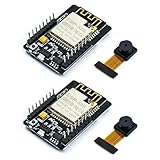
- ESP32CAM is based on ESP32 chip and OV camera module, use low-power dual-core 32-bit CPU, which can be used as an application processor.
- The main frequency is up to 240MHz, and the computing power is up to 600 DMIPS.
- Built-in 520 KB SRAM , external 8MB PSRAM ,support UART/SPI/I2C/PWM/ADC/DAC and other interfaces;Support picture wireless upload, TF card, multiple sleep modes, STA/AP/STA+AP working mode, secondary development.
- It is an ideal solution for IoT applications. The ESP-32CAM comes in a DIP package that plugs directly into the backplane for rapid production.
- ESP-32CAM can be widely used in various IoT applications. Suitable for home smart devices, industrial wireless control, wireless monitoring, QR wireless identification, wireless positioning system signals, etc.
Raspberry Pi’s camera setup documentation also cautions that camera boards are sensitive to static electricity. Take grounding precautions while handling the module.
What this route gives you
Camera Module 3’s autofocus and higher specified resolution make this the stronger option when focus and image detail matter. The Pi also provides a Linux environment and access to Python tooling and accessories, but you are assembling a larger system than a single camera board.
Rank #2
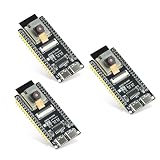
- Dual-core processor: The ESP32 module is based on the powerful ESP32-S3-WROOM N16R8 module and is equipped with a dual-core 32-bit LX7 processor. Its excellent AI computing performance, real-time processing capabilities, and low power consumption make it ideal for image recognition, edge AI, and complex IoT applications
- Integrated 2-megapixel OV3660 camera: Built-in OV3660 camera to capture clear images and stream video in real time. Perfect for smart surveillance, face recognition, and AI-based computer vision projects. It is the preferred solution for DIY makers and professionals to build camera-enabled IoT systems
- Dual Type-C ports for OTG and serial debugging: Designed with two USB Type-C interfaces - one supports USB OTG for host/device functions, and the other provides TTL serial for easy programming and debugging
- Shared antenna: Supports IEEE 802.11b/g/n Wi-Fi (2.4GHz) and Bluetooth 5 (LE and Mesh), using shared antennas to optimize wireless performance. Enhanced 2 Mbps PHY and long-distance communication (Coded PHY) ensure stable multitasking in harsh environments
- Multi-scenario applications: The ESP32 S3 development board maintains high stability even at high temperatures, making it ideal for industrial environments, educational purposes, and AI-driven projects. It is a versatile choice for robots, smart devices, and machine vision in lab or field applications
Build an ESP32-CAM for the lowest-cost functional camera
The AI-Thinker ESP32-CAM is a Wi-Fi-enabled camera board based on an ESP32 module. Raspberry Pi Official Magazine describes it as a cheap, hackable camera and notes Bluetooth and 4MB of external RAM. The board has no USB port, so you need a USB-to-UART adapter to program it.
Parts you need
- An ESP32-CAM development board.
- A USB-to-UART adapter.
- A suitable power source and an enclosure if the project needs physical protection.
The cited hardware descriptions do not establish a comparable image-quality result or battery runtime for the ESP32-CAM, so judge it as a low-cost embedded camera option rather than assuming performance from the board name alone.
Crashes, No Sound, or Screen Glitches?
Random freezes, missing sound and display glitches usually trace back to one bad driver. Find and replace yours safely.Free scan · under a minutePC Slower Than It Used to Be?
A free scan shows the junk files, broken settings and background clutter dragging Windows down - then fixes them in one click.Free scan · Windows 10 & 11Rank #3

- 【160° Wide-angle Lens】 This ov2640 AC OV2640 camera module features a 160° viewing angle and 2 megapixels, providing you with an open view. Ideal for esp32 cam, ESP32_camera, esp32-cam, and esp32 camera module projects.
- 【High-Quality Image】 The OmniVision image sensor applies unique sensor technology to improve image quality by reducing or eliminating optical or electronic defects such as fixed-pattern noise, tailing, and floating scatter, obtaining clear and stable color images.
- 【Compact & Low Voltage for ESP32 MCU】 The small size and low operating voltage of this OV2640 camera module provide all required functions for a microcontroller-based UXGA camera and image processor, making it perfect for esp32 camera module applications.
- 【Flexible Output & SCCB/I2C Control】 Controlled via the SCCB bus (compatible with I2C), the OV2640 camera can output 10-bit sampled data at various resolutions in whole frame, sub-sampling, and windowing. It supports JPEG, RGB, and YUV formats for ESP32-CAM.
- 【Full Image Processing Control】 The lens delivers UXGA images up to 15 fps. Users have full control over image quality, data format, and transmission method. All image processing functions including gamma curve, white balance, saturation, chroma, etc., can be programmed through the SCCB interface.
Flash the board with Arduino IDE
- Connect 5 V to 5 V, ground to ground, adapter TX to U0R, and adapter RX to U0T.
- Temporarily connect IO0 to ground to put the board into programming mode.
- In Arduino IDE, select the ESP32 Arduino board and upload your firmware.
- After programming, disconnect IO0 from ground before normal camera operation.
Espressif’s 2026 esp32-camera component documentation says the component is available through ESP-IDF and requires no separate installation when using the Arduino-ESP32 core. This supports a straightforward Arduino-based route without requiring a separate camera-library installation.
Independent reader supportYour contribution helps us test, update, and keep practical guides available for everyone.Which DIY camera should you make?
- Choose ESP32-CAM if the priority is keeping the parts list and cost low, adding Wi-Fi snapshots to an embedded project, or experimenting with a compact camera board.
- Choose Raspberry Pi with Camera Module 3 if you want the documented autofocus and resolution, or value Linux, Python and a broader platform for accessories and later expansion.
For either route, budget for the complete build rather than the camera sensor or board alone. The historical comparison illustrates the price gap, but it is not a live quote for today’s parts.
Quick Recap
Product prices and availability are accurate as of the date/time indicated and are subject to change. Any price and availability information displayed on Amazon at the time of purchase will apply.

