
Windows Errors? Fix Them Before They Spread
Repair common Windows errors and clear accumulated junk for a smoother, more stable PC - no reinstall needed.Free scan · no reinstallOutdated Drivers Are Slowing You Down
One free scan finds every outdated or missing driver and matches the right update for your exact hardware.Free scan · exact hardware matchIn HotHardware’s March 23, 2026 review, the Core Ultra 7 270K Plus and Core Ultra 5 250K Plus generally outperform their predecessors across the AI, encoding and creator workloads covered on this page. The wins are workload-specific: the 270K Plus leads the review’s LAME XP and Blackmagic RAW comparisons, while high-clocked, single-CCD AMD CPUs lead some AI framework tests. The review describes the results qualitatively; its chart values are not available in the article text, so exact margins cannot be stated.
What these results cover
This is a look at HotHardware’s application and creator results, not a summary of its gaming tests. The review covers local AI benchmarks, audio encoding, 8K RAW video processing, Photoshop and DaVinci Resolve. Results depend on the workload and test configuration; a win in one application does not establish a general performance lead.
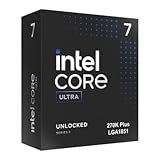
The 270K Plus is a 24-core, 24-thread LGA1851 processor with 8 performance cores and 16 efficiency cores. Intel lists a maximum turbo frequency of 5.5 GHz, 36 MB of Intel Smart Cache, 125 W processor base power and 250 W maximum turbo power. The 250K Plus has 18 cores (6P+12E). Both require an LGA1851 motherboard and DDR5 memory; Intel lists DDR5 support up to 7200 MT/s for the 270K Plus. Intel’s 270K Plus specifications identify a suggested price range of $339–$349, which is a listing, not a verified street price.
How the Plus CPUs perform in local AI tests
UL Procyon AI Computer Vision
HotHardware describes this as a CPU-only test using integer precision. It does not use every available CPU core, and cache bandwidth and latency can affect results. The review says the Plus processors improve on their predecessors, while high-clocked AMD processors with a single CCD stand out in the relevant results. These scores should not be read as a measure of GPU or NPU performance.
Free tools Windows power users keep installed
One-click scans. No signup required.
#1 Best Overall

- Next‑Gen Platform Support: Compatible with Intel 800 Series Chipset‑based motherboards with LGA1851 Socket enabling PCIe 5.0/4.0 and high‑speed DDR5 memory (up to 7200 MT/s).
- High‑Performance Core Configuration: Features up to 24 cores (8 P‑cores + 16 E‑cores) for demanding gaming and creator
- Ultra‑Fast Boost Clocks: Reaches up to 5.5 GHz max turbo frequency for top‑tier responsiveness and performance
- Built for Enthusiasts: Unlocked for performance tuning when paired with Intel Z‑series chipsets, making it ideal for overclockers and power users.
- Robust Power & Thermal Design: Engineered with 125W base power and 250W max turbo power to sustain high‑intensity
Geekbench AI
Geekbench AI reports FP32, FP16 and INT8 results as geometric means across multiple workload runs. HotHardware says the Plus models improve on the prior generation, but AMD’s higher-clocked single-CCD processors lead in the ONNX and OpenVINO framework results discussed in the review. Because frameworks and numerical precision differ, the results are not interchangeable into one universal AI ranking.
The review also characterizes the original and Plus 200S processors as featuring a Meteor Lake-class NPU. That context does not change the scope of these particular CPU benchmark results.
Rank #2
- Limited Amazon Model *Only is for products sold and shipped by Amazon.co.jp
- Supports PCIe 5.0 and 4.0 and DDR5
- Supports motherboards with Intel 800 series chipset
- 125W processor-based power
- 40MB L2 Cache
Audio encoding: LAME XP
For its custom LAME XP test, HotHardware converted 24 copies of a 223 MB WAV file using the encoder’s multi-threading capability; shorter processing time is better. Its written account says the 270K Plus narrowly beats the 285K and the 250K Plus beats the 245K. The page does not provide accessible numerical chart values in its text, so it supports those relative findings but not a precise time or percentage advantage.
8K RAW video: Blackmagic RAW Speed Test
HotHardware tested 8K decoding at two bitrate or compression levels. Its qualitative description says the Plus chips perform well against the original 200S processors: the 270K Plus leads, and the 250K Plus performs strongly for its tier. Without the chart’s numerical values, those comparisons should remain directional rather than being expressed as an exact throughput gain.
Rank #3

- 20 cores (8 P-cores + 12 E-cores) and 20 threads. Integrated Intel Graphics included
- Performance hybrid architecture integrates two core microarchitectures, prioritizing and distributing workloads to optimize performance
- Up to 5.3 GHz. 36 MB Cache
- Compatible with Intel 800 series chipset-based motherboards
- Turbo Boost Max Technology 3.0, and PCIe 5.0 & 4.0 support. Intel Optane Memory support. No thermal solution included
Photoshop and DaVinci Resolve
The review introduces PugetBench creator tests for Photoshop and DaVinci Resolve. The Photoshop workload includes file opening and saving, filters and manipulation of high-resolution images. The available written descriptions do not expose chart scores or precise margins for either application, so they do not establish which CPU wins by how much in these creator workloads.
How much faster are the Plus processors overall?
ComputerBase’s separate 2026 application testing reports an 18% multi-core rating gain for the Core Ultra 7 270K Plus over the 265K and a 26% gain for the Core Ultra 5 250K Plus over the 245K. These are ComputerBase results from its own test configuration, not HotHardware measurements or guaranteed gains in every application. ComputerBase’s Core Ultra 200S Plus test provides that independent context.
Rank #4

- Get ultra-efficient with Intel Core Ultra desktop processors that improve both performance and efficiency so your PC can run cooler, quieter, and quicker.
- Core and Threads 24 cores (8 P-cores plus 16 E-cores) and 24 threads. Integrated Intel Graphics included
- Performance Hybrid Architecture Integrates two core microarchitectures, prioritizing and distributing workloads to optimize performance
- Performance Unlocked Up to 5.7 GHz unlocked. 40MB Cache
- Compatibility Compatible with Intel 800 series chipset-based motherboards
Intel says the refresh adds four E-cores to each Plus model relative to its predecessor and cites higher die-to-die frequency and Intel Binary Optimization Tool as parts of its performance story. Those explanations and uplift figures are Intel’s claims, not a promise that every application will improve by the same amount. Intel’s launch page quotes Robert Hallock, identified there as VP, Client Computing Group, General Manager, Enthusiast Channel Segment, saying the processors offer “up to 15% geomean faster gaming performance” than existing Core Ultra Series 2 desktop processors. Intel’s figure is a gaming claim based on a geometric mean across 38 games at 1080p High, with Binary Optimization Tool enabled where supported, versus the 265K; Intel says results vary. It is not a result from the AI, encoding or creator tests on this review page. Intel’s launch announcement gives the company’s stated qualifications.
Independent reader supportYour contribution helps us test, update, and keep practical guides available for everyone.What to check before building around one
Both processors use the LGA1851 platform and DDR5. Before choosing a motherboard or memory kit, check the board manufacturer’s CPU support list, required BIOS version and memory compatibility details. Intel’s listed DDR5 support ceiling for the 270K Plus is not a guarantee that every kit will run at that speed in every system.
Quick Recap
Product prices and availability are accurate as of the date/time indicated and are subject to change. Any price and availability information displayed on Amazon at the time of purchase will apply.

