
Crashes, No Sound, or Screen Glitches?
Random freezes, missing sound and display glitches usually trace back to one bad driver. Find and replace yours safely.Free scan · under a minutePC Slower Than It Used to Be?
A free scan shows the junk files, broken settings and background clutter dragging Windows down - then fixes them in one click.Free scan · Windows 10 & 11For substantial static text on an AVR Arduino, compare the Unishox Arduino PROGMEM library with storing the text directly in flash, then measure the compiled firmware size. Unishox’s README says its decompressor makes compression worthwhile when the net saving exceeds 3000 bytes; that is the library author’s guidance, not a guaranteed break-even point for every sketch. For data with long repeated runs, run-length encoding (RLE) is another possibility, but it can expand random data and requires careful buffer sizing.
PROGMEM and compression solve different problems: PROGMEM puts constant data in program flash instead of SRAM, while compression changes how data is represented and adds decoding work. Your board architecture, data type, access pattern, and compiled results determine whether either approach helps.
Choose the approach that fits the data
| Approach | Best fit | What to weigh |
|---|---|---|
| Direct PROGMEM access | Static values that do not need compression. | Keeps constants out of SRAM on applicable AVR boards, but the data still occupies flash. AVR code must use program-memory access functions rather than treating the values as ordinary variables. See Arduino’s PROGMEM reference. |
| Unishox Arduino PROGMEM | Text strings, including UTF-8 content, that benefit from compact storage and can be decoded when needed. | Offers indexed retrieval of compressed text. Count decompressor code, indexes, and temporary output storage against the flash saved. The README warns that binary data may compress poorly. See the Unishox repository. |
| uCompression RLE | Data with long repeated or constant runs. | RLE may be a poor fit for random data, which can grow rather than shrink. The repository says its functions have no error checking, so buffer capacity and chunk-size assumptions need particular care. See the uCompression repository. |
| Reduce or relocate storage | Data that compresses poorly or still exceeds available internal storage. | Arduino suggests minimizing arrays, reviewing library size, using an SD card, or selecting a board with more storage. These change the storage design rather than compressing the existing table. See Arduino’s memory-usage guidance. |
Check whether PROGMEM applies to your board
Arduino describes PROGMEM as a way to keep constant data in program flash rather than copy it to SRAM at startup. On AVR boards such as the Uno Rev3 and Leonardo, reading those stored values requires program-memory helpers such as pgm_read_*; an ordinary variable read is not interchangeable.
Do not assume that AVR-specific patterns are necessary on every Arduino. Arduino notes that boards such as the Due, MKR WiFi 1010, and GIGA R1 WiFi automatically use program space for const variables. Confirm the behavior for your board and core in the board-relevant PROGMEM documentation.
Quick wins for a faster PC:
Scan for outdated or missing drivers - takes under a minuteDriver Scan →Repair Windows errors before they cause bigger problemsFix Now →#1 Best Overall

- START CODING WITH THE ELEGOO UNO R3: Connect the included USB cable, upload your first sketch, and build sensor, motor, display, and automation projects, making it a practical controller for maker desks, classrooms, coding clubs, and robotics labs
- ATMEGA328P CORE FOR EVERYDAY PROJECTS: A 16 MHz clock, 32 KB flash, 14 digital I/O pins with 6 PWM outputs and 6 analog inputs provide a versatile foundation for LEDs, buttons, relays, servos, displays and sensors
- RELIABLE USB PROGRAMMING AND CLEAR WIRING: The ATmega16U2 USB interface supports sketch uploads and serial communication, while clearly labeled headers help simplify connections to jumper wires, shields and modules
- POWER AND EXPAND YOUR WAY: Run the board from USB or a recommended 7-12 V external supply, then add compatible shields and modules for data logging, automation, robotics, test fixtures and custom electronics projects
- BOARD AND USB CABLE INCLUDED: Comes with 1 ELEGOO UNO R3 development board and 1 USB-A to USB-B data cable; breadboard, sensors, shields and power adapter are not included, and younger learners should work with an experienced adult
Decide whether compression earns its overhead
Identify the data and its redundancy
Unishox is intended for text and its README gives examples such as messages and UTF-8 content. RLE instead represents repeated values compactly, so it is more plausible for long constant regions than for arbitrary, varied bytes. Neither description establishes how a particular table will compress.
Compare complete builds, not just encoded data
Build the sketch both ways and compare the compiled flash use. Include the decoder, any lookup or index tables, and other code added for compression; also account for the SRAM needed to hold decompressed output. Unishox’s repository says savings should exceed 3000 bytes to justify its decompressor, but treat that as the author’s rule of thumb and verify it against your own source and build.
Rank #2

- Powerful: The Arduino Nano V3.0 Board Microcontroller Built with ATmega328P and CH340 chips instead of FT232, Improved new version CH340G Replace FT232RL, making it ideal for beginners
- Seamless Compatibility: Fully compatible with Arduino Nano, supporting Arduino IDE, ISP programming and USB download. Works seamlessly with Windows, Mac, and Linux operating systems for a hassle-free experience.
- Versatile I/O & Compact Design: Features 14 digital I/O pins (6 PWM outputs), 6 analog inputs, a 16MHz quartz oscillator, USB-C power socket, ICSP port, and reset button. Its compact, breadboard-friendly design ensures easy handling and integration.
- Flexible Power Supply Options: Supports multiple power sources, including USB-C, 6-12V unregulated external power, or 5V regulated external power. The Nano board intelligently switches to the higher voltage source automatically—no jumper selection required.
- Excellent Communication Capabilities: Designed for seamless communication with PCs and arduino microcontrollers, the Nano board is fully compatible with multiple operating systems and offers stable and reliable performance for a variety of projects.
The Unishox README also claims “up to 60%” compression depending on text composition. That is a project-reported maximum, not a result guaranteed for your data. Arduino Project Hub’s 2019 entry for Shox96 separately advertises “up to 60% saving on program memory space”; that headline claim is likewise not an independent benchmark. The Project Hub page describes an Arduino Uno environment as having 32kb of flash, but that is its contextual statement, not a universal capacity for Arduino boards. Check the specifications for your exact board.
Check access pattern and failure behavior
Compression adds runtime decoding. Consider how often the data is needed, whether it must be accessed as a whole or by index, and whether the decoding time and output buffer fit the application. For uCompression, size destination buffers for the worst case and keep chunk sizes consistent: its repository explicitly warns that functions lack error checking and that undersized buffers or mismatched sizes can cause undefined behavior, potentially a crash or reboot.
Rank #3
![Arduino Uno REV3 [A000066] - ATmega328P Microcontroller, 16MHz, 14 Digital I/O Pins, 6 Analog Inputs, 32KB Flash, USB Connectivity, Compatible with Arduino IDE for DIY Projects and Prototyping](https://m.media-amazon.com/images/I/515P6aYSP4L._SL160_.jpg)
- ATmega328P Microcontroller: Powered by the reliable ATmega328P, running at 16 MHz with 32KB of flash memory, 2KB SRAM, and 1KB EEPROM, offering ample resources for a wide range of basic to advanced electronics projects.
- 14 Digital I/O Pins & 6 Analog Inputs: Features 14 digital I/O pins (6 of which support PWM output) and 6 analog inputs (10-bit resolution), providing flexible options for sensors, motors, and other external components.
- USB Connectivity for Easy Programming: The built-in USB port allows for direct programming and serial communication, enabling a simple connection to your computer for sketch uploading and debugging through the Arduino IDE.
- Compatible with Arduino IDE: Full compatibility with the Arduino IDE ensures easy access to a vast array of libraries, code examples, and community-driven projects, making the Uno a great choice for both beginners and experienced makers.
- Widely Used in Education & Prototyping: The Arduino Uno is a standard in educational environments, widely used for learning and teaching electronics and programming. It's perfect for prototyping, robotics, IoT projects, and more.
Test in a practical order
- Confirm the target: identify the board and core, then check whether its constants need AVR-style PROGMEM declarations and reads.
- Measure the uncompressed baseline: build with the data stored directly, and note compiled flash use and any SRAM used to copy or access it.
- Choose a candidate by data type: try Unishox for text; consider RLE for repeated runs. Do not assume either will reduce arbitrary binary data.
- Measure the compressed build: include decoder code, indexes, and the largest decompressed buffer in the comparison. Test actual runtime access, not just the encoded representation.
- Reject unsafe or ineffective results: confirm buffer bounds and size assumptions, especially with uCompression, and keep compression only if the total flash and runtime trade-offs suit the project.
If compression is not enough
When data does not compress well or internal storage remains insufficient, Arduino’s guidance is to reduce array sizes, review the libraries included in the sketch, move suitable data to an SD card, or choose a board with more storage. Those options may be more effective than adding a decoder for data that does not shrink.
Quick Recap
Best Value
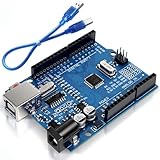
- Unlock your creativity with the versatile UNO R3 Board ATmega328P! Explore endless possibilities in electronics projects with its user-friendly Arduino development environment, extensive digital and analog I/O pins, and compatibility with various sensors and modules. Let your imagination soar!
- Experience the power of UNO R3 Board ATmega328P! This feature-packed development board boasts a high-performance ATmega328P microcontroller, 32KB of flash memory, and 2KB of SRAM. It's perfect for both beginners and advanced users seeking to build innovative applications in robotics, home automation, and more.
- Ignite your passion for electronics with the UNO R3 Board ATmega328P! Its open-source design allows for customization, while its 14 digital I/O pins and 6 analog input pins provide ample connectivity options. Get ready to bring your ideas to life and create interactive projects like never before.
- Elevate your DIY projects with the UNO R3 Board ATmega328P! This highly versatile development board offers seamless integration with the Arduino ecosystem, providing access to a vast library of code and resources. With its reliable performance and broad compatibility, you can easily prototype and realize your electronic dreams.
- Discover the endless potential of the UNO R3 Board ATmega328P! With its robust communication interfaces, including UART, SPI, and I2C, you can connect and communicate with a wide range of devices. Whether you're a hobbyist or a professional, this powerful development board is a must-have for creating innovative and interactive electronic systems.
Rank #4
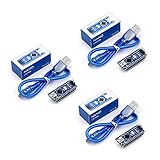
- Original ATmega328P CH340 chip is used. Improved new version CH340G Replace FT232RL.
- LAFVIN Nano V3.0 card is 100% compatible with the Nano card, and fully compatible with Windows, Mac and Linux operating system.
- Works the same as original Nano, runs perfectly on programming software.
- Using Atmel Atmega328P-AU MCU, Support ISP download; Support USB download and Power.
- LAFVIN Nano CH340 controller is a compact board similar to the R3 board, smaller and breadboard-friendly than Diecimila.
Product prices and availability are accurate as of the date/time indicated and are subject to change. Any price and availability information displayed on Amazon at the time of purchase will apply.

