
Free tools Windows power users keep installed
One-click scans. No signup required.
You can make a pocket-sized aquarium with pocket-tank, a handheld virtual aquarium for a Waveshare ESP32-S3-Touch-AMOLED-1.8 board. It displays simulated fish on an AMOLED screen; it does not hold water or live animals. A compact model running locally chooses each fish’s goals, while a separate reflex layer handles movement and interactions.
What the ESP32 aquarium does
The project, called pocket-tank, turns a small touchscreen board into a self-contained virtual tank. Its fish are software sprites with simulated needs and behavior. The repository says the on-device model and fish behavior do not require a network or cloud connection.
The documented hardware target is the Waveshare ESP32-S3-Touch-AMOLED-1.8, with an ESP32-S3R8, 16 MB of flash, 8 MB of PSRAM, a 368×448 AMOLED display, capacitive touch, an IMU, a PMIC, and an RTC. The repository says both board revisions are supported and auto-detected. It also mentions community ports, but says the main project does not build or test them, so they may lag behind.
How the AI fish choose what to do
According to the project README, each fish periodically supplies a compact description of its state, including drives, personality, nearby fish and objects, and life stage. A 14.3-million-parameter student transformer selects a goal and urgency. A reflex layer carries out the chosen action and keeps the scene moving while the model runs; the repository says heuristics do not override the model’s selected goal.
#1 Best Overall

- 2.4GHz Dual Mode WiFi + Bluetooth Development Board
- Support LWIP protocol, Freertos
- SupportThree Modes: AP, STA, and AP+STA
- Ultra-Low power consumption, Compatible with Arduino IDE
- ESP32 is a safe, reliable, and scalable to a variety of applications
Goals and simulated needs
The README lists seven possible goals: seek_food, follow_friend, inspect_reef, visit_bubbles, explore, rest, and dart_play. The model’s described state includes hunger, energy, stress, curiosity, boredom, boldness, sociability, laziness, trust, and life stage. These describe the project’s simulation, not evidence about cognition or care needs in live fish.
The repository says a fish that repeats an activity for about a minute grows bored and is generally steered toward exploring; hunger remains more important, and fish rest at night. It also describes sampling among possible outputs, with close top choices represented by visible hesitation. These are the project’s descriptions of its behavior.
Rank #2
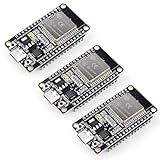
- Dual-Core Performance Up to 240 MHz: Run sensor processing, wireless communication, automation logic and connected-device tasks on a 32-bit dual-core ESP32 platform designed for responsive embedded and IoT projects
- Built-in Wi-Fi and Bluetooth 4.2: Connect to 2.4 GHz Wi-Fi networks or use Bluetooth Classic and BLE for wireless sensors, smart devices, remote controls, home automation and other connected projects
- Flexible Power-Saving Modes: ESP32 power-management features support dynamic clock scaling and low-power operating modes, helping developers reduce energy use in compatible sensing, monitoring and connected-device applications, suitable for battery-powered Internet of Things (IoT) devices.
- USB-C Programming with CP2102: Connect through USB-C for power, sketch uploads and serial monitoring, while GPIO, UART, SPI and I2C interfaces support sensors, displays, motor drivers and other modules (USB-C cable not included)
- Over-the-Air Update Support: Configure OTA functionality through a compatible ESP-32 software framework to update deployed firmware over Wi-Fi without reconnecting the board by USB for every revision
What the project’s model figures mean
The pocket-tank README reports that the 14.3-million-parameter student model was distilled from a roughly 26-billion-parameter teacher. It reports a model size of 57 MB in fp32 and 7.56 MB in four-bit form, with a closed-schema vocabulary of 54 tokens. The repository gives no publication year for these figures on the page reviewed, and they are project-reported rather than independent benchmarks.
The README also reports 72% agreement between the student and teacher on chosen goals, while the teacher agrees with itself 82% of the time. It says training used 51,613 teacher-labeled situations. These figures describe the project’s reported training and comparison; they should not be read as a general measure of ESP32 AI performance.
Crashes, No Sound, or Screen Glitches?
Random freezes, missing sound and display glitches usually trace back to one bad driver. Find and replace yours safely.Free scan · under a minutePC Slower Than It Used to Be?
A free scan shows the junk files, broken settings and background clutter dragging Windows down - then fixes them in one click.Free scan · Windows 10 & 11Rank #3

- Powerful ESP-32 Board: Unlock the world of Internet of Things (IoT) and advanced electronics with the heart of this kit: the ESP-32 board. It features a powerful dual-core processor, integrated Wi-Fi and Bluetooth 4.2, making it perfect for building connected, smart devices that communicate with your phone or the cloud. It's fully compatible with the Arduino IDE for easy programming.
- Super Starter Kit: This kit contains over 35 different modules and electronic components, including sensors, displays, motors, and input devices. From LEDs and buttons to an OLED screen, servo motor, and keypad, you have everything needed to explore a vast range of projects in one box.
- Step by Step Online Tutorial: Jump right in with our detailed, beginner-friendly tutorial. Access 30+ projects with complete code, clear circuit diagrams, and step-by-step instructions. Learn the fundamentals of electronics, coding, and how to utilize the ESP-32's unique capabilities without any prior experience.
- Hands-on Learning for All Skill Levels: Perfect for students, makers, engineers, and hobbyists. Start with basic circuits and coding, then progress to intermediate and advanced IoT applications. Build practical projects like weather stations, smart home controllers, remote-controlled devices, and interactive gadgets. The skills you learn are the foundation for real-world innovation.
- Quality & Great Support: Elegoo is committed to quality. We provide a clear, detailed tutorial guide, refined code, and a well-organized component kit. All modules are carefully selected for reliability and ease of use. Our dedicated technical support team and active online community are ready to help you succeed in your learning journey.
Ways to try pocket-tank
| Option | What it involves | Best fit |
|---|---|---|
| PC simulator | Runs the project’s shared code and shipped model on a computer. | Trying the aquarium without first flashing a physical board. |
| Browser installer | The project describes a browser-based installation path for Chrome or Edge. | Using the supported handheld board with a browser-based setup. |
| ESP-IDF build and flash | Builds and flashes firmware, with a separate model partition. | People comfortable with an embedded development workflow. |
The repository README accessed October 4, 2026 describes the project as release v0.2.0 alpha and says the simulator, browser installer, firmware, and living-tank features are implemented. Alpha software can change, and availability or setup details may differ as the project evolves; consult the pocket-tank repository README for its current instructions. The project is MIT-licensed, while separately cloned components may have their own licenses.
Quick Recap
Best Value

- 2.4GHz Dual Mode WiFi + Bluetooth Development Board
- Ultra-Low power consumption, works perfectly with the Arduino IDE
- Support LWIP protocol, Freertos
- SupportThree Modes: AP, STA, and AP+STA
- ESP32 is a safe, reliable, and scalable to a variety of applications
Rank #4

- 2.4GHz Dual Mode WiFi + Bluetooth Development Board
- Support LWIP protocol, Freertos;ESP32 is a safe, reliable, and scalable to a variety of applications
- SupportThree Modes: AP, STA, and AP+STA
- Ultra-Low power consumption, Compatible with Arduino IDE
- 1PCS 30Pin ESP32 Development Board 2.4GHz WiFi Dual Cores Microcontroller Integrated with Antenna RF Low Noise Amplifiers Filters
What to check before building the handheld version
- Confirm you have the documented Waveshare ESP32-S3-Touch-AMOLED-1.8 board if you want to reproduce the main project’s hardware build.
- Choose the simulator if your priority is a lower-effort trial; choose board installation or an ESP-IDF build if you want the portable touchscreen device.
- Check the repository’s current setup instructions and release status before proceeding, since its described release is alpha.
- Treat a community port as unverified by the main project unless its own maintainer documents compatibility and testing.
Product prices and availability are accurate as of the date/time indicated and are subject to change. Any price and availability information displayed on Amazon at the time of purchase will apply.

