
Do these 3 things before closing this tab:
1Clear out junk files and repair common Windows errors2Fix the driver behind crashes, sound loss and screen glitches3Repair Windows errors before they cause bigger problemsiTechGuides is reader-supported. When you buy through links on our site, we may earn an affiliate commission. As an Amazon Associate I earn from qualifying purchases. Learn more
The best M2 heatsink depends on the SSD, workload, airflow, and available clearance: choose the Thermalright HR-09 2280 PRO for maximum passive cooling, the be quiet! MC1 Pro for compact desktop use, the be quiet! MC1 for low-clearance or PS5 installations, and an active cooler such as Thermaltake’s MS-1 for extreme sustained PCIe 5.0 workloads.
There is no single best M.2 cooler for every computer. A large passive tower can deliver more cooling capacity than a thin cover, but a compact heatsink with good thermal-pad contact and direct airflow can be the better real-world choice. Many gaming and everyday desktop systems also perform perfectly well with a correctly installed motherboard heatsink.
Key takeaways
- The Thermalright HR-09 2280 PRO is the strongest maximum-passive-cooling candidate, but its listed 74 mm height creates major GPU, CPU-cooler, motherboard, and side-panel clearance risks.
- The be quiet! MC1 Pro measures 74 × 24 × 13 mm, supports single- and double-sided M.2 2280 SSDs, and passed a PCIe 5.0 stress test without throttling in Tom’s Hardware’s air-cooled test setup.
- The be quiet! MC1 measures 74 × 24 × 10 mm, supports single- and double-sided M.2 2280 drives, and is specifically listed by be quiet! as compatible with the PlayStation 5 M.2 slot.
- A heatsink mainly preserves sustained performance by reducing thermal throttling; a heatsink does not automatically reduce the SSD’s electrical power consumption or guarantee a longer lifespan.
- Motherboard M.2 heatsinks are not automatically effective: Tom’s Hardware found full contact with its test SSD on only six of 20 modern Intel and AMD motherboards.
- Thermaltake’s MS-1 adds an 8,000 RPM fan, a 6 mm copper heatpipe, and a 3-pin connection, making it an extreme-workload option rather than a default gaming upgrade.
What are the best M2 heatsinks for maximum cooling performance and efficiency gains?
The best M2 heatsink for maximum passive cooling is the Thermalright HR-09 2280 PRO, while the best compact premium choice is the be quiet! MC1 Pro. The be quiet! MC1 is the better low-profile and PS5-oriented option, and the Thermaltake MS-1 is the most appropriate candidate when active cooling is justified by sustained PCIe 5.0 workloads or poor airflow.
The word “best” needs a use case. Cooling performance should be judged by stable throughput during long transfers, not only by the lowest idle temperature or the highest short benchmark score. A heatsink is useful when it prevents or delays throttling, maintains consistent transfer speeds, and fits the SSD and system without creating a new hardware problem.
#1 Best Overall

- 【Designed for desktop PC/PS5】- Perfectly fit for Samsung 860 EVO, 960 EVO, 970 EVO, 970 Pro, 980 Pro, PS5 etc. this M.2 SSD heatsink compatible with all single sided Type.
- 【Main body material】- Aluminum alloy, silver plating (helps eliminate static electricity), anodic oxidation surface treatment. Dimensions: 3 x 0.95 x 0.4inm.2 heatsink well fit for PS5 installation as well as PC M.2 Slot.
- 【Thermal Pads】- with good thermal conductivity ability. Low viscosity, with no damage to the M.2 SSD.
- 【High Performance】- With 10°C - 20°C cooling effect (varies depending on the environments), cool your M.2 2280 SSD to a safe temp to avoid overheating and throttling, improve your computer's performance.
- 【Easy to Install 】 - With double-sided clip design, are suitable for M.2 NVME SSD of various heights, stable installation, better protection of your M.2 SSD with good heat dissipation performance.
Quick comparison
| Heatsink | Best for | Cooling design | Size or key specification | Drive support | Active or passive | Main limitation | Price signal |
|---|---|---|---|---|---|---|---|
| Thermalright HR-09 2280 PRO / PRO BLACK | Maximum passive cooling | Two 6 mm heatpipes and a large fin stack | 86 × 24 × 74 mm; 90 g listed for the PRO | M.2 2280; verify double-sided and system clearance | Passive | 74 mm height can conflict with a GPU, CPU cooler, motherboard armor, or side panel | No official current price verified |
| be quiet! MC1 Pro | Compact premium desktop cooling | Integrated copper heatpipe and slotted heatsink | 74 × 24 × 13 mm | Single- and double-sided M.2 2280 | Passive | Needs airflow and still requires a 13 mm clearance check | €16.90 manufacturer RRP |
| be quiet! MC1 | Low-profile desktop or PS5 installation | Thin heatsink cover without an integrated heatpipe | 74 × 24 × 10 mm | Single- and double-sided M.2 2280; PS5-listed | Passive | Less thermal headroom than the MC1 Pro or a tower cooler | €12.90 manufacturer RRP |
| Thermaltake MS-1 | Extreme sustained Gen 5 workloads | 6 mm copper heatpipe, aluminum fins, and microblower | 70 × 22 × 14 mm assembly; 20 × 20 × 8.6 mm fan | M.2 2280 | Active | Requires a suitable 3-pin connection and adds noise, dust, and a moving part | No official current price verified |
| Iceberg Thermal IceFLOE M.2 | PC or PS5-oriented alternative | Passive M.2 heatsink | Detailed clearance dimensions need verification | Designed for PC and PS5 use; verify the complete fit | Passive | No independent comparative thermal data was surfaced | No current official price verified |
| iHTP M.2 2280 cooler | Potential budget performance | Aftermarket M.2 cooler tested under sustained IOMeter load | M.2 2280; confirm current specifications before buying | M.2 2280 | Passive | Current availability, official sales channel, and price require verification | $6.99 in a January 2025 review, not a current August 2026 price |
Manufacturer specifications and product compatibility should be checked against the specific SSD and system. The official pages list the Thermalright HR-09 2280 PRO dimensions and heatpipe design, the be quiet! MC1 Pro dimensions and double-sided support, and the be quiet! MC1 dimensions and PS5 positioning.
Which M2 heatsink is best for maximum passive cooling?
The Thermalright HR-09 2280 PRO is the best candidate when maximum passive cooling matters more than compact compatibility. The tower-style cooler uses two 6 mm heatpipes and a 33-fin heatsink stack. Thermalright lists dimensions of 86 × 24 × 74 mm, a weight of 90 g, and a six-year warranty for the PRO model on its official product page.
The HR-09 PRO BLACK uses the same broad design approach, with two 6 mm heatpipes. Thermalright lists a 0.4 mm fin thickness and a 1.8 mm fin gap for the black version on its official specification page. The black model is primarily an aesthetic alternative unless a particular revision has different dimensions or included hardware.
Crashes, No Sound, or Screen Glitches?
Random freezes, missing sound and display glitches usually trace back to one bad driver. Find and replace yours safely.Free scan · under a minutePC Slower Than It Used to Be?
A free scan shows the junk files, broken settings and background clutter dragging Windows down - then fixes them in one click.Free scan · Windows 10 & 11A large passive fin stack gives heat more surface area to dissipate, and heatpipes move heat away from the SSD’s controller. The HR-09 is therefore a strong fit for workstations, benchmarking, sustained transfers, and high-power PCIe 5.0 drives installed in a well-ventilated desktop.
The HR-09 is not a universal winner. A 74 mm-tall cooler can obstruct a graphics card, interfere with a CPU cooler or motherboard armor, collide with a side panel, or make an adjacent M.2 socket unusable. Measure the actual space above the M.2 socket before choosing the HR-09, especially when the socket sits beneath a graphics card.
Is the be quiet! MC1 Pro the best compact M2 heatsink?
The be quiet! MC1 Pro is the best compact premium all-rounder for many desktop users because the MC1 Pro combines a relatively low 13 mm profile, an integrated copper heatpipe, passive operation, and support for both single- and double-sided M.2 2280 SSDs.
be quiet! lists the MC1 Pro at 74 × 24 × 13 mm, with a three-year warranty and a €16.90 manufacturer’s suggested retail price. The €16.90 figure is a manufacturer RRP rather than a guaranteed current U.S. retail price; regional pricing and availability can differ.
Tom’s Hardware reported that the MC1 Pro passed its PCIe 5.0 stress testing without throttling when paired with an air-cooled system. The result applies to Tom’s Hardware’s SSD, test workload, ambient conditions, and airflow configuration rather than every PCIe 5.0 drive. The review also found that the slotted design benefits from airflow across the motherboard, particularly near an air CPU cooler; see the MC1 and MC1 Pro review and its thermal results.
The MC1 Pro is a better default than a 74 mm tower when the computer has a graphics card close to the M.2 socket or when the user wants silent cooling without a large obstruction. The MC1 Pro still needs a 13 mm height check, and the heatpipe cannot compensate for a stagnant air pocket or incorrect thermal-pad contact.
What is the best low-profile M2 heatsink for a PS5?
The be quiet! MC1 is the most practical low-profile and PS5-oriented choice in this group. The MC1 measures 74 × 24 × 10 mm, supports single- and double-sided M.2 2280 modules, includes a screwdriver, and is listed by be quiet! as compatible with the PlayStation 5 M.2 slot.
Rank #2

- High-Performance Cooling with Integrated Heatpipe: Advanced aluminum heatsink with built-in heatpipe ensures efficient heat dissipation, keeping your M.2 NVMe SSD cool even under heavy workloads.
- Maintains Maximum Read and Write Speed: Prevents thermal throttling by lowering SSD temperatures, allowing your drive to maintain top performance for longer periods.
- Compatible with Single and Double-Sided M.2 2280 Drives: Designed to fit both single-sided and double-sided M.2 2280 modules, offering flexible compatibility with a wide range of NVMe SSDs.
- Premium Black Aluminum Design: Sleek matte black finish delivers a clean, high-quality look that perfectly matches modern PC builds while providing excellent thermal conductivity.
- Easy Installation and Secure Fit: Simple mounting system allows quick, hassle-free setup on your M.2 slot for reliable cooling and long-term durability.
be quiet! lists a €12.90 RRP and a three-year warranty for the MC1. The MC1 has no integrated heatpipe, so the MC1 offers less thermal headroom than the MC1 Pro or HR-09. The lower 10 mm profile is more important than maximum cooling capacity when the assembly must fit beneath a console cover.
“M.2 2280 compatible” is not by itself proof of PS5 compatibility. The SSD must meet Sony’s own capacity, interface, and performance requirements, and the complete SSD-plus-heatsink assembly must fit under the expansion-bay cover. The cooler must not interfere with the spacer, mounting screw, or installation orientation. The MC1 product specifications confirm be quiet!’s PS5 positioning, but readers should still check the console revision and complete assembly height.
The MC1 Pro is physically taller at 13 mm and should not automatically be assumed to fit every PS5 revision or configuration. A console owner should prioritize the complete measured clearance envelope over the cooling capacity of a taller desktop heatsink.
When is an active M2 cooler such as the Thermaltake MS-1 worthwhile?
The Thermaltake MS-1 is best reserved for extreme sustained workloads, high-power Gen 5 SSDs, or hot enclosures where passive heatsinks cannot move enough heat into the surrounding air. The MS-1 combines a 6 mm copper heatpipe, aluminum fins, and a 20 × 20 × 8.6 mm microblower.
Thermaltake’s product documentation lists an 8,000 RPM fan, 0.44 CFM airflow, 16 dBA noise, a 3-pin connection, and a 70 × 22 × 14 mm cooler assembly. Those are manufacturer specifications from the MS-1 packing manual, not independent system-level noise measurements. A small fan running at 8,000 RPM can also have a noticeable tonal character even when the rated dBA figure appears low.
Quick wins for a faster PC:
Repair Windows errors before they cause bigger problemsFix Now →Fix the driver behind crashes, sound loss and screen glitchesFind Drivers →Clear out junk files and repair common Windows errorsFree Scan →Active cooling introduces a moving part, dust accumulation, a possible fan-failure point, and a connection requirement. A suitable motherboard header or adapter must be available, and the fan cable must not interfere with the GPU or other components. For ordinary gaming, a functioning motherboard heatsink or compact passive cooler is usually a more sensible starting point.
Are Iceberg Thermal IceFLOE M.2 and iHTP good alternatives?
Iceberg Thermal’s IceFLOE M.2 is a credible PC- and PS5-oriented alternative, but the available research does not establish that the IceFLOE is a top-performing cooler. Iceberg Thermal states that the product has a six-year lifespan guarantee on its IceFLOE M.2 product page. Current price and detailed clearance dimensions should be verified before purchase.
The iHTP M.2 2280 cooler is a budget-performance candidate rather than a confirmed current recommendation. Tom’s Hardware reported that the iHTP delivered the strongest performance in its tested group at a review-time price of $6.99, using an IOMeter workload designed to stress both NAND and a Phison E26 controller. The iHTP review was published in January 2025, so $6.99 must not be presented as an August 2026 price. Current availability and an official manufacturer buying page were not established in the available research.
Do M.2 SSDs need a heatsink?
Many M.2 SSDs do not need an aftermarket heatsink, particularly when the drive handles short bursts, ordinary desktop activity, or gaming and already has a motherboard heatsink that makes proper contact. Additional cooling becomes more valuable with PCIe 5.0 drives, long sequential writes, video editing, large file transfers, virtualization, databases, multiple active NVMe drives, high ambient temperatures, restricted airflow, or an M.2 socket exposed to GPU exhaust.
Kingston identifies heavy workloads, multiple NVMe drives, high ambient temperatures, and GPU-generated heat as situations where extra M.2 cooling can help. Kingston also recommends monitoring SSD temperature and looking for repeated performance dips that coincide with thermal limits in its SSD cooling guidance.
Rank #3

- 【FIT For M.2 2280 SSD】Compatible with Single-sided and Double-sided NVMe M.2 SSD. Works with Desktop PC and Workstations. Universal fit for standard 2280 form factor SSD
- 【Fast Heat Dissipation】Our Product Utilizes Aluminum Fin-type Heatsink with High-performance Thermal Silicone Pads, This Efficient Design Ensures That Your M.2 SSD Maintains A Safe Temperature, Thereby Preventing Performance Throttling
- 【High-quality Thermal Conductive Silicone Pad】Atdcoek M.2 SSD Heatsink Use of Thermally Conductive Silicone Pad with A Thermal Conductivity of 2.0 W/mK, Easy to Clean Without Damaging the SSD
- 【Easy To Install】The SSD Heatsink is Ssecured with Two Silicone Elastic Bands, Allowing for Tool-free Installation - no Screws Required. Simply Place the Heat Dissipation Silicone Pad and Press Firmly to Ensure Close Contact
- 【Value 5-pack Set】This Kit Includes 5 Aluminum Fin-type Heatsink, 5 High-performance Thermal Silicone Pads, 10 silicone rubber band, 1 Extra Cross-head Screwdriver, and 5 Pack M2 Screw Kit
A reader whose SSD remains below 60°C during the actual workload and does not show a sustained throughput drop may not gain meaningful performance from a larger heatsink. A cooler can still provide additional margin for hotter summer conditions or future workloads, but lowering an already safe temperature is not the same as improving measurable performance.
Use this workload-based decision guide
| Workload or system | Likely cooling requirement | Reasonable starting choice |
|---|---|---|
| Office work, web browsing, and short desktop bursts | Low | Existing motherboard heatsink, or a thin passive cover if no heatsink is supplied |
| Gaming and game installation | Low to moderate | Motherboard heatsink or be quiet! MC1 when the socket has no adequate cover |
| Long sequential writes or large file transfers | Moderate to high | be quiet! MC1 Pro, a motherboard heatsink with verified contact, or a larger heatpipe cooler |
| PCIe 5.0 workstation or benchmark workload | High | Thermalright HR-09 2280 PRO if clearance permits; consider Thermaltake MS-1 for active cooling |
| PS5 storage expansion | Console clearance is decisive | be quiet! MC1 or another cooler verified against the complete PS5 height envelope |
| Compact case with a GPU over the M.2 socket | Moderate, with strict clearance limits | Low-profile passive cooler or the motherboard heatsink after checking contact |
Why do PCIe 5.0 SSDs need more cooling attention?
PCIe 5.0 SSDs can produce more heat than older, lower-power drives, especially during long sequential transfers. Controller design, firmware, NAND, drive power, thermal-pad contact, airflow, and workload all affect the result, so not every Gen 5 SSD needs a large tower cooler.
Tom’s Hardware observed a heatsink-less PCIe 5.0 SSD fall from just under 4,000 MB/s to roughly 1,700 MB/s after approximately 50 seconds in its test. The result is strong evidence that cooling can materially affect sustained throughput, but the test was more demanding than ordinary gaming. The observation appears in Tom’s Hardware’s motherboard M.2 heatsink investigation.
The Tool Desk
Outbyte Driver Updater FREEScan for outdated or missing drivers - takes under a minuteDriver Scan →Outbyte PC Repair FREERepair Windows errors before they cause bigger problemsFix Now →The practical target is not necessarily the lowest possible temperature. The practical target is stable performance during the workload that matters to the reader. A cooler that prevents a sharp throughput collapse is more valuable than a cooler that reduces idle temperature by a small amount while changing no real-world task.
Is a motherboard M.2 heatsink good enough?
A motherboard M.2 heatsink can be excellent, mediocre, or ineffective depending on thermal-pad thickness, pad compression, controller contact, SSD-sidedness, socket location, and mounting pressure. A motherboard cover should be inspected before it is automatically replaced.
Tom’s Hardware tested 20 modern Intel and AMD motherboards and reported full contact with its test drive on only six boards. The publication linked some variation to M.2 height rules and the freedom motherboard manufacturers have when selecting thermal-pad thickness. The result does not mean that 14 specific boards are unusable or that every motherboard heatsink is poor; it demonstrates that visual presence is not proof of thermal contact.
Inspect the thermal pad for an imprint over the SSD controller after removing the cover. The controller is usually the hottest component, so a pad that touches only the NAND or misses the controller can produce poor results. Double-sided SSDs require particular care because a lower-side pad or cover may press unevenly against the PCB.
Recommended Free Tools
If the motherboard heatsink makes full, even contact and the SSD does not throttle under the intended workload, replacing the motherboard cover may deliver little benefit. If the pad does not touch the controller, correcting the pad arrangement or choosing a compatible aftermarket cooler can be more valuable than selecting the biggest heatsink.
What M.2 compatibility and clearance should you check?
The main aftermarket market uses M.2 2280 SSDs, meaning approximately 22 mm wide and 80 mm long. M.2 describes a physical form factor and connector family rather than automatically identifying the storage protocol: NVMe drives use PCIe, while some M.2 drives use SATA.
A cooler designed for M.2 2280 may not fit M.2 2230, 2242, 2260, or 22110 drives. A double-sided SSD also needs adequate bottom-side clearance and a cooler whose thermal pads are intended for components on both sides. The be quiet! MC1 and MC1 Pro explicitly support single- and double-sided M.2 2280 modules, but support claims for other models should be checked against the manufacturer’s instructions.
Rank #4
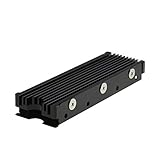
- 【Designed for M.2 SSD】-The heat sink is specially designed for M.2 2280mm SSD, which is very suitable for desktop computers/Playstation 5, etc.
- 【Double-sided cooling】- Aluminum alloy-Groove design, greatly increase the heat dissipation area, with 10°C - 30°C cooling effect (Varies depending on the environments), cool your M.2 SSD to a safe temp to avoid overheating and throttling, improving the performance of your computer.
- 【Easy to Install and Operate】 - With double-sided clip design, 6 adjustable height screws, suitable for M.2 SSD of various heights, stable installation, better protection of your M.2 SSD.
- 【Unique Nano Thermal Pad】- Advancing Gene thermal pad is made from Nano Silicon Grease Material, with good thermal conductivity ability. Soft enough and good ductility, compatible with uneven surfaces of the M.2 SSD. Low viscosity, with no damage to the SSD warranty label.
- 【Fine Workmanship】- Main body material: Aluminum alloy, silver plating (Helps eliminate static electricity), anodic oxidation surface treatment. Dimensions: 3 x 0.95 x 0.4in., net weight: 1oz., minimum installation height requirement: 12mm.
Desktop clearance checklist
- Measure the vertical gap between the M.2 socket and the graphics card backplate, fan area, or heatsink.
- Check whether a CPU cooler overhangs the M.2 socket.
- Check side-panel clearance, especially for the 74 mm-tall Thermalright HR-09.
- Confirm that a motherboard M.2 armor plate or adjacent M.2 socket will not collide with the cooler.
- Check the SSD’s single-sided or double-sided layout and maximum component height.
- Confirm that the cooler does not block PCIe slot latches, cables, or the SSD mounting screw.
- Do not assume that a cooler that fits an open test bench will fit beneath a graphics card in a closed case.
PS5 clearance checklist
- Verify Sony’s requirements for the SSD’s capacity, interface, and performance.
- Measure the complete SSD-plus-heatsink assembly, not only the heatsink.
- Confirm that the assembly fits beneath the PS5 expansion-bay cover.
- Check that the cooler does not interfere with the spacer, mounting screw, or drive orientation.
- Verify the specific PS5 revision and installation configuration before buying.
Which M2 heatsink design is best for your system?
A thin aluminum cover is best for low-power SSDs, gaming drives, tight cases, and PS5 installations. A thin cover has limited thermal mass and surface area, but the low profile reduces compatibility problems.
A two-piece sandwich heatsink is a sensible general desktop upgrade, particularly for drives with components on both sides. Sandwich coolers depend heavily on the supplied thermal pads, pad thickness, and screw pressure; a nominally high-conductivity pad cannot compensate for incomplete contact.
A heatpipe cooler is better suited to PCIe 5.0 drives, sustained writes, and hot M.2 locations when the case provides reasonable airflow. A large tower cooler maximizes passive surface area but has the greatest obstruction risk. An active fan-assisted cooler is appropriate when sustained heat is extreme or passive airflow is inadequate, but the fan adds noise, dust, power-connection requirements, and a failure point.
Thermal-pad conductivity ratings should not be treated as a complete ranking system. Thickness, softness, contact area, mounting pressure, heatsink mass, airflow, and SSD power all influence the final temperature and sustained performance.
Independent reader supportYour contribution helps us test, update, and keep practical guides available for everyone.How should you install an aftermarket M2 heatsink?
- Shut down the desktop computer and disconnect its power cable. For a PS5, follow the console’s shutdown and cover-removal procedure.
- Remove the motherboard’s M.2 cover if one is installed, and identify whether the SSD is single-sided or double-sided.
- Read the cooler instructions and choose the thermal pad arrangement intended for the SSD layout.
- Remove every protective film from the thermal pads before assembly.
- Place the pad over the controller and NAND area specified by the cooler instructions; do not cover the mounting screw or obstruct the connector.
- Install the SSD in the M.2 socket and secure the SSD mounting screw or spacer without bending the PCB.
- Place the heatsink evenly over the SSD and tighten its screws evenly, using only the manufacturer’s specified pressure or limit.
- Check that the heatsink is not pressing the SSD down unevenly and that the cooler does not touch neighboring components.
- Reinstall the graphics card, motherboard cover, side panel, or console expansion-bay cover.
- Test the SSD under the workload that previously produced high temperatures or performance drops.
Correct contact matters more than forcing a cooler tightly against the drive. Excess pressure can bend the M.2 PCB, while an incorrectly thick pad can prevent the heatsink from touching the controller. If the SSD has a factory heatsink, check the SSD manufacturer’s instructions and warranty terms before removing it.
What’s actually slowing this PC down?
Pick the symptom - the matching free tool is one click away.
How do you test whether an M2 heatsink actually helps?
Test temperature and throughput before and after installation using the same SSD, firmware, workload, ambient conditions, case fans, and fan profile. Record idle temperature, temperature during a sustained transfer, controller and NAND sensor readings where available, and throughput over time.
A useful comparison includes the bare drive, the motherboard heatsink, a compact aftermarket heatsink, a heatpipe cooler, and an active cooler when active cooling is relevant. A short CrystalDiskMark result can show burst performance, but a sustained sequential write or mixed-I/O test is more useful for exposing thermal throttling.
According to Tom’s Hardware, its iHTP review used an IOMeter workload designed to stress both NAND and a Phison E26 controller. That kind of workload is more revealing for cooler comparisons than an idle reading, but results from one SSD and one test system should not be generalized to every drive.
The meaningful result is not simply a lower temperature. The meaningful result is whether throughput remains stable instead of dropping sharply during the reader’s actual workload. A heatsink that lowers the reported temperature but does not prevent throttling may not justify its height, cost, or installation complexity.
Free tools Windows power users keep installed
One-click scans. No signup required.
What should you do if the SSD gets hotter after installation?
If the SSD becomes hotter after installing a heatsink, remove and reinstall the cooler rather than assuming the SSD has failed. A hotter result usually points to contact, pad, airflow, or sensor-verification issues.
Best Value

- The M.2 SSD cooler MC1 provides efficient cooling, enabling maximum read/write speed for single and double sided M.2 2280 modules.
- The MC1 enables lower temperatures for the M.2 SSD, which allows it to run at full performance for an extended timespan. It fits both single and double sided M.2 2280 modules.
- For shorter loading times and more free space the PlayStation5 can be extended with an M.2 SSD. Thanks to its ideal dimensions, the be quiet! MC1 is suited perfectly to provide the necessary cooling power for the extended memory.
- Check that every protective film was removed from the thermal pad.
- Inspect the pad imprint to confirm contact with the SSD controller.
- Check whether the pad is too thick, too thin, or positioned over the wrong components.
- Confirm that a lower-side pad is not pressing the SSD PCB unevenly.
- Make sure the heatsink is not trapped in a GPU-generated hot-air pocket.
- Improve case intake and exhaust airflow, then repeat the same test.
- Test the motherboard heatsink separately to identify whether the aftermarket cooler or original cover makes better contact.
- Check SSD firmware and confirm that the monitoring software is reporting the intended controller or NAND sensor.
What cooling performance and efficiency gains should you expect?
An M.2 heatsink’s main performance gain is usually consistency under sustained load, not a higher peak benchmark score. Short bursts can finish before the SSD reaches its thermal limit, while long writes, reads, mixed random I/O, and simultaneous activity on multiple drives can keep the controller and NAND active long enough for throttling to matter.
A heatsink generally does not transform the SSD’s electrical efficiency. A cooler can improve effective performance per unit of elapsed time by reducing throttling, preventing repeated slowdowns, and allowing a workload to finish sooner. Lower temperature alone does not prove lower power draw.
Cooler operation can reduce thermal stress, but cooler operation does not guarantee a longer SSD lifespan. NAND endurance, total write volume, controller behavior, firmware, power-loss events, and the manufacturer’s endurance and warranty specifications also affect service life.
Do these 3 things before closing this tab:
1Repair Windows errors before they cause bigger problems2Scan for outdated or missing drivers - takes under a minute3Clear out junk files and repair common Windows errorsFinal recommendations by user type
| User type | Recommendation | Why | Check before purchase |
|---|---|---|---|
| Enthusiast or workstation user seeking maximum passive cooling | Thermalright HR-09 2280 PRO or PRO BLACK | Large 33-fin stack and two 6 mm heatpipes provide the most passive cooling headroom in this shortlist | 74 mm height, GPU and CPU-cooler clearance, side-panel clearance, and airflow |
| Most desktop users with a hot Gen 4 or Gen 5 drive | be quiet! MC1 Pro | Compact 13 mm profile, integrated heatpipe, silent operation, and double-sided M.2 2280 support | 13 mm clearance and airflow across the motherboard |
| Low-clearance system or PS5 owner | be quiet! MC1 | 10 mm profile, double-sided support, and manufacturer-listed PS5 compatibility | Complete PS5 assembly height and the specific console revision |
| Extreme Gen 5 workload in a hot or poorly ventilated enclosure | Thermaltake MS-1 | Active airflow plus a heatpipe can add cooling where passive airflow is inadequate | 3-pin connection, fan noise, dust, and moving-part reliability |
| Budget buyer | iHTP M.2 2280 cooler, only after current verification | Tom’s Hardware reported the strongest result in its tested group at a historical $6.99 review price | Current stock, official buying channel, current price, and exact fit |
| Buyer with favorable local availability | Iceberg Thermal IceFLOE M.2 | Credible PC- and PS5-oriented alternative | Detailed dimensions and independent comparative results |
For a normal desktop, first inspect the motherboard heatsink’s contact and test the SSD under the real workload. If the drive throttles and clearance permits, choose the MC1 Pro for a balanced upgrade or the HR-09 2280 PRO for maximum passive capacity. Choose the MC1 when low height or PS5 fit matters most, and choose the MS-1 only when the workload and airflow justify active cooling.
Frequently Asked Questions
Do M.2 SSDs need an aftermarket heatsink?
Many M.2 SSDs do not need an aftermarket heatsink for ordinary desktop use or gaming when the included motherboard heatsink makes proper contact. An aftermarket heatsink becomes more useful for PCIe 5.0 drives, sustained transfers, high ambient temperatures, restricted airflow, or repeated thermal throttling.
Is a taller M.2 heatsink always better?
A taller M.2 heatsink is not always better because cooling capacity also depends on thermal-pad contact and airflow. A 74 mm tower such as the Thermalright HR-09 2280 PRO may cool strongly but can conflict with a GPU, CPU cooler, motherboard armor, or side panel.
Can the be quiet! MC1 be used in a PS5?
The be quiet! MC1 is listed by be quiet! as compatible with the PlayStation 5 M.2 slot, but the complete SSD-and-heatsink assembly must still meet the console’s clearance and installation requirements. M.2 2280 compatibility alone does not prove that every SSD and cooler combination fits.
Windows Errors? Fix Them Before They Spread
Repair common Windows errors and clear accumulated junk for a smoother, more stable PC - no reinstall needed.Free scan · no reinstallOutdated Drivers Are Slowing You Down
One free scan finds every outdated or missing driver and matches the right update for your exact hardware.Free scan · exact hardware matchDoes an M.2 heatsink improve SSD power efficiency?
An M.2 heatsink generally does not reduce the SSD’s electrical power consumption. A cooler can improve effective performance per unit of elapsed time by reducing thermal throttling and allowing sustained workloads to complete with fewer slowdowns.
What should I check if my motherboard M.2 heatsink seems ineffective?
Inspect the thermal-pad imprint after removing the cover and confirm that the pad contacts the SSD controller. Check pad thickness, compression, single- or double-sided SSD layout, mounting pressure, and airflow before replacing the motherboard heatsink.
The Bottom Line
Bottom line: Choose the Thermalright HR-09 2280 PRO when maximum passive cooling and desktop clearance are both available. Choose the be quiet! MC1 Pro for the best compact premium balance, the be quiet! MC1 for low-clearance or PS5-oriented installations, and the Thermaltake MS-1 only for sustained workloads that justify active cooling. Before buying any aftermarket cooler, verify the motherboard heatsink’s contact and measure the complete installation.
Quick Recap
Product prices and availability are accurate as of the date/time indicated and are subject to change. Any price and availability information displayed on Amazon at the time of purchase will apply.
Quick wins for a faster PC:
Repair Windows errors before they cause bigger problemsFix Now →Fix the driver behind crashes, sound loss and screen glitchesFind Drivers →Clear out junk files and repair common Windows errorsFree Scan →
