
Crashes, No Sound, or Screen Glitches?
Random freezes, missing sound and display glitches usually trace back to one bad driver. Find and replace yours safely.Free scan · under a minutePC Slower Than It Used to Be?
A free scan shows the junk files, broken settings and background clutter dragging Windows down - then fixes them in one click.Free scan · Windows 10 & 11iTechGuides is reader-supported. When you buy through links on our site, we may earn an affiliate commission. As an Amazon Associate I earn from qualifying purchases. Learn more
The best iPhone and iPad apps to learn piano depend on your goal: Simply Piano is the easiest starting point for most complete beginners, flowkey is strongest for song-based learning, Skoove offers the best balance of lessons and theory, Yousician excels at motivation, and Piano Marvel is the better choice for notation and sight-reading.
No app is a complete replacement for a piano teacher. Piano apps are particularly useful for guided lessons, repetition, note-and-timing feedback, song practice, and building a daily habit; they are much less reliable at diagnosing posture, hand tension, fingering, phrasing, pedaling, and other physical or musical details.

Key takeaways
- Simply Piano is the friendliest choice for an absolute beginner, while Skoove is better suited to learners who want theory, reading, technique, and songs in one structured course.
- flowkey is the strongest fit for recognizable songs and video demonstrations, but a large song catalog does not by itself provide complete piano training.
- Yousician is useful for learners who need scores, challenges, streaks, and immediate feedback to practice consistently.
- Piano Marvel is the most natural fit for notation-focused practice, measurable exercises, teachers, parents, and digital-keyboard owners using MIDI.
- An iPad is generally more comfortable than an iPhone for notation, sheet music, video demonstrations, and longer sessions, although an iPhone is sufficient for trying an app or practicing briefly.
- MIDI usually provides more dependable note detection than microphone recognition on a digital piano, while microphone mode remains important for acoustic-piano owners.
Which piano-learning app is best for you?
The best iPhone and iPad apps to learn piano serve different kinds of learners. Choose the app according to the skill you want to build rather than by App Store rating, song count, or the most attractive introductory offer.
What’s actually slowing this PC down?
Pick the symptom - the matching free tool is one click away.
| App | Best fit | What the app emphasizes | Main limitation |
|---|---|---|---|
| Simply Piano | Absolute beginners, families, and intimidated learners | Step-by-step courses, visual guidance, songs, rewards, and immediate feedback | Progress can feel more song- and game-oriented than a comprehensive traditional method |
| flowkey | People motivated by favorite songs and demonstrations | Video lessons, interactive note-following, graded arrangements, and practice controls | Song-first learning can leave gaps in technique, reading, and musical correction |
| Skoove | Beginners wanting a broad, balanced course | Lessons, theory, note reading, technique, songs, videos, looping, and tempo tools | A large curriculum does not guarantee deep physical or technical instruction |
| Piano by Yousician | Learners who need motivation and regular practice | Game-like progression, challenges, songs, goals, and immediate performance feedback | Scores and streaks may not develop notation, phrasing, or technique deeply enough |
| Piano Marvel | Sight-reading, structured practice, teachers, parents, and MIDI users | Notation-focused lessons, measurable exercises, and practice tracking | Less casual and immediately entertaining than consumer-oriented alternatives |
What does “learn piano” actually mean?
Learning to play a few simplified songs is a valid short-term goal, but it is not the same as developing independent piano skills. A useful piano-learning app should help with some combination of keyboard geography, finger numbers, rhythm, reading treble and bass clefs, two-hand coordination, chords, scales, technique, and repertoire.
Popular on Amazon

- UNLIMITED CONNECTION: This true full size 61 key keyboard piano is made of premium material. The LCD display can simply and clearly displays the status of the functions being used. With audio input/output/microphone jack(with UDISK port),you can connect microphone and headphone(included), you will not interfere with others when practicing singing and playing late at night, fully enjoy the music
- TIMBRE AND RHYTHM: JIKADA 61-key electronic music keyboard has two built-in stereo speakers, provide 255 tones, 255 rhythms, 50 demo songs and 61 types of keyboard percussion and give you premium sounds and effects. With status memory function, you can save the tone, rhythm, tempo and other parameters to be changed during playing, for fast shifting
- 3 TEACHING MODES: JIKADA 61 light-up keys keyboard piano with 3 powerful teaching modes, lead you to step by step. And piano note stickers help you more easily to learn and memorize the music theory, musical notations and keys positions
- MULTI FUNCTIONS: This electronic keyboard has master volume/ accom volume/ tempo control, single-finger chords, fingered chords, sustain, vibrato, split, transposition, metronome, volume or transpose control. With record and playback function, and the playback function can also help the performer recall the performance effect and make targeted connections to improve the performance next time
- SUPER BUNDLE: Includes a keyboard (size: 36.4in * 13.4in * 3.5in), a x-shaped stand, a soft stool, headphones, a microphone, a music rest and a power adapter. And the stool can be folded for convenient storage and space-saving. This item is not intended for users under 12 years old
Over time, a serious learner also needs to develop dynamics, articulation, pedaling, sight-reading, memorization, listening, self-correction, relaxed movement, and the ability to play a complete piece musically. Interactive apps can support several of these areas, but “correct note” feedback is not comprehensive piano instruction.
An app may recognize that a player pressed the wrong key without explaining whether the cause was poor fingering, an awkward hand position, rushing, tension, or failure to look ahead. An app also cannot reliably assess shoulder tension, wrist alignment, inefficient movement, voicing, expressive phrasing, or whether the sustain pedal is being used musically.
How do the leading piano apps teach?
Simply Piano: best for an easy, confidence-building start
Simply Piano is the best starting point for many absolute beginners because its step-by-step courses, visual guidance, song library, short workouts, and immediate feedback reduce the intimidation of traditional piano study. The US App Store listing for Simply Piano describes support for acoustic and MIDI keyboards or pianos, two free courses, additional courses, songs, slower playback, and practice workouts.
Simply Piano is a strong choice for a child, family, or adult who needs visible progress and frequent encouragement. The guided interface can make the first weeks easier than opening a method book and trying to interpret every instruction alone.
The trade-off is that animated guidance and song completion can make progress feel more substantial than it is. Test whether you can name the notes, count the rhythm, understand the fingering, and play a short passage without following the display. If you can only reproduce the moving prompts, your transfer to printed music may be weaker than your in-app score suggests.
Who should skip it: experienced players who already read comfortably and want advanced repertoire, nuanced technical correction, or teacher-level interpretation.
Pricing: A US App Store snapshot from August 2026 displayed multiple individual, family, monthly-style, annual-style, and promotional offers, including amounts such as $19.99, $119.99, $149.99, and $179.99. These are not one permanent price: Simply’s subscription support page says pricing varies by country, platform, plan, and promotion. Check the renewal terms in the app before subscribing.
flowkey: best for learning recognizable songs
flowkey is the best fit for song-driven learners who want to see a pianist’s hands and begin playing familiar music quickly. The flowkey US App Store listing describes video demonstrations, interactive note-following, beginner courses, multiple difficulty levels, and songs from classical, pop, film, television, and other categories.
flowkey is particularly appealing to adults who prefer a calmer, less game-like experience. Tempo adjustment, repetition, and playback controls make it easier to isolate a difficult section instead of repeatedly starting a complete song.
Song arrangements are not the same as a complete curriculum. A learner can accumulate recognizable pieces while still struggling with sight-reading, scales, efficient fingering, rhythm away from the app, or expressive interpretation. Use the beginner courses and notation features rather than treating flowkey only as a song catalog.
Also popular on Amazon
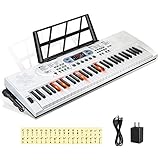
- 【Perfect for Beginners】 Hricane 61-key electronic keyboard is perfect for beginners and players of all skill levels, and made for kids and adults alike. The attached keyboard sticker can help beginners familiarize themselves with the position of the scale.
- 【A Variety of Functions】This digital keyboard has 200 tones, 200 rhythms, 70 demo songs, teaching mode, recording, programming, sustain tremolo, dual speakers, LCD display and other functions, allowing you to get endless fun playing.
- 【Lighted Keys】61 keys with lights, suitable for beginners to play. Turn on the teaching mode, you can learn with the illuminated keyboard, and you can also adjust the speed of teaching mode. Note: When you don't need to light up the keyboard, you can turn it off, so it becomes a normal keyboard.
- 【Smart Chords and Dual Keyboards】 Chords can be played with single finger chords and multi-finger chords; dual keyboard playing allows parents and children to play the piano interactively.
- 【Product Details】 Product size: 76 * 23 * 6cm / 30" * 9" * 2.3"(L * W * H) and Weight for 2.5 KG. Piano keyboard will come with a Microphone, a Key Sticker, an USB cable with adaptor and an audio cable(Please Note That all accessories are put in the white foam box).
flowkey supports acoustic pianos, digital pianos, and keyboards through the device microphone or supported Bluetooth/MIDI connections. That flexibility makes flowkey a reasonable option for both acoustic-piano owners and digital-keyboard users, although recognition quality depends on the setup.
The Tool Desk
Outbyte PC Repair FREEClear out junk files and repair common Windows errorsFree Scan →Outbyte Driver Updater FREEFix the driver behind crashes, sound loss and screen glitchesFind Drivers →Who should skip it: learners who need intensive correction of posture, hand movement, or technique, or who want a clearly teacher-supervised curriculum.
Pricing: A US App Store snapshot from August 2026 displayed offers of approximately $19.99, $24.99, $29.99, $119.99, $139.99, and $149.99, depending on the product or subscription offer. The listing required iOS/iPadOS 15.6 or later. Because the listing contains multiple offers, verify the price and renewal conditions inside the app.
Skoove: best balanced curriculum for beginners
Skoove is the strongest general-purpose choice for learners who want more than song play-throughs. The Skoove iPad App Store listing describes structured lessons, bite-sized exercises, music theory, note reading, technique, instructional videos, audio or AI feedback, tempo controls, looping, and more than 500 lessons and courses.
Skoove suits a beginner who wants a mixture of methodical instruction and enjoyable repertoire. Short lessons can work well for a person with only 5–15 minutes available, provided the learner spends some of that time repeating passages rather than simply advancing through new screens.
Free tools Windows power users keep installed
One-click scans. No signup required.
The main caution is that breadth is not the same as depth. Skoove can tell you whether notes are being played correctly and can organize practice, but the app cannot fully diagnose tension, inefficient movement, inappropriate fingering, or musical phrasing. Add occasional human feedback if those issues matter.
Who should skip it: someone seeking a completely free course, or someone who wants only a narrow specialty such as advanced classical technique or casual song entertainment.
Pricing: A US App Store snapshot from August 2026 displayed Premium offers of $19.99, $29.99, $59.99, and $149.99, including trial-related products. The listing does not establish one universal price for every user, so check the offer shown for your account and region.
Piano by Yousician: best for motivation and practice habits
Piano by Yousician is the best fit for learners who struggle to practice consistently. The app uses lessons, songs, challenges, progression, and immediate feedback to create a game-like practice loop. The Piano by Yousician App Store listing describes microphone listening, feedback, tutorials, songs, and challenges for iPhone and iPad.
Scores, goals, reminders, and streak-like progress can turn an inconsistent learner into someone who practices regularly. That benefit is educationally important: a good six-month habit usually matters more than choosing an app with a theoretically perfect curriculum that the learner never opens.
Also popular on Amazon

- 61 key keyboard piano kit: complete beginner set with stand, bench, headphones and note stickers.
- Expressive playing: pitch bend wheel and LED panel with 200 rhythms, 200 tones and demo songs.
- Learn faster: Simply Piano lessons and keynote stickers guide kids and adults note by note.
- Quiet practice: headphones keep sessions private in shared rooms and family spaces.
- Everything included: start playing on day one with fewer extra purchases.
The same game layer can also become a distraction. Passing a song is not the same as learning to read ahead, shape a phrase, control dynamics, use the pedal, or recover calmly after a mistake. Treat the score as one signal, not a complete evaluation of musicianship.
Who should skip it: learners who dislike game mechanics or want traditional notation, technique, and musical interpretation to dominate every session.
Pricing: Yousician pricing varies by region, plan, and purchase channel. The available research does not establish a reliable August 2026 US price, so check both the current US App Store offer and the official Yousician piano page before paying. Do not rely on an old comparison article’s price.
Piano Marvel: best for notation and measurable practice
Piano Marvel is the best candidate for learners who prioritize standard notation, sight-reading, structured exercises, and measurable practice. Piano Marvel is especially relevant to parents, teachers, and digital-keyboard owners who want progress tracking rather than a purely entertainment-led experience. Its official product information should be checked at Piano Marvel’s website for current iPad availability, operating-system requirements, MIDI compatibility, lesson access, and subscription pricing.
Piano Marvel may be a better long-term supplement than a song-first app for a student who wants to read music independently. The downside is motivational: method-oriented exercises can feel less immediately rewarding than a popular song or game challenge.
Use Piano Marvel with a digital piano or keyboard that can send MIDI when possible. MIDI can make note and timing detection more dependable, but connection requirements and support can differ by keyboard, cable, operating system, and app configuration.
Who should skip it: casual learners who want the most visually entertaining, phone-first experience or who are likely to abandon structured exercises without a strong external routine.
Recommended Free Tools
Pricing: The available research does not provide a sufficiently authoritative August 2026 price snapshot. Verify the current price directly with Piano Marvel rather than importing a figure from an older comparison.
Which app is best for each type of learner?
| Learner or goal | Best starting choice | Why | Important qualification |
|---|---|---|---|
| Absolute beginner | Simply Piano | Friendly sequencing, visual explanations, immediate feedback, and short guided activities | Add notation practice so visual prompts do not become the only way you play |
| Adult returning after years away | flowkey or Skoove | flowkey offers demonstrations and songs; Skoove offers a broader refresher curriculum | Choose the interface you will actually use several times per week |
| Child learning without a private teacher | Simply Piano or Yousician | Rewards, visible progress, and structured activities can support motivation | An adult should observe posture, tension, counting, and playing without prompts |
| Acoustic-piano owner | flowkey, Simply Piano, or Skoove | These options support microphone-based listening, which does not require MIDI hardware | Room noise, resonance, pedals, and device placement can reduce recognition accuracy |
| Weighted digital-piano owner | Piano Marvel or Skoove | Notation or structured lessons pair well with a stable keyboard and MIDI connection | Confirm the exact MIDI connection supported by the keyboard and app |
| Pop-song learner | flowkey or Simply Piano | Recognizable arrangements and guided song practice make the first payoff quick | A simplified arrangement is not the same as learning accompaniment, voicings, or rhythm patterns |
| Classical or notation-focused learner | Piano Marvel | Notation, sight-reading, structured exercises, and measurable practice are central priorities | Use a teacher or method book for technique, phrasing, scales, and interpretation |
| Motivation-sensitive learner | Yousician | Challenges, scores, goals, and progression can make regular practice easier | Do not optimize only for points or lesson completion |
| Student who already has a teacher | Piano Marvel or flowkey | Useful for repetition, tempo work, supplemental repertoire, sight-reading, and practice logs | The teacher’s fingering, technical instructions, and interpretation should take priority |
| Limited to 5–15 minutes | Skoove or Simply Piano | Bite-sized lessons and short practice activities fit brief sessions | Repeat one small passage carefully instead of rushing through multiple lessons |
How should you compare piano apps before subscribing?
Compare curriculum quality, notation instruction, feedback, practice tools, hardware compatibility, screen usability, and total subscription terms. A high song count is useful only when arrangements are graded, searchable, playable at the learner’s level, and connected to transferable skills.
- Curriculum: Look for sequenced lessons rather than only a song catalog. Check whether the course continues beyond the first beginner stage.
- Notation: Confirm that the app teaches note names and rhythms and offers a path toward playing from a score without animated assistance.
- Feedback: Determine whether the app detects wrong notes, timing, duration, and rhythm, and whether it explains errors or merely produces a pass/fail result.
- Practice tools: Look for slow tempo, looping, section repetition, hands-separate practice, a metronome, recording, progress tracking, daily goals, and technical or sight-reading drills.
- Hardware: Confirm iPhone and iPad support, the minimum iOS/iPadOS version, microphone behavior, Bluetooth MIDI, USB MIDI, and acoustic-piano compatibility.
- Value: Check whether meaningful content is free, how long the trial lasts, whether the offer is monthly or annual, how renewal works, and what remains accessible after cancellation.
App Store ratings mainly describe satisfaction, usability, entertainment value, and whether the product met a user’s expectations. Ratings do not establish long-term musical outcomes, and song count does not prove teaching quality.
Also popular on Amazon

- ✔️【Full Size 61 Piano for Beginners】To explore the beauty of music and enhance learning interest. LED Lighted-key Keyboard Piano with 3 teaching modes offers game-like practice. Good learning partner but also a professional teacher, HD Display keys light up in demo note order, guide them from beginner to advanced level professional
- ✔️【Keyboard with Lighted Up Keys】61 Key Piano Keyboard's versatile white body and stylish design can be easily integrated into different styles of family spaces; Like a blank canvas, its allow re-design to paint or paste favorites pattern to inspire creativity and imagination, specially designed for artistic beauty and musical creativity, suitable for people especially beginners
- ✔️【Superior Electric Piano Sound】Equipped with two built-in 5W speakers, 61 electric piano delivers room-filling sound. Its slim piano body makes it portable and perfect for indoor or outdoor activities. Rich functions like sustain, vibrato, dual keyboard, chord, microphone gift, recording, playback, etc., Considerate for beginners, Our electronic keyboard features USB connectivity, EQ and audio line output, allowing it to be connected to speakers for sound amplification
- ✔️【Powerful Features】Many buttons to mess around with, Massive Sound Library meets beginners' strong curiosity in music, up to 600 timbres & rhythms, 50 demo songs, 8 percussions, cultivate beginners recognition of different musical instruments at ease. Music note displays on the large LED screen clearly, reduce dependence on stickers, help recognize notes by listening
- ✔️【Durable Safe Portable】Made of environmental protection rosin, safe and portable ABS material, fine workmanship, it will not cause harm to users. Moderate default volume protects users' ears, with an earphone jack to practice silently immersively. Keyboard size is 0.866 inch wide. Powered by 6 AA batteries, or charge by cable is both available, suitable for home, outdoor, lesson, and other occasions
Is an iPhone or iPad better for learning piano?
An iPad is generally better for serious piano practice because notation, video demonstrations, and full-keyboard interfaces are easier to see. An iPhone remains practical for short sessions, microphone recognition, and testing an app before buying another device.
| Device | Advantages | Limitations | Best use |
|---|---|---|---|
| iPhone | Portable, commonly already owned, convenient for brief sessions, adequate for microphone feedback | Smaller notation, less visibility of both hands and the keyboard, awkward positioning over a piano | Trying an app, traveling, or practicing for a few minutes |
| iPad | Larger notation, clearer videos, easier placement on a music rest, more comfortable for longer sessions and visual limitations | Costs more if not already owned; older models may not meet current operating-system requirements; wired MIDI may require an adapter or hub | Regular practice, sight-reading, video instruction, and children’s lessons |
A larger screen does not correct an app’s instructional limitations, and an iPad is not mandatory. If you already own an iPhone, start with it. If you already own a compatible iPad, the larger display may improve usability more than changing between similar apps.
How does microphone recognition compare with MIDI?
Microphone recognition listens to the piano’s sound and tries to infer the notes, while MIDI sends digital note events directly from a compatible keyboard. MIDI is usually more reliable for digital pianos; microphone mode is the practical option for acoustic pianos and keyboards without MIDI.
| Connection | Works best when | Common problems | How to improve results |
|---|---|---|---|
| Microphone | The instrument is acoustic or lacks MIDI, the room is quiet, and the device is positioned near the piano | Background noise, resonance, overlapping notes, sustain-pedal confusion, soft or repeated notes, and the app hearing its own playback | Lower the piano volume, move the device closer, use headphones for app audio, release the pedal during testing, and keep the device stable |
| Bluetooth MIDI | A digital piano or keyboard supports Bluetooth MIDI | Pairing failures, disconnections, permissions, and inconsistent support for particular configurations | Grant Bluetooth permission, connect before opening the app if necessary, disconnect unused Bluetooth devices, and reconnect if detection fails |
| USB MIDI | A digital piano or keyboard has USB-MIDI or five-pin MIDI output | Required adapters, hubs, cables, power limitations, or unusual/incomplete MIDI data | Use a compatible adapter or interface, select the correct input inside the app, and test single notes, chords, sustain, and both hands |
Exact menu names differ by app and version. In general, grant microphone and Bluetooth permissions, choose the keyboard or MIDI input in the app’s settings, and test the connection before beginning a paid course.
Independent reader supportYour contribution helps us test, update, and keep practical guides available for everyone.How do you troubleshoot wrong-note or missed-note detection?
If an app hears the wrong notes, first determine whether the problem comes from the acoustic environment, the selected input, or the MIDI connection. Lower the instrument volume, move the device closer to the sound source, use headphones for app playback, release the sustain pedal, and make sure a second instrument is not producing sound.
Do these 3 things before closing this tab:
1Fix the driver behind crashes, sound loss and screen glitches2Clear out junk files and repair common Windows errors3Scan for outdated or missing drivers - takes under a minute- Check that the app has microphone and Bluetooth permission.
- Confirm that the intended keyboard or MIDI input is selected.
- Move an iPhone or iPad to a stable position with a clear view of the display and a useful sound balance.
- Test one note, a chord, sustain, and both hands separately.
- If Bluetooth MIDI fails, disconnect nearby Bluetooth devices, restart the app, and pair the keyboard again.
- If the instrument supports MIDI, try a wired connection; if wired MIDI fails, test microphone mode to isolate the problem.
Microphone recognition can be affected by room noise, sustain-pedal resonance, acoustic-piano volume, speaker placement, and overlapping notes. MIDI avoids much of that acoustic uncertainty but introduces cables, adapters, permissions, and compatibility issues.
What can piano apps not teach well?
Piano apps are strongest at structured repetition, note and timing feedback, guided repertoire, and practice motivation. Piano apps are weaker at physical technique and musical interpretation, so learners should periodically play without prompts and obtain human feedback when possible.
- Posture and tension: An app may not notice raised shoulders, collapsed wrists, excessive finger force, or inefficient movement.
- Fingering: A note detector can accept the right pitch even when the fingering creates a problem in the next measure.
- Musicality: Correct notes and rhythm do not automatically produce appropriate dynamics, articulation, voicing, phrasing, or pedaling.
- Independent reading: Prompt-following can hide an inability to look ahead, recognize patterns, maintain a pulse, or recover after a mistake.
- Individual diagnosis: A teacher can identify why a learner is stuck and adapt the explanation, exercise, fingering, or repertoire.
Every few practice sessions, play a short piece from printed music or memory with the app closed. Ask whether you can maintain the pulse, recover after errors, identify patterns, and listen critically. That test reveals more about independent progress than an in-app completion badge.
How should parents supervise a child using a piano app?
Parents should treat a piano app as a practice aid rather than an unsupervised substitute for instruction. Observe whether the child is relaxed, counting, using sensible hand positions, and able to explain or play the notes without visual prompts.
Quick wins for a faster PC:
Scan for outdated or missing drivers - takes under a minuteDriver Scan →Clear out junk files and repair common Windows errorsFree Scan →Fix the driver behind crashes, sound loss and screen glitchesFind Drivers →- Watch for shoulder, wrist, and finger tension.
- Ask the child to count or clap a rhythm before playing it.
- Check whether the child understands note names rather than memorizing falling patterns.
- Have the child play a familiar passage with the visual prompts hidden or the app closed.
- Prioritize relaxed movement and understanding over scores, streaks, or lesson completion.
How should you test an app during a free trial?
Use a 20–30-minute test session with your actual iPhone or iPad and your actual piano before committing to a subscription. A polished demo on a different device or keyboard cannot prove that recognition, screen size, or lesson difficulty will suit you.
Also popular on Amazon
- Complete one instructional lesson and note whether the explanation makes sense without outside help.
- Try a song below your current level, then try one at your target level.
- Test microphone mode or MIDI using single notes, chords, sustain, and both hands.
- Find a notation-only or notation-heavy mode and determine whether you understand the score.
- Try hands-separate practice, slowing the tempo, looping a section, and repeating a mistake.
- Close the app and attempt part of the piece independently.
- Read the subscription, renewal, cancellation, family-plan, and post-cancellation terms before entering payment details.
Meaningful access is commonly subscription-based even when an app is free to download. Simply Piano’s listing specifically identifies two free courses, but free access across competing apps can differ by account, trial, region, and offer. Treat a “free download” as an opportunity to test the product, not as proof that a complete free course is available.
What is the best long-term way to learn piano with an app?
The strongest long-term approach is an app plus occasional feedback from a qualified teacher or a well-chosen method book. Use the app for repetition, tempo practice, sight-reading, supplemental repertoire, and practice logs; use a teacher to correct posture, tension, fingering, technique, pedaling, and interpretation.
Students who already take lessons should tell the teacher which app they use. An app’s suggested fingering or interpretation may conflict with the teacher’s plan, and the teacher’s instructions should take priority. A weighted digital piano with touch sensitivity, a sustain-pedal input, and MIDI is a useful long-term setup, but a learner does not need an expensive digital piano to begin.
The Tool Desk
Outbyte Driver Updater FREEScan for outdated or missing drivers - takes under a minuteDriver Scan →Outbyte PC Repair FREERepair Windows errors before they cause bigger problemsFix Now →If you practice only twice a week, an annual subscription may provide poor value compared with a free resource, a method book, or occasional lessons. If you practice most days and the app’s structure removes friction, a subscription may be worthwhile. The right purchase is the one that matches your practice frequency and learning goal.
Final recommendations
Choose Simply Piano for the easiest, friendliest start; choose flowkey if recognizable songs and video demonstrations are your main motivation; choose Skoove for a broad beginner curriculum that combines theory, reading, technique, and songs; choose Yousician if gamification is what keeps you practicing; and choose Piano Marvel if notation, sight-reading, and measurable exercises matter most.
For serious development, do not ask which app will replace piano instruction. Ask which app will help you practice the right skills consistently, then add a teacher, method book, or independent playing routine to cover what the app cannot evaluate.
Frequently Asked Questions
Can I learn piano with an iPhone without a MIDI keyboard?
Yes. Microphone-based recognition lets many piano apps listen to an acoustic piano or a keyboard without MIDI, although accuracy depends on room noise, device placement, volume, resonance, sustain-pedal use, and overlapping notes. MIDI is usually more dependable when a compatible digital piano is available.
What’s actually slowing this PC down?
Pick the symptom - the matching free tool is one click away.
Is an iPad required to use piano-learning apps?
No. The leading apps support iPhone as well as iPad, but an iPad is more comfortable for notation, video demonstrations, full-keyboard visibility, and longer practice sessions. An iPhone is adequate for short sessions or trying an app before buying another device.
Can a piano app replace a private teacher?
No. Piano apps provide useful guided lessons, repetition, and feedback on notes or timing, but they do not reliably diagnose posture, hand tension, fingering, efficient movement, phrasing, voicing, or pedaling. Occasional teacher feedback is especially valuable for children, classical learners, and students who are stuck.
Are piano-learning apps free?
Most leading piano apps are free to download but place substantial lessons, songs, or features behind a subscription or trial. Prices vary by country, platform, plan, promotion, and account, so check the current offer and renewal terms in the US App Store or the relevant official service before subscribing.
The Bottom Line
Bottom line: There is no universal winner. Simply Piano is the easiest entry point, flowkey is strongest for song learning, Skoove offers the broadest balanced beginner experience, Yousician is the best motivator, and Piano Marvel is the better notation-focused option. Use the app that fits your goal, test it with your own instrument, and add human feedback for technique and musicality.
Do these 3 things before closing this tab:
1Fix the driver behind crashes, sound loss and screen glitches2Repair Windows errors before they cause bigger problems3Scan for outdated or missing drivers - takes under a minute
