
AVR-Laptop is a DIY mini-computer built around an ATmega2560-based Arduino-compatible board. It runs a multitasking interface with small apps and games, plays audio, and shows video on a 128×64 monochrome screen—but its 8 KB of SRAM makes every feature an exercise in careful allocation. The project is an exploration of what an 8-bit AVR can do, not a replacement for a conventional laptop.
What is AVR-Laptop?
Vladimir’s ongoing AVR-Laptop project packs a custom QWERTY keyboard, monochrome LCD, audio hardware, storage, and battery into a 3D-printed enclosure measuring 12×11×3.4 cm. Its controller is an Arduino-compatible Mega 2560 Pro Mini built around the ATmega2560. Hackster.io has also published an independent summary of the build.
The project overview describes a 128×64 ST7920-based LCD, VS1053 audio decoder and speakers, microSD storage, a real-time clock, and an 18650 battery. FreeRTOS provides the firmware’s task scheduling. The owner chose the compact board in part to keep the computer small and make replication simpler.
What it can run
The project owner reports an interface with Alt-Tab task switching and a shared UI engine. Its listed applications include a file manager, video and music players, clock, calculator, Sokoban, Snake, and Game of Life. A text editor is described as under development. These are small, purpose-built applications running within the system’s hardware limits, not desktop software for a general-purpose operating system.
Free tools Windows power users keep installed
One-click scans. No signup required.
#1 Best Overall

- START CODING WITH THE ELEGOO UNO R3: Connect the included USB cable, upload your first sketch, and build sensor, motor, display, and automation projects, making it a practical controller for maker desks, classrooms, coding clubs, and robotics labs
- ATMEGA328P CORE FOR EVERYDAY PROJECTS: A 16 MHz clock, 32 KB flash, 14 digital I/O pins with 6 PWM outputs and 6 analog inputs provide a versatile foundation for LEDs, buttons, relays, servos, displays and sensors
- RELIABLE USB PROGRAMMING AND CLEAR WIRING: The ATmega16U2 USB interface supports sketch uploads and serial communication, while clearly labeled headers help simplify connections to jumper wires, shields and modules
- POWER AND EXPAND YOUR WAY: Run the board from USB or a recommended 7-12 V external supply, then add compatible shields and modules for data logging, automation, robotics, test fixtures and custom electronics projects
- BOARD AND USB CABLE INCLUDED: Comes with 1 ELEGOO UNO R3 development board and 1 USB-A to USB-B data cable; breadboard, sensors, shields and power adapter are not included, and younger learners should work with an experienced adult
Why 8 KB of SRAM changes the design
The ATmega2560 has 8 KB of SRAM, a device figure also noted in Hackster’s coverage; see Microchip’s ATmega2560 product page for the chip’s official identity. Vladimir says global variables and system services use roughly half of that memory. A one-bit framebuffer for a 128×64 display occupies 1,024 bytes, or 1 KB, before the firmware allocates memory for task stacks, application state, and other data.
That small budget affects architecture, not just how many files or images fit. The owner says task stacks had to be kept small and data structures lean. A display buffer, UI services, and multiple tasks all compete for the same limited SRAM, so adding features requires managing memory carefully.
How the monochrome display handles graphics
The display has 128 pixels across and 64 down, with each pixel represented by one bit in the framebuffer. Vladimir selected parallel signaling to speed up communication with the ST7920 controller and wrote a driver for pixel operations, drawing primitives, text, and XBM images.
Rank #2
![Arduino Uno REV3 [A000066] - ATmega328P Microcontroller, 16MHz, 14 Digital I/O Pins, 6 Analog Inputs, 32KB Flash, USB Connectivity, Compatible with Arduino IDE for DIY Projects and Prototyping](https://m.media-amazon.com/images/I/515P6aYSP4L._SL160_.jpg)
- ATmega328P Microcontroller: Powered by the reliable ATmega328P, running at 16 MHz with 32KB of flash memory, 2KB SRAM, and 1KB EEPROM, offering ample resources for a wide range of basic to advanced electronics projects.
- 14 Digital I/O Pins & 6 Analog Inputs: Features 14 digital I/O pins (6 of which support PWM output) and 6 analog inputs (10-bit resolution), providing flexible options for sensors, motors, and other external components.
- USB Connectivity for Easy Programming: The built-in USB port allows for direct programming and serial communication, enabling a simple connection to your computer for sketch uploading and debugging through the Arduino IDE.
- Compatible with Arduino IDE: Full compatibility with the Arduino IDE ensures easy access to a vast array of libraries, code examples, and community-driven projects, making the Uno a great choice for both beginners and experienced makers.
- Widely Used in Education & Prototyping: The Arduino Uno is a standard in educational environments, widely used for learning and teaching electronics and programming. It's perfect for prototyping, robotics, IoT projects, and more.
Text placement is one example of the low-level work involved. When a character starts at a horizontal position that does not align with a framebuffer byte boundary, its bits must be shifted and divided between adjacent bytes. A character can therefore require updates to more than one byte even though it occupies a fixed number of pixels.
The Tool Desk
Outbyte PC Repair FREERepair Windows errors before they cause bigger problemsFix Now →Outbyte Driver Updater FREEFix the driver behind crashes, sound loss and screen glitchesFind Drivers →In the project log, Vladimir reports that sending an XBM frame initially took about 40 ms and later about 32 ms after optimization. The builder says much of the delay came from waiting for the display controller rather than from CPU computation. The changes included moving byte transfers into a timer interrupt and sending only rows marked as changed through a dirty-line mechanism. Those timings are project-reported measurements, not an independent benchmark.
How AVR-Laptop plays video and audio
AVR-Laptop does not decode a conventional compressed video codec. Its custom playback format combines monochrome XBM image frames with MP3 audio in one file. A Python converter extracts source-video frames, converts them to 128×64 monochrome images, and prepares them for playback from microSD. During playback, the AVR reads the frames into its framebuffer while the VS1053 handles audio decoding.
Rank #3
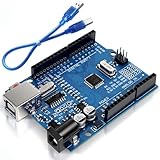
- Unlock your creativity with the versatile UNO R3 Board ATmega328P! Explore endless possibilities in electronics projects with its user-friendly Arduino development environment, extensive digital and analog I/O pins, and compatibility with various sensors and modules. Let your imagination soar!
- Experience the power of UNO R3 Board ATmega328P! This feature-packed development board boasts a high-performance ATmega328P microcontroller, 32KB of flash memory, and 2KB of SRAM. It's perfect for both beginners and advanced users seeking to build innovative applications in robotics, home automation, and more.
- Ignite your passion for electronics with the UNO R3 Board ATmega328P! Its open-source design allows for customization, while its 14 digital I/O pins and 6 analog input pins provide ample connectivity options. Get ready to bring your ideas to life and create interactive projects like never before.
- Elevate your DIY projects with the UNO R3 Board ATmega328P! This highly versatile development board offers seamless integration with the Arduino ecosystem, providing access to a vast library of code and resources. With its reliable performance and broad compatibility, you can easily prototype and realize your electronic dreams.
- Discover the endless potential of the UNO R3 Board ATmega328P! With its robust communication interfaces, including UART, SPI, and I2C, you can connect and communicate with a wide range of devices. Whether you're a hobbyist or a professional, this powerful development board is a must-have for creating innovative and interactive electronic systems.
Vladimir reports playback at 24 frames per second or more with sound. Hackster repeats the claim but does not describe laboratory testing, so treat it as the builder’s reported result rather than independently verified performance. The AVR still has to coordinate frame changes and keep the audio decoder supplied with data.
The owner also describes temporal dithering to suggest shades of gray on the one-bit display. It does not give the screen additional colors; the effect depends on changing the displayed pattern over time. In the video log, Vladimir writes: “The difficulty wasn’t that the AVR couldn’t keep up, but that frames had to be swapped at the right moment.”
Do these 3 things before closing this tab:
1Scan for outdated or missing drivers - takes under a minute2Repair Windows errors before they cause bigger problems3Fix the driver behind crashes, sound loss and screen glitchesWhy the project switched to FreeRTOS
The first software design used a task menu and a simple task interface. As the UI grew, separate tasks began duplicating widgets, and blocking operations could stop the shell from servicing display updates. A task that waits for an operation to finish can leave the interface stale if display work depends on that same flow.
Rank #4

- START CODING WITH A FLEXIBLE UNO R3 BOARD: Connect the included USB cable, upload sketches with Arduino IDE and build sensor, motor, display and automation projects for maker desks, classrooms, coding labs and electronics prototyping
- ATMEGA328P CORE FOR EVERYDAY PROJECTS: A 16 MHz clock, 32 KB flash, 2 KB SRAM, 1 KB EEPROM, 14 digital I/O pins with 6 PWM outputs and 6 analog inputs support LEDs, buttons, relays, servos, displays and sensors
- CH340C USB-TO-SERIAL INTERFACE: The onboard CH340C handles USB communication for sketch uploads and serial monitoring, while clearly labeled digital, analog and power headers help simplify wiring to modules and shields
- USB OR EXTERNAL POWER: Run the board from the included USB cable or a recommended 7-12 V external DC supply, then expand with compatible shields and modules for robotics, data logging, automation and custom embedded projects
- BOARD AND USB CABLE INCLUDED: Comes with 1 ELEGOO UNO R3 controller board and 1 USB-A to USB-B data cable; breadboard, jumper wires, sensors, shields and power adapter are not included
Vladimir adopted FreeRTOS and substantially rewrote the architecture. A shared UI engine handles widgets, forms, dialogs, focus, and event dispatch; individual tasks use that engine rather than directly managing one another. This helped organize concurrent work, but did not create more RAM: task stacks and UI state still had to fit within the ATmega2560’s small SRAM budget.
Independent reader supportYour contribution helps us test, update, and keep practical guides available for everyone.How the custom keyboard works
The owner describes a 64-key keyboard in an 11×6 physical arrangement and an 8×8 conceptual matrix. Matrix scanning activates one column at a time and reads the rows to determine which keys are pressed. Software debouncing waits for several scans to agree before accepting a change, reducing false input from switch bounce.
In a later revision, the builder added a diode for each key and a 4-to-16 decoder for column selection. The diodes improve simultaneous-key detection, while the decoder reduces the number of controller pins needed for selecting columns. This is the topology used in the project’s revision, not a mandatory design for every matrix keyboard.
Best Value

- TURN CODE INTO REAL-WORLD RESULTS — Follow 22+ guided lessons to make LEDs blink, read temperature and distance, move servo and stepper motors, control an LCD and respond to joystick or IR input; ideal for a family weekend build, homeschool unit, coding club or STEM classroom
- MORE PROJECT VARIETY IN ONE ORGANIZED KIT — Includes the UNO R3 controller, LCD1602 with pre-soldered header, breadboard power module, ultrasonic and DHT11 sensors, joystick, IR receiver and remote, SG90 servo, stepper motor, relay, DC motor, fan blade, displays, LEDs, buttons, resistors and jumper wires
- START WITHOUT SOLDERING — Plug-in modules, a solderless breadboard and the pre-soldered LCD help beginners focus on wiring, code and testing; the illustrated component list makes it easier to find each part and move from one lesson to the next
- LEARN THE LOGIC, THEN CREATE YOUR OWN — Use Arduino IDE and the included example code to understand digital input and output, analog sensing, timing, motor control and display functions, then change thresholds, speeds and sequences for alarms, environmental monitors, reaction games and motion projects
- CLEAR SETUP SUPPORT FOR FIRST-TIME BUILDERS — Download the latest tutorial and code, select the UNO board and correct computer port, check component polarity and breadboard rows, and keep power-module input at 9V or below; younger learners should work with an experienced adult
What would be needed to build something similar?
The project identifies component types, but it does not yet provide a complete bill of materials or a finished build guide. The owner says code, schematics, and documentation are being prepared for GitHub publication; the project page listed no files or instructions when checked. A component category alone is not enough to guarantee that a particular module or board listing will work with the design.
- Controller: an Arduino-compatible Mega 2560 Pro Mini based on the ATmega2560. Confirm the exact variant, pinout, clock, voltage, and physical dimensions before buying; these listing details are not established by the project description.
- Display: a 128×64 ST7920-based monochrome LCD. The documented build uses parallel signaling, so verify the module’s interface and wiring needs.
- Audio and storage: a VS1053 audio decoder and microSD storage, with the project also describing speakers.
- Other hardware: an RTC, an 18650 battery, keyboard switches and diodes, and a 4-to-16 decoder appear in the project description and logs.
- Mechanical and firmware work: the build uses a custom 3D-printed enclosure, keyboard matrix, display driver, and FreeRTOS-based firmware.
These are documented component types, not a verified shopping list: exact models and universal compatibility are not established. Check the project page for its publication status before treating it as a ready-to-follow build.
Why use an AVR instead of a Raspberry Pi or STM32?
The project’s stated purpose is to explore the limits of an AVR, not to select the best platform for a conventional laptop. A Raspberry Pi with a color display would offer a different kind of system, while another microcontroller platform would involve different memory, processing, display, and power-management trade-offs. The available project coverage does not provide an apples-to-apples benchmark among AVR-Laptop, STM32, and Raspberry Pi.
For someone choosing a platform rather than repeating the experiment, the relevant questions are the intended applications, available RAM and processing headroom, display resolution and color, power-management needs, and the amount of custom hardware and firmware work acceptable. AVR-Laptop’s constraints are central to its design challenge; they are not evidence that it outperforms more capable alternatives.
Windows Errors? Fix Them Before They Spread
Repair common Windows errors and clear accumulated junk for a smoother, more stable PC - no reinstall needed.Free scan · no reinstallCrashes, No Sound, or Screen Glitches?
Random freezes, missing sound and display glitches usually trace back to one bad driver. Find and replace yours safely.Free scan · under a minuteQuick Recap
Product prices and availability are accurate as of the date/time indicated and are subject to change. Any price and availability information displayed on Amazon at the time of purchase will apply.

