
Quick wins for a faster PC:
Scan for outdated or missing drivers - takes under a minuteDriver Scan →Clear out junk files and repair common Windows errorsFree Scan →Aurora crossed the exascale threshold in Argonne National Laboratory’s May 2024 Top500 submission, delivering 1.012 exaflops on 9,230 of its 10,624 nodes. On a separate mixed-precision benchmark aimed at AI workloads, Argonne reported 10.6 exaflops using 9,500 nodes. The system has 21,248 Intel Xeon CPU Max processors—but those two benchmark results measure different kinds of computing, and neither establishes that Aurora is the fastest system for every AI task.
What does it mean that Aurora broke the exascale barrier?
An exaflop is one quintillion floating-point operations per second (1018). In its May 13, 2024 Top500 submission, Aurora achieved 1.012 exaflops on the High-Performance Linpack (HPL) benchmark, exceeding the one-exaflop threshold. Argonne reported the result using 9,230 of Aurora’s 10,624 compute nodes, not the entire system.
That result made Aurora an official exascale system, but it is a benchmark result rather than a promise that every program running on Aurora will execute at a quadrillion-billion calculations per second. Actual performance depends on the workload, its precision and how well its software uses the system’s processors, memory and network.
How many Intel CPUs and GPUs does Aurora have?
Argonne and Intel list 21,248 Intel Xeon CPU Max Series processors and 63,744 Intel Data Center GPU Max Series processors across 10,624 compute nodes. That works out to two CPUs and six GPUs per node. The “21K” in the headline is a rounded figure; the published CPU count is 21,248.
The Tool Desk
Outbyte Driver Updater FREEScan for outdated or missing drivers - takes under a minuteDriver Scan →Outbyte PC Repair FREERepair Windows errors before they cause bigger problemsFix Now →#1 Best Overall

- Intel Xeon E5-2699 V4 Docosa-core (22 Core) 2.20 Ghz Processor - Socket Lga 2011-v3 - 5.50 Mb - 55 Mb Cache - 64-bit Processing - 14 Nm - 145 W
| Aurora component | Published specification |
|---|---|
| Compute nodes | 10,624 |
| CPUs | 21,248 Intel Xeon CPU Max Series processors; two per node |
| GPUs | 63,744 Intel Data Center GPU Max Series processors; six per node |
| Memory per node | Each CPU has 64 GB HBM and 512 GB DDR5; each GPU has 128 GB HBM |
| Aggregate system memory | 20.4 PB |
| Platform and interconnect | HPE Cray EX platform with Slingshot 11 interconnect |
| Storage | DAOS storage rated at 230 PB and 31 TB/s |
Aurora’s unified CPU/GPU memory architecture is designed to help the system’s processors work together on large computing tasks. The memory and storage figures describe system capacity and rated storage performance; they are not a measure of how fast an individual application will run.
What does Aurora’s 10.6 AI exaflops figure mean?
Argonne reported 10.6 exaflops on HPL-MxP, a mixed-precision benchmark associated with AI and other workloads that can use lower-precision arithmetic. The result used 9,500 nodes. It is not the same measurement as Aurora’s 1.012-exaflop May 2024 Top500 HPL result: the benchmarks use different numerical precision and test different performance capabilities.
Rank #2
![Intel Xeon Silver [3rd Gen] 4310 Dodeca-core [12 Core] 2.10 GHz Processor - OEM Pack](https://m.media-amazon.com/images/I/31KUwTUW75L._SL160_.jpg)
Mixed precision can perform more operations per second by using numerical formats that need less precision than traditional high-precision calculations. That can be useful in AI, but the benchmark number alone does not show how quickly Aurora trains a particular model, serves real-world inference requests or performs every scientific workload. Those outcomes depend on the model, software and task.
Is Aurora the fastest AI supercomputer?
The evidence supports a dated, benchmark-specific claim, not a universal or current ranking. In its 2024 announcement, Argonne reported Aurora’s HPL-MxP result of 10.6 exaflops and identified it as the leader on that AI-oriented benchmark. The same year, the U.S. Department of Energy placed Aurora second to Frontier on the Top500 HPL list: 1.012 exaflops for Aurora versus 1.206 exaflops for Frontier.
Rank #3
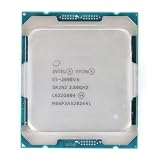
- Total Cores 14
- Total Threads 28
- Processor Base Frequency 2.60 GHz
- Max Turbo Frequency 3.50 GHz
- Sockets Supported LGA2011-3
Those statements are not contradictory: they refer to different benchmarks. Nor do they establish Aurora’s ranking across all AI training, inference or high-performance computing measures in 2026. A meaningful comparison needs to specify the benchmark and precision, test date and portion of the system used, as well as the workload and hardware configuration.
What is Aurora used for?
Aurora is the Argonne Leadership Computing Facility’s exascale system, developed by Intel and Hewlett Packard Enterprise for the U.S. Department of Energy. Argonne says it entered service for open science in January 2025. Its research applications include drug and materials discovery, cosmology, brain mapping, aerospace design, fusion and nuclear-energy modeling, quantum-computing studies, climate and Earth-system analysis, and large-scale data analytics.
Rank #4

- Manufacturer: Intel CPU Frequency: 2.20 GHz CPU Max Turbo Frequency: 3.60 GHz Number of Cores: 22 Threads: 44 Cache: 55 MB Intel Smart Cache Number of UPI Links: 0 Lithography: 14 nm Thermal Design Power: 145 W Memory Types: DDR4 1600/1866/2133/2400 Max Memory Size: 1.5 TB Max # Memory Channels: 4 Sockets Supported: FCLGA2011-3 E5-2699v4
Examples from Argonne’s early science work
- Drug discovery: Argonne reported screening 11 billion drug molecules per hour on 128 nodes, with the rate scaling to 22 billion per hour on 256 nodes. These are reported research results, not a general-purpose performance guarantee.
- Cosmology: Teams used about 2,000 nodes for large-scale-structure simulations.
- Brain mapping: Researchers planned datasets 1,000 times larger than their initial computations. This is a reported projection, not a completed-result measurement.
The examples show why a supercomputer’s value is not captured by one peak or benchmark number: researchers use its combined computing, memory, network and storage resources to tackle specific scientific problems.
Independent reader supportYour contribution helps us test, update, and keep practical guides available for everyone.Can the public use or buy Aurora?
Aurora is a national-laboratory research resource, not a workstation or cloud appliance for individual purchase. Argonne describes access to its open-science computing through allocation programs including DOE INCITE and ALCC. Researchers should consult the Argonne Leadership Computing Facility for current eligibility, application schedules and program terms.
Recommended Free Tools
Quick Recap
Best Value

- Part Number Identification: CD8069504194501 for easy reference and compatibility verification
- CPU Series Specification: 2nd Generation Intel Xeon Scalable processor from the Gold 6000 series
- Processor Frequency: 3.10GHz base clock speed with 18 cores for high-performance computing tasks
- Package Type: OEM tray processor without retail packaging
- Cooling Device Notice: Processor only, cooling device not included and must be purchased separately
Product prices and availability are accurate as of the date/time indicated and are subject to change. Any price and availability information displayed on Amazon at the time of purchase will apply.

