
Windows Errors? Fix Them Before They Spread
Repair common Windows errors and clear accumulated junk for a smoother, more stable PC - no reinstall needed.Free scan · no reinstallCrashes, No Sound, or Screen Glitches?
Random freezes, missing sound and display glitches usually trace back to one bad driver. Find and replace yours safely.Free scan · under a minuteIntel’s argument at Mobile World Congress 2026 was that telecom operators can run selected AI inference and network workloads on Xeon 6 CPUs with integrated acceleration, rather than adding separate accelerator hardware. The pitch targets constraints at cell sites and network edges—power, space, cost and system complexity—not a claim that CPUs outperform GPUs for every task.
What Intel announced at MWC 2026
MWC Barcelona ran March 2–5, 2026. Intel said it would demonstrate AI inference in live mobile networks and examples spanning radio access networks (RAN), 5G core, enterprise networks and edge computing. Its central platform was Xeon 6, including CPUs with Intel Advanced Matrix Extensions (AMX) for matrix operations used in AI workloads. Intel’s February 10 event announcement and its MWC press kit set out the program and related infrastructure components.
The broader strategy is software-programmable infrastructure across RAN, core and edge. Intel’s case is that operators may be able to place suitable inference on CPU systems already serving network functions, instead of adding a discrete accelerator. That could simplify deployments where rack space, power and maintenance are constrained, but whether it does so depends on the workload and system design.
Why Intel says CPUs can fit telecom AI
Telecom networks run time-sensitive tasks across distributed locations, from centralized data centers to cell sites and far-edge appliances. Intel argues that a CPU platform with integrated AI acceleration can perform selected inference alongside those network functions, reducing the need for extra hardware in some configurations. A CPU can also offer a more familiar, flexible platform for combining workloads, though operators still have to assess performance, power draw, software support, security and total system cost for their specific deployment.
#1 Best Overall

- Intel Xeon E5-2699 V4 Docosa-core (22 Core) 2.20 Ghz Processor - Socket Lga 2011-v3 - 5.50 Mb - 55 Mb Cache - 64-bit Processing - 14 Nm - 145 W
That is a workload-specific argument, not a universal CPU-versus-GPU verdict. EE Times described Nokia’s GPU-focused AI-RAN direction with Nvidia as a contrasting infrastructure strategy. The available reporting does not provide a neutral, equivalent benchmark showing that one approach wins across RAN, core, edge, inference and training. Operators evaluating the options need to compare the intended task, latency and throughput targets, energy and space budgets, system complexity, security requirements and software ecosystem.
What Intel and its partners demonstrated
Cloud RAN and network-function consolidation
Intel said Ericsson demonstrated Cloud RAN on Xeon 6 servers while processing real-time 8K immersive media alongside Cloud RAN and user plane function (UPF) workloads on the same CPU, without extra hardware or additional footprint. That is Intel’s account of a demonstration, not evidence that every operator can consolidate the same functions under its own traffic and service requirements. Intel vice president Cristina Rodríguez described a cell-site consolidation case to EE Times: “With 72 cores, we eliminate one server,” adding that the described setup moved from two servers to one. The statement concerns that specific case, not a general deployment outcome.
Rank #2
![Intel Xeon Silver [3rd Gen] 4310 Dodeca-core [12 Core] 2.10 GHz Processor - OEM Pack](https://m.media-amazon.com/images/I/31KUwTUW75L._SL160_.jpg)
AI-based link adaptation
EE Times reported that AT&T, Intel and Ericsson demonstrated AI-based link adaptation with throughput 20% higher than older rule-based systems. The figure applies to the reported demonstration comparison; it should not be read as a network-wide throughput gain or an independently verified result across other deployments.
Telco-cloud inference and partner work
Intel said Samsung demonstrated agentic AI inference in telco cloud using live network data to optimize time-sensitive operations. Intel’s event recap also names work involving SK Telecom, Rakuten Mobile, Cisco and Google Cloud, alongside AT&T, Ericsson and Samsung. Examples included a rugged Rakuten Mobile, Dell and Intel outdoor distributed unit, and Cisco on-premises edge AI. These examples show the range of partner activity Intel presented; they do not establish performance comparisons among the systems.
Rank #3
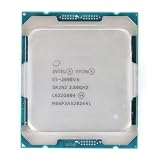
- Total Cores 14
- Total Threads 28
- Processor Base Frequency 2.60 GHz
- Max Turbo Frequency 3.50 GHz
- Sockets Supported LGA2011-3
5G core security and far-edge UPF
Intel said it demonstrated Nokia 5G core security using Xeon 6 E-cores, Intel Trust Domain Extensions (TDX) and Intel QuickAssist Technology. In a separate far-edge UPF example, Intel described a Nokia UPF deployment on its Xeon 6 SoC platform with Dell Technologies infrastructure. Intel reported a 30% performance boost for 5G core UPF and 43% runtime CPU power savings in that Nokia UPF context. Those are Intel-reported figures, not independent comparisons against GPU systems or results guaranteed for other configurations. The Intel announcement about the far-edge UPF deployment identifies the Nokia Edge Appliance and Dell PowerEdge XR8000 and XR8720t edge servers. Intel stated that the appliance would be available at the beginning of Q3 2026; that target date has passed, but current shipping or purchasing availability is not established here.
How to read the performance and efficiency figures
Intel’s event recap claims up to 2.4 times more RAN capacity and up to 70% better performance per watt versus the prior generation. It also identifies up to 72 cores for the Xeon 6 SoC. These are Intel’s figures, with the generational comparison stated by Intel; they are not independent results or a direct comparison with GPU platforms.
Rank #4

- Manufacturer: Intel CPU Frequency: 2.20 GHz CPU Max Turbo Frequency: 3.60 GHz Number of Cores: 22 Threads: 44 Cache: 55 MB Intel Smart Cache Number of UPI Links: 0 Lithography: 14 nm Thermal Design Power: 145 W Memory Types: DDR4 1600/1866/2133/2400 Max Memory Size: 1.5 TB Max # Memory Channels: 4 Sockets Supported: FCLGA2011-3 E5-2699v4
Intel’s February event announcement also repeated a forecast that more than one-third of enterprise workloads would move from centralized data centers by 2028. That is a forecast attributed to Intel, not an independently verified statistic in the cited announcement. Intel’s recap, employee-authored account of its MWC CPU approach, is useful for understanding the company’s position, but its performance and efficiency claims should be treated as vendor claims.
What operators should compare before choosing an architecture
- Workload: Separate inference from training and identify the actual RAN, core or edge function being accelerated.
- Service targets: Measure the latency, throughput and capacity required under the operator’s expected traffic, rather than extrapolating from a single demonstration.
- Power and physical constraints: Compare complete system consumption and footprint at the deployment location, especially for cell sites and far-edge installations.
- Total cost and complexity: Include servers, accelerators where applicable, networking, integration, cooling, operations and software—not just processor specifications.
- Software and security: Confirm that the required network functions, AI stack, isolation and security capabilities are supported in the intended environment.
- Evidence quality: Prefer like-for-like tests on the operator’s workload. The MWC claims described here do not establish a universal winner between CPU- and GPU-based infrastructure.
What the MWC case does—and does not—show
Intel used MWC 2026 to make a practical case for Xeon 6 CPUs with integrated AI acceleration in selected telecom workloads: consolidate functions where possible, run some inference on CPU infrastructure, and extend compute toward the edge. The partner examples span RAN, core security, link adaptation and UPF. The evidence cited is a mix of vendor claims and reported demonstrations, not a neutral head-to-head evaluation. For operators, the useful takeaway is to assess the architecture against the precise workload and deployment constraints rather than assume that either CPUs or GPUs are preferable in every network.
Free tools Windows power users keep installed
One-click scans. No signup required.
Quick Recap
Best Value

- Part Number Identification: CD8069504194501 for easy reference and compatibility verification
- CPU Series Specification: 2nd Generation Intel Xeon Scalable processor from the Gold 6000 series
- Processor Frequency: 3.10GHz base clock speed with 18 cores for high-performance computing tasks
- Package Type: OEM tray processor without retail packaging
- Cooling Device Notice: Processor only, cooling device not included and must be purchased separately
Product prices and availability are accurate as of the date/time indicated and are subject to change. Any price and availability information displayed on Amazon at the time of purchase will apply.

