
No—not in every situation. Biometrics have weaknesses passwords do not: a face or fingerprint is not a secret, matching can produce errors, and a compromised trait is hard to replace. But passwords can be phished, reused, or replayed. The bigger question is how each factor is used. A biometric that unlocks a passkey on your device is a different security design from a face or fingerprint sent to a remote service as a standalone login credential.
Why biometrics can be less secure in some ways
Your face and fingerprints are not secrets
A password can be kept private. A face is visible, fingerprints can be left on objects, and iris patterns may be captured in high-resolution images. That makes biometric traits harder to protect as secrets: an attacker may be able to obtain an image or impression without first breaking into an account.
Possessing a biometric sample does not automatically defeat a well-designed system. Sensors and software can use liveness checks or presentation-attack detection to look for signs of a fake. Those defenses still depend on the sensor and the path that processes its data; they reduce risk but do not make the underlying trait secret.
A biometric match can be wrong
Biometric systems compare a new sample with an enrolled template and decide whether the samples are close enough to count as a match. Because the comparison is probabilistic, systems can make two kinds of error: a false match, which accepts the wrong person, and a false non-match, which rejects the legitimate user. NIST summarizes the distinction this way: “Biometric comparison is probabilistic, whereas the other authentication factors are deterministic.”
#1 Best Overall
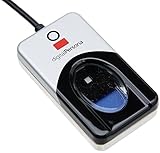
- Target Applications - Desktop PC security, Mobile PCs, Custom applications
- Indoor, home and office use
- Blue LED - soft, cool blue glow fits into any environment; doesn't compete in low light environments
- Small form factor - conserves valuable desk space
- Rugged construction - high-quality metal casing weighted to resist unintentional movement
NIST’s 2025 SP 800-63B-4 guidance gives several performance benchmarks: a false-match rate (FMR) of 1 in 10,000 or better, a recommended false-non-match rate (FNMR) below 5%, and an impostor attack presentation accept rate (IAPAR) below 0.07 for tested deployments. These figures describe different measures; they are not interchangeable, and the guidance does not guarantee that every consumer device meets them. A meaningful comparison for a particular system depends on the biometric modality, test conditions, and demographic coverage.
A leaked biometric is difficult to revoke
If a password is exposed, you can change it. You cannot replace your face or fingerprint in the same straightforward way. Protected or cancelable biometric templates may limit the harm or allow a template to be replaced, but NIST says their availability is limited. This makes the system’s storage, matching, deletion, and recovery design especially important.
Rank #2

- New replacement old Red Logo Digital persona URU4500, HID , USB reader. Original HID Brand
- Small form factor
- Metal Casing resists unintentional movement.
- SuperiorRed "Flash" indicates that a fingerprint image has been captured, 512 dpi / 8-bit grayscale (256 gray levels) ESD resistance
- Encrypted fingerprint data
Passwords have different—and serious—risks
Passwords have an advantage in being changeable and capable of being generated as random, unique strings. But they are also vulnerable when people reuse them, choose guessable ones, enter them on a phishing site, or expose them through a breach. A password can be replayed: if an attacker obtains the same credential a service accepts, the attacker may be able to submit it again.
A password manager can generate and store a different strong password for each service, reducing reuse. Adding multifactor authentication (MFA) helps protect accounts when a password alone is not enough, but ordinary password entry is not itself phishing-resistant: a convincing fake site can trick a user into handing over a valid password.
Quick wins for a faster PC:
Clear out junk files and repair common Windows errorsFree Scan →Fix the driver behind crashes, sound loss and screen glitchesFind Drivers →Rank #3

- High-quality metal casing
- Soft, cool blue glow fits into any environment
- Small form factor
- Works well with dry, moist, or rough fingerprints
How the main options compare
| Security question | Biometric used as a login factor | Password | Passkey or FIDO2 security key |
|---|---|---|---|
| Is the credential secret? | The trait is not secret; samples may be captured from the person or surroundings. | It can be kept secret, though people may expose or reuse it. | Authentication relies on cryptographic keys, not on keeping a face or fingerprint secret. |
| Can it be revoked? | Not readily: the underlying trait cannot be changed like a password. | Yes. Change it after exposure and replace reused credentials. | Access can be removed by managing or revoking the authenticator; recovery depends on the service and account setup. |
| Phishing and replay | Depends on the design. A remotely verified biometric is not automatically phishing-resistant. | Can be phished and replayed if stolen. | Correctly implemented passkeys and FIDO2/WebAuthn authenticators are phishing-resistant. |
| Spoofing and matching errors | Sensor defenses can help, but false matches, false non-matches, and presentation attacks remain relevant. | No biometric matching or sensor, but guessing and credential theft remain risks. | Uses a cryptographic authenticator rather than matching a biometric at the service. |
| Recovery and fallback | Needs a non-biometric alternative if the sensor fails or the user cannot use it. | Can be reset, but recovery depends on the service’s process. | Needs a recovery plan, such as another registered authenticator or the service’s account-recovery process. |
Why a biometric-unlocked passkey is different
When a device uses a fingerprint or face scan to unlock a passkey, the biometric can stay local to the device and serve as the gate to a cryptographic authenticator. The service receives authentication from the passkey rather than a copy of the user’s face or fingerprint. This is not the same as a service collecting a biometric and treating it as a standalone secret.
NIST’s guidance says biometrics “SHALL be used only as part of multi-factor authentication with a physical authenticator (i.e., ‘something you have’).” Its 2024 supplement on syncable authenticators says correctly implemented syncable authenticators can provide a phishing-resistant authenticator while supporting features such as simplified recovery, cross-device use, and native biometrics. A passkey is not a biometric: the biometric, when used, unlocks the authenticator locally.
Rank #4

- Certified to Microsoft’s highest fingerprint security standards (ESS & SDCP) for robust, hardware-isolated authentication. Supports next-gen Windows features, including Copilot Recall and Windows Hello with ESS support.
- Windows Hello ready for fast, password free fingerprint login to Windows and Microsoft 365 accounts
- On device fingerprint storage keeps biometric data securely within the key. Supports privacy regulations (GDPR, BIPA, CCPA) through on device biometric processing; TAA compliant.
- Reliable wired USB fingerprint authentication with USB C and USB A compatibility for desktop PCs.
- Consistent, all condition 360° fingerprint recognition.
What to use for safer sign-in
- Choose a passkey or FIDO2 security key where the service supports it. A correctly implemented FIDO2/WebAuthn authenticator is a stronger choice against phishing than password-only sign-in. Check that the service and authenticator support the same sign-in method.
- Use face or fingerprint recognition as a local unlock, not as a remote secret. If your device offers a biometric to unlock its authenticator, find out whether matching happens on-device and what biometric data, if any, the service stores.
- Set up recovery before you need it. Register another authenticator or configure the service’s supported recovery method. Keep a non-biometric sign-in option in case the sensor fails or biometric use is unavailable.
- For services that still require passwords, use unique generated passwords. Store them in a password manager and protect the manager with MFA. Do not reuse a password to make account recovery easier.
- Check how biometric data is handled. Ask what is stored, where matching occurs, how deletion works, and what happens if you lose access to the device. Treat biometric data as sensitive personal information.
So, are fingerprints safer than passwords?
Neither a fingerprint nor a password is automatically safer in isolation. A fingerprint used for a poorly designed remote login can expose an irreplaceable trait and still be vulnerable to spoofing or matching errors. A unique random password is changeable, but remains phishable. For most people, the more useful comparison is between authentication designs: prefer a phishing-resistant passkey or security key, use a biometric only to unlock it locally when possible, and keep a secure recovery route.
Quick Recap
Best Value
![ineo USB Fingerprint Reader for Windows 10/11, Windows Hello, One-Touch Login & Screen Lock, Plug & Play, Password-Free, 5ft Cable [Not for Mac]](https://m.media-amazon.com/images/I/41dBey3dy0L._SL160_.jpg)
- BIOMETRIC SECURITY: USB fingerprint reader provides advanced biometric authentication to secure your computer and protect sensitive data with your unique fingerprint.
- ONE-TOUCH COMPUTER LOCK: Instantly lock your Windows computer with a single touch using the Win + L shortcut, providing quick security when stepping away from your desk.
- FAST AND ACCURATE SCANNING: High-precision optical sensor delivers reliable fingerprint recognition with quick response time for seamless login and authentication.
- PLUG AND PLAY CONVENIENCE: Simple USB connection with easy setup process allows you to start using fingerprint security within minutes without complex installation.
- COMPACT DESIGN: Sleek and portable biometric scanner features a space-saving footprint that fits comfortably on any desk without cluttering your workspace.
Product prices and availability are accurate as of the date/time indicated and are subject to change. Any price and availability information displayed on Amazon at the time of purchase will apply.
Recommended Free Tools

