
iTechGuides is reader-supported. When you buy through links on our site, we may earn an affiliate commission. As an Amazon Associate I earn from qualifying purchases. Learn more
Apple’s next computer should be a shared smart-home display: a place where anyone at home can check household information, control accessories, and talk to Siri without finding and unlocking someone’s phone. That is a product case, not an announcement—Apple has not confirmed a screen-equipped home computer in the official sources cited here.
Why a shared screen could improve Apple Home
Apple already lets people control supported smart-home accessories through its Home app, and it supports Matter, a standard intended to improve interoperability among smart-home platforms. But a phone is personal, portable, and often locked away. A display in a common room could make useful controls and household status visible to everyone who needs them.
That distinction matters most in shared routines: checking a sensor or light, changing a thermostat, or seeing household information without asking who has the phone. A dedicated screen would earn its place only if it made those tasks noticeably easier than the Home app, while remaining useful when nobody is actively controlling an accessory.
What Apple already provides
Home, Matter, and Thread
Apple describes HomeKit as a way for apps to coordinate and control supported accessories from multiple vendors. Apple says Matter support arrived in iOS 16.1, iPadOS 16.1, macOS Ventura, watchOS 9.1, tvOS 16.1, and HomePod software 16.1. Apple’s Home developer overview and its Matter support documentation explain the platform and compatibility framework.
#1 Best Overall
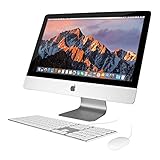
- Renewed products look and work like new. These pre-owned products have been inspected and tested by Amazon-qualified suppliers, which typically perform a full diagnostic test, replacement of any defective parts, and a thorough cleaning process. Packaging and accessories may be generic. All products on Amazon Renewed come with a minimum 90-day supplier-backed warranty.
Thread is a low-power Internet Protocol mesh: compatible accessories can forward packets to one another, which Apple says can improve coverage and redundancy. Matter compatibility alone does not tell you whether an accessory can be added to Apple Home or which hub it needs.
Home hubs are already part of the system
Apple Support says HomePod mini and HomePod become home hubs automatically when set up, while Apple TV becomes one when added to a room in the Home app. Apple says a home hub is required to add Matter accessories to Apple Home. Thread-enabled Matter accessories need a Thread-enabled hub—Apple lists HomePod mini and Apple TV 4K (3rd generation) Wi-Fi + Ethernet—or a supported third-party border router. Availability varies by country or region. Check Apple’s home hub setup and compatibility guidance and the accessory’s specific requirements before buying.
So the proposed computer would not be the first Apple device to act as a home hub. Its potential difference is a shared, glanceable interface: HomePod mini is a speaker, Apple TV is primarily connected to a television, and an iPad is a general-purpose tablet that a household might mount. A purpose-built product would need to combine the right parts of those roles without simply duplicating them.
What the rumors establish—and what they do not
Apple has not officially confirmed a screen-equipped home computer in the Apple sources cited here. MacRumors’ July 15, 2026 roundup described a rumored square display, camera, apps, Siri integration, and possible speaker-base or wall-mount options. Its September 30, 2026 guide described a different rumored screen size, two mounting or base variants, and a possible October 13 introduction. Those are press reports, not specifications or a launch announcement. The differing screen-size reports are a reason not to treat either measurement as settled.
The September guide says current reporting envisions Siri, Home control, video, calendar, and weather. It also relays a report that LG Electronics is working on smart-home accessories that could integrate with Apple’s prospective hub; that does not establish a released lineup or final compatibility. For context, see the July roundup and September guide. Apple has not confirmed the device’s name, final capabilities, price, or release date.
What Apple would need to get right
Make it genuinely shared
A home interface should be easy for household members to use, not just the person who configured it. Touch and voice should both work, and the screen should surface useful household information without requiring a personal phone. Apple would also need to make clear how personal settings and household-wide information are separated.
Rank #2

- BRILLLLLLIANT — iMac is the ultimate all-in-one desktop computer, powered by the M4 chip and built for Apple Intelligence.* With a stunning 24-inch Retina display, iMac gives you the space you need in an iconic, colorful design that livens up any room.
- FITS PERFECTLY IN YOUR SPACE — The all-in-one desktop design is strikingly thin, comes in seven vibrant colors, and elevates any space with style.
- BUILT FOR APPLE INTELLIGENCE — Apple Intelligence is the personal intelligence system that helps you write, express yourself, and get things done effortlessly. With groundbreaking privacy protections, it gives you peace of mind that no one else can access your data — not even Apple.*
- SUPERCHARGED BY M4 — Get more done faster with the Apple M4 chip. From editing photos to creating presentations to gaming, you’ll fly through work and play.
- IMMERSIVE DISPLAY — The industry-leading 24-inch 4.5K Retina display features 500 nits of brightness and supports up to 1 billion colors.*
Make placement and privacy understandable
A wall-mounted display and a countertop screen with a speaker base are different reported concepts, not confirmed product variants. If Apple offers either approach, buyers would need to assess where it can be seen and reached, how its speaker and microphones work in that location, and what a camera or presence sensing does. Privacy controls and indicators should be clear enough that a shared device does not create uncertainty about who or what it is sensing.
What’s actually slowing this PC down?
Pick the symptom - the matching free tool is one click away.
Support the accessories people actually own
A screen would be more useful if it made accessory status and controls obvious, but its existence would not remove Matter or Thread requirements. Apple would need to explain which hub functions it provides, whether it supports Thread, and which accessories require another hub or border router. Buyers should judge total system cost and support lifespan as well as the screen’s price—none of those details is confirmed for the rumored device.
Be useful beyond Home controls
A device that only duplicates a few Home app controls may not justify another screen in the house. Shared calendar or weather information, video, and voice assistance could broaden its everyday use, but those functions are reported possibilities rather than confirmed specifications. Apple would need to show that the device offers a distinct benefit over an iPad already mounted at home, without asking buyers to assume it can replace an iPad or function as a Mac.
Independent reader supportYour contribution helps us test, update, and keep practical guides available for everyone.Apple’s announced Home and Siri features are separate from the rumored hardware
Apple’s June 2026 announcement describes Apple Intelligence features for the Home app: grouping related accessory notifications into an activity, generating descriptions of HomeKit Secure Video clips, searching those clips, and elevating noteworthy clips. Those features are not evidence that a new display is required. See Apple’s announcement of Home app intelligence features.
Apple said its next-generation Foundation Models run on device and on servers using Private Cloud Compute. Apple’s stated privacy position is that personal data handled by Private Cloud Compute is not stored or made accessible to Apple or anyone else. That is Apple’s claim about its system; it does not independently establish how every component of a future home device would work. Apple’s announcement also says the new Siri AI would be available as a beta later in 2026 to users with supported devices set to English. Apple cautions that availability can vary by language, region, and local rules, and says the features are subject to change. A rumored hub therefore should not be assumed to launch with mature Siri AI or the same feature availability everywhere.
Do these 3 things before closing this tab:
1Repair Windows errors before they cause bigger problems2Fix the driver behind crashes, sound loss and screen glitches3Clear out junk files and repair common Windows errorsWho would benefit—and who may not
- A shared display could help households that often need to check or adjust home accessories and want a common control point that does not depend on one person’s phone.
- An existing setup may be enough if household members are comfortable using the Home app, or if a HomePod or Apple TV already provides the hub role they need.
- Wait for confirmed details if your decision depends on exact screen size, camera behavior, Thread support, Siri availability, price, or compatibility. None is established for a final product.
The strongest case is not that every Apple household needs another computer. It is that shared controls and information deserve an interface designed for a shared room. Apple’s existing Home platform provides a foundation; a new device would need to make that foundation easier to use without adding more cost, confusion, or privacy uncertainty than it removes.
Quick Recap
Product prices and availability are accurate as of the date/time indicated and are subject to change. Any price and availability information displayed on Amazon at the time of purchase will apply.

