
Android 17 Beta 2 was reported to add a ChromeOS-inspired safeguard for USB4 and Thunderbolt: restricting PCIe tunneling, the pathway that can give an attached peripheral direct access to system memory. That matters for docks and other high-speed accessories, but it does not mean every USB-C device can read a phone’s memory—or that every accessory will stop working. The effect depends on the device, the tunnel an accessory needs, and, on managed Android devices, administrator policy.
What security feature is Android 17 Beta 2 borrowing?
The reported feature targets PCIe tunneling, a capability used by USB4 and Thunderbolt peripherals. According to Chromium’s official USB4 security reference, “PCI Express (PCIe) Tunneling is a prominent feature of USB4 (and Thunderbolt) peripherals. This feature provides an external peripheral with Direct Memory Access (DMA) to Chromebook’s System Memory (DRAM).” DMA is a way for a device to access memory without relying on ordinary software-mediated transfers; that access can increase risk if a connected peripheral or its driver is compromised.
ChromeOS treats PCIe tunneling as a security-sensitive capability rather than allowing every connected device unrestricted access. Android 17 Beta 2 was reported to bring a related protection to Android, while Android’s enterprise documentation specifically describes how administrator-imposed USB data restrictions affect high-speed tunnels. These are related protections, but the published Android policy description is not a claim that Android duplicates every ChromeOS control.
Can a USB4 or Thunderbolt device read a phone’s memory?
PCIe tunneling can provide a supported external peripheral with DMA access to system memory, as Chromium’s reference describes for Chromebooks. That does not establish that every USB4 or Thunderbolt accessory can freely inspect a connected Android phone. The actual risk and access depend on host and accessory support, whether a PCIe tunnel is permitted, and the platform’s security controls.
#1 Best Overall

- 240W Superfast Charging: Empower your devices with Superb 240W PD 3.1, charging a MacBook Pro 16" to 56% in 30 minutes. Backward compatible with 140W/100W/65W devices, ensuring future-proof performance for laptops, phones, and accessories
- Lightning 80Gbps Data Transfer: Transfer a 20GB 4K movie in just 3 seconds with USB4 Gen4's 80Gbps bandwidth, 8x faster than standard USB C cables. Perfect for photographers, developers, or anyone moving massive files between SSDs, NAS, or dual computers
- Industry Leading HD Display: Unlock cinematic visuals with DisplayPort 2.1 mode, supporting up to 16K@60Hz and extending to dual 8K@60Hz or triple 4K@144Hz Display. Ideal for gaming rigs, 3D rendering workstations, or multi screen traders demanding ultra smooth, zero lag visuals
- All-in-One Solution: A single USB C to C cable handles 240W charging, 80Gbps data syncing, and 16K max video output. Seamlessly connect USB C laptops, such as MacBook Pro Air, Dell XPS, phones,such as iPhone 16, Galaxy S24, tablets like iPad Pro, monitors, and accessories. Supports Thunderbolt 4 3, USB4, USB 3.2 3.1 3.0, and more
- Sturdy and long-lasting: Solid and durable nylon braided cable ensures longer service life up to 10,000 bends. Double sided USB C connectors with over molded strain relief are designed for frequent insertions, Aluminum housing, high purity copper wire, and triple shielding will keep long lasting fast charging performance
A USB-C connector alone is not evidence that a phone, cable, or accessory supports USB4 or Thunderbolt. USB-C describes the connector; USB4 and Thunderbolt describe capabilities that must be supported by the relevant devices and connection.
How ChromeOS limits PCIe-tunnel risk
ChromeOS’s official security design describes several layers rather than relying on a single prompt or port block:
Rank #2

- Move Files Fast: Transfer music, movies, or entire seasons of TV shows in seconds at 40 Gbps.
- HD Display: Connect your laptop to an external monitor to mirror or extend your screen in up to 8K@60Hz or 4K@144Hz.
- Huge Range of Power: Supports a maximum 240W charge when paired up with a compatible charger. Charge virtually any USB-C device from phones and accessories to laptops.
- Built to Last: Proven in lab tests to withstand up to 5,000 bends.
- What You Get: Anker 515 USB-C to USB-C Cable (USB4, 3.3ft), welcome guide, our worry-free 18-month warranty, and friendly customer service.
- IOMMU restrictions: peripherals start without memory access, which is granted only when allowed by the system.
- Stricter kernel DMA handling: the operating system applies additional controls to DMA behavior.
- A limited driver set: ChromeOS uses a small, vetted set of device drivers for this security-sensitive path.
- Tunnel authorization: PCIe tunnels are blocked by default and require authorization under ChromeOS’s session and protection rules.
Google’s user-facing support guidance describes a setting called “Block Thunderbolt or USB4 accessories from accessing and sharing memory (RAM),” enabled by default for maximum security. ChromeOS requires a signed-in, unlocked, non-guest session for new tunnel authorization; authorization is removed at logout or when the device disconnects.
What Android’s documented control means for managed devices
Android 17’s enterprise documentation says USB4 and Thunderbolt PCIe tunneling respects physical data-layer restrictions. If an administrator uses DevicePolicyManager to restrict USB data signaling, high-speed PCIe tunnels are blocked to reduce the device’s attack surface. In other words, this is policy-aware behavior: an organization’s USB data restrictions can affect high-speed tunnels, rather than Android relying only on a simple list of approved cables or ports.
Outdated Drivers Are Slowing You Down
One free scan finds every outdated or missing driver and matches the right update for your exact hardware.Free scan · exact hardware matchWindows Errors? Fix Them Before They Spread
Repair common Windows errors and clear accumulated junk for a smoother, more stable PC - no reinstall needed.Free scan · no reinstallRank #3

- 【Up to 40Gbps Data Sync】Delivers up to 40Gbps high speed transaltion, 4x faster than USB 3.2 cable, 2x faster than previous generation USB4 cable. It can copy 10GB files in seconds, avoid waiting, and effortlessly get everything you want. Plug and play, no drive needed.*The final performance depends on whether your device supports USB4, Thunderbolt 4/3.
- 【240W Rapid Charging】Up to 240W (48/5A) power supply when paired with a compatible charger. Backward compatible with 100W, 140W, 180W in Extended Power Range(EPR). It is ready to provide you with enough power at any time. Equipped E-Marker chip for safety, stability, and battery protection. Support PD 3.1, QC 4.0, FCP, AFC fast charging technology for future proof.
- 【8K HDR Design for Professionals】 Provide a single 8K@60Hz / 5K@60Hz / 4K@144Hz or dual 4K@60Hz display support. Connect your laptop or dock to a monitor and get a crisp detail and 10-bit color depth view. Support MST Daisy Chain, release your efficiency and improve the professionalism of the project.
- 【Future-proofed Compatibility】The USB 4 cable fully supports the function of Thunderbolt 4. Backward compatible with Thunderbolt 3, USB 3.2 Gen 2, USB 3.2 Gen 2 x 2, USB 2.0. It works seamlessly with all Thunderbolt 4 / 3 / Type-C devices. Compatible with Apple Studio Display, Mac Studio, Mac Mini, MacBook, Surface, iPad Pro, iPhone 17/16, docking station, SSD, power bank, GaN charger, etc. We recommend using cables below 5FT when connecting to the docking for stable performance.
- 【Top-Notch Material】Aluminum shell ensures efficient heat dissipation and protects the chip. Experience unprecedented durability with our unique 48-strand braided techniques. It offers 3x protection without tangle and gets worry-free usage. Triple protection with EMI-resistant tinplate, 28 AWG OFC conductors, and stainless steel connectors improves signal quality and ensures long-lasting connections.
For a managed fleet, administrators should check whether their USB data-signaling policy will block tunnels required by a dock or another work accessory. The documentation establishes the effect of the restriction on tunneling; it does not establish that every Android device, accessory, or management configuration exposes an identical user-facing control.
Will a dock still work if Android blocks PCIe tunneling?
It may work with reduced functionality, but the result depends on what the dock and connected devices require. Google’s ChromeOS support guidance identifies docks, displays, and storage accessories as relevant USB4 or Thunderbolt accessory categories. A dock that relies on PCIe tunneling for its full capabilities may lose some functions or performance when that tunnel is blocked. The available documentation does not promise that every dock will retain a particular set of functions.
Rank #4
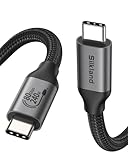
- 80Gbps Data Transfer: Silkland USB 4 Version 2.0 cable delivers a lightning-fast 80Gbps bidirectional data. Backup 6GB files in 1 second – drastically reduce wait times. It is USB-IF certified, meets full USB4 specs (TID:12800, verified by USB-IF official). *Actual speed depends on your device.
- 120Gbps Display Powerhouse: Boast 120Gbps unidirectional bandwidth, 3X the bandwidth of Thunderbolt 4/USB4 (40Gbps). Connect dual 8K/6K or triple 4K@144Hz displays for professional workflows. Enables 16K resolution & 4K@540Hz for ultimate creative/gaming.
- 240W Max Fast Charging: 240W meets power-hungry charging needs(like laptops). Supports PD 3.1 & backward compatible (60W/100W/140W). Equipped with an E-Marker chip for safety, stability, and battery protection.
- Full Thunderbolt 5 Cable Compatible: Future-proof and backward compatible with Thunderbolt 4/3, USB4, and USB 3.2. Works seamlessly with MacBook M4 Pro/Max, iPhone 17/16, Mac Mini, iPad, SSDs, docks, USB C Monitors, etc. Plug and play, OTG supported, and no driver needed.
- Premium Durability & Design: Slim Case-Friendly Shell fits phone cases effortlessly. Aluminum dissipates heat. Tangle-free 48-strand braided nylon ensures worry-free usage. Triple Shielding (EMI tinplate, 28 AWG OFC, stainless connectors) ensures signal integrity.
Before relying on a dock, verify that both the host device and dock support the advertised USB4 or Thunderbolt capabilities, and check the dock maker’s requirements for the functions you need. Match the cable to the supported USB4 or Thunderbolt generation and bandwidth; generic USB-C labeling by itself does not confirm those capabilities.
Independent reader supportYour contribution helps us test, update, and keep practical guides available for everyone.What is established—and what is not—about Android 17 Beta 2
The report about Android 17 Beta 2 describes a ChromeOS-inspired protection against the DMA risk associated with USB4 and Thunderbolt PCIe tunneling. Android’s enterprise documentation establishes that DevicePolicyManager USB data-signaling restrictions block high-speed tunnels. Those points support the conclusion that Android’s approach considers both peripheral access and administrator policy.
Recommended Free Tools
Best Value

- USB-IF-certified, connects any USB-C enabled devices. For power transfer/charging and data transfer between smartphones, power banks, wall/car chargers, hard-drives, tablets, laptops (up to 240 W) and more.
- Box contents: One 3.3-foot 240 W USB-C 4 cable for charging and powering devices, transferring data, photos and music. Compatible with Thunderbolt 4, Thunderbolt 3 and USB4 PCs and displays; backwards compatibility with USB 3.2 and USB 2.0.
- Fast charging and data transfer: supports super-fast charging up to 240 W (48 V/5 A) and data transfer speeds up to 40 Gbps when used with compatible devices. Note: To achieve 240W during charging, the device, charger, and cable must all support 48/5V.
- High video resolution: 8K video. Single 8K@60 Hz, 4K@120 Hz or dual 4K@60 Hz resolution. Note: for video output, make sure that your USB-C device supports DisplayPort Alternate Mode. To reach 240 W charging, the device, charger and cable must all be EPR-capable.
- Enhanced durability: Tested to bend 95 degrees 5,000 times. Thermoplastic elastomer (TPE) jacket for added flexibility and improved durability.
The available documentation does not publish a numeric security improvement, benchmark, attack-rate reduction, or supported-device count for this feature. Google’s Android 17 announcement says the release rolled out first to Pixel devices and to other eligible Android devices during 2026, but it does not quantify the availability of this particular protection. Check the documentation and settings for the specific device and Android build in use.
Quick Recap
Product prices and availability are accurate as of the date/time indicated and are subject to change. Any price and availability information displayed on Amazon at the time of purchase will apply.

