
iTechGuides is reader-supported. When you buy through links on our site, we may earn an affiliate commission. As an Amazon Associate I earn from qualifying purchases. Learn more
The AMD Radeon RX 6600 remains a capable 1080p gaming card in 2026, but only at the right price. Its 8GB VRAM, efficient 132W design, and strong raster performance suit high-quality 1080p gaming, while weak ray tracing, limited 1440p headroom, and inflated listings make it a poor buy when faster alternatives cost only slightly more.
AMD launched the RX 6600 on October 13, 2021, at a suggested price of $329. The RX 6600 is now best treated as a discounted or properly warranted used/refurbished option—not as a card worth buying at any price simply because it targets 1080p.
Key takeaways
- The RX 6600 has 28 RDNA 2 compute units, 1,792 stream processors, 8GB of GDDR6, and a 132W typical board-power rating.
- Tom’s Hardware measured the RX 6600 at approximately 4% behind the RTX 3060 and approximately 13% behind the RX 6600 XT in its launch-era 1080p test suite.
- The RX 6600 is best suited to 1080p high or ultra rasterized gaming, while 1440p ultra, 4K, and demanding ray tracing are weak use cases.
- AMD lists a 450W minimum recommended power supply and one 8-pin auxiliary connector, but partner-card dimensions and power requirements vary.
- Newegg listings observed on August 16, 2026 ranged from roughly $229–$300 for some used or refurbished cards and approximately $445–$499 for some new or marketplace listings.
Verdict: should you buy the RX 6600?
Buy it when a reliable used or refurbished card is substantially cheaper than faster alternatives and your target is 1080p rasterized gaming. Consider an RX 6600 XT, RX 6650 XT, RX 7600, RTX 3060, or a higher-tier used card when the price premium is small. Avoid it at $400 or more unless the competing market is unusually inflated.
Quick wins for a faster PC:
Repair Windows errors before they cause bigger problemsFix Now →Scan for outdated or missing drivers - takes under a minuteDriver Scan →What is the AMD Radeon RX 6600?
The AMD Radeon RX 6600 is the lower-tier, non-XT desktop graphics card in AMD’s original RDNA 2 Radeon RX 6000 family. The card uses AMD’s Navi 23 GPU and is designed primarily for 1080p gaming rather than high-refresh 1440p or 4K.
Popular on Amazon

- System Compatibility Note: 2-slot card, 269.2x131.8x40.3mm, single 8-pin power, recommended 550W PSU. Verify chassis clearance before purchase.
- Dedicated Support: Please contact us directly through Amazon for any product questions or assistance you may require.
- Next-Gen AMD RDNA 3 Architecture: Powered by RX 7600 GPU with 32 CUs and 2048 stream processors, delivering exceptional 1080p gaming with hardware ray tracing.
- Factory Overclocked for Maximum Performance: Boost clock up to 2695MHz and game clock of 2280MHz, providing the raw power for smooth high-framerate gaming.
- 8GB GDDR6 Memory on 128-Bit Bus: Equipped with 8GB of high-speed GDDR6 memory running at 18 Gbps, offering ample bandwidth for modern game textures.
The core design combines a relatively modest GPU with 8GB of GDDR6 memory and AMD’s Infinity Cache. That combination works well when the card renders at 1080p, but the 128-bit memory interface and limited compute resources become more restrictive as resolution, texture demand, and ray-tracing effects increase.
RX 6600 specifications at a glance
| Specification | Radeon RX 6600 |
|---|---|
| Architecture | AMD RDNA 2 |
| GPU | Navi 23 |
| Compute units | 28 |
| Stream processors | 1,792 |
| Ray accelerators | 28 |
| Game clock | 2,044MHz |
| Boost clock | Up to 2,491MHz |
| Memory | 8GB GDDR6, up to 14Gbps |
| Memory interface | 128-bit |
| Memory bandwidth | Up to 224GB/s |
| Infinity Cache | 32MB |
| Typical board power | 132W |
| Recommended PSU | 450W |
| Auxiliary power | 1 × 8-pin connector |
| PCIe interface | PCIe 4.0 x8 |
| Display outputs | DisplayPort 1.4a and HDMI 2.1 |
| Video decode | AV1 decoding is supported; AV1 encoding should not be assumed without checking the specific application and GPU capability |
| Operating systems listed by AMD | Windows 10 64-bit, Windows 11 64-bit, and Linux x86-64 |
| Launch | October 13, 2021, at a $329 suggested price |
These specifications come from AMD’s official Radeon RX 6600 product specifications and AMD’s October 13, 2021 launch announcement. Partner models can use different coolers, factory-overclocked settings, board-power limits, dimensions, and warranty terms.
Is the RX 6600 really a 1080p graphics card?
Yes. The RX 6600 is most convincing at 1080p high or ultra settings in conventional rasterized games. The card can also drive high-refresh 1080p esports titles when the processor is fast enough, although lightweight competitive games may become CPU-limited before the GPU reaches its limit.
Free tools Windows power users keep installed
One-click scans. No signup required.
AMD reports manufacturer-tested 1080p maximum-setting results of 98 frames per second in The Division 2, 138 frames per second in Doom Eternal, 102 frames per second in Far Cry 6, and 118 frames per second in Shadow of the Tomb Raider. Those figures are AMD’s own results under specified test conditions, not universal frame-rate guarantees; the figures and test notes appear on the AMD product page.
Independent testing gives a more useful overall picture. In Tom’s Hardware’s 2021 launch-era review, the RX 6600 averaged 95 frames per second across a 13-game 1080p ultra test suite. Tom’s Hardware also measured the RX 6600 at approximately 4% behind the RTX 3060 at 1080p and approximately 13% behind the RX 6600 XT at 1080p ultra. These are historical results from a particular test system, driver set, game selection, and preset—not a current 2026 benchmark promise. See the Tom’s Hardware 1080p benchmark results for the original conditions.
TechSpot’s independent review and benchmark database also places the RX 6600 in the expected lower-midrange performance class, while showing why no single FPS number should be applied to every game. Results change with the engine, API, CPU, driver, memory configuration, preset, and upscaling mode. The TechSpot RX 6600 review provides additional historical comparison data.
What type of 1080p experience should you expect?
| Workload | RX 6600 suitability | Practical expectation |
|---|---|---|
| 1080p high rasterized gaming | Strong fit | Use high settings as the normal starting point; many games should have useful performance headroom. |
| 1080p ultra rasterized gaming | Good fit with title-by-title adjustments | Many games are playable at ultra, but demanding engines may require lower shadows, textures, or effects. |
| 1080p esports | Good, sometimes excessive | The CPU and monitor refresh rate may matter more than the RX 6600 in lightweight competitive games. |
| 1080p ray tracing | Weak fit | Disable or selectively reduce ray tracing; upscaling may be necessary in demanding games. |
| 1440p ultra | Conditional | Expect more compromises because the GPU, 128-bit memory interface, and 8GB capacity provide limited headroom. |
| 4K gaming | Poor fit | The RX 6600 is not designed as a 4K card. |
Tom’s Hardware observed that the RX 6600’s advantage narrowed as resolution and quality increased. The resolution trend matters more than a label such as “8GB”: the RX 6600’s compute capacity and memory subsystem must process the higher-resolution workload as well as store its assets.
How does the RX 6600 compare with the RX 6600 XT and RX 6650 XT?
The RX 6600 XT is the direct step-up model, while the RX 6650 XT is a later, higher-clocked member of the same general product family. Both are sensible alternatives when the price premium is modest and the buyer wants more 1080p headroom.
Tom’s Hardware’s 2021 testing placed the RX 6600 approximately 13% behind the RX 6600 XT at 1080p ultra and approximately 11% behind at 1080p medium. The improvement is noticeable rather than transformative: the XT models are better suited to high-refresh 1080p, but the RX 6600 remains the better choice when the price gap is large.
| Option | Best reason to choose it | What the buyer gives up or must check | Buying rule |
|---|---|---|---|
| RX 6600 | Efficient 1080p raster performance at a discounted price | Less 1080p headroom and weaker ray tracing than step-up or Nvidia alternatives | Choose when clearly cheaper and backed by acceptable return protection. |
| RX 6600 XT | More high-refresh 1080p performance | Usually costs more and still has 8GB memory and modest ray-tracing capability | Prefer when the premium over the RX 6600 is small. |
| RX 6650 XT | Additional 1080p performance within the same broad AMD class | Value depends entirely on current pricing and card condition | Compare the complete purchase price rather than launch MSRP. |
| RX 7600 | Newer AMD product availability and platform positioning | Do not assume it is automatically faster or better value without current independent results and pricing | Choose only after checking current benchmarks, price, warranty, and power requirements. |
| RTX 3060 12GB | DLSS, stronger ray tracing, Nvidia software, and 12GB VRAM | Higher power draw and a price that may not justify its age | Pay more when Nvidia features or additional VRAM matter to the workload. |
| Used RX 6700 XT or similar higher-tier card | More 1440p and demanding-game headroom | Higher power, larger cards, and greater used-market inspection risk | Consider when priced close to an inflated RX 6600 and the PSU and case can support it. |
The performance comparison is not a universal ranking. Tom’s Hardware’s launch-era 1080p suite put the RX 6600 slightly behind the RTX 3060 overall and approximately 11–13% behind the RX 6600 XT, but individual games can reverse or widen those differences. A current purchase decision should compare live prices and the features that matter to the buyer.
Also popular on Amazon
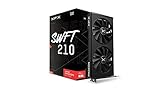
- Chipset: AMD RX 7600
- Memory: 8GB GDDR6
- XFX SWFT Dual Fan Cooling Solution
- Boost Clock: Up to 2655 MHz
How does the RX 6600 compare with the RTX 3060?
The RTX 3060 is the most important historical comparison because the two cards occupy a similar 1080p performance class. Tom’s Hardware measured the RX 6600 approximately 4% slower than the RTX 3060 overall at 1080p in its 2021 test suite.
The RTX 3060 is the more compelling choice for ray tracing, DLSS, Nvidia-specific creator and productivity software, and workloads that benefit from 12GB of VRAM. The RX 6600 is the more compelling choice when lower power consumption, ordinary rasterized 1080p gaming, and a lower purchase price matter more.
Neither card is automatically the better purchase in 2026. A cheap RX 6600 can beat an overpriced RTX 3060 on value, while an RTX 3060 can justify its cost for a buyer who specifically uses DLSS, ray tracing, or Nvidia’s software ecosystem.
What are the RX 6600’s ray-tracing limitations?
The RX 6600 supports hardware ray tracing through 28 ray accelerators, but the RX 6600 is not a strong ray-tracing purchase. Demanding reflections, global illumination, shadows, and other ray-traced effects can reduce frame rates substantially at 1080p.
The limitation comes from the complete design rather than one missing feature. The RX 6600 has fewer compute resources than higher-tier cards, a 128-bit memory interface, 32MB of Infinity Cache, and a 132W board-power target. Those constraints make heavy ray-traced workloads a poor match even though the feature is technically supported.
Do these 3 things before closing this tab:
1Fix the driver behind crashes, sound loss and screen glitches2Repair Windows errors before they cause bigger problems3Scan for outdated or missing drivers - takes under a minuteTom’s Hardware’s 2021 ray-tracing assessment found that low-end RDNA 2 cards with this type of memory configuration struggled particularly with ray tracing. Upscaling can restore some performance, but upscaling quality varies by game, mode, render resolution, and implementation. The Tom’s Hardware ray-tracing results and analysis should be read as historical architectural context rather than a guarantee for every current game.
The practical rule is simple: use native or upscaled rasterized settings as the RX 6600’s default, and treat ray tracing as an optional effect that may need to be disabled or reduced.
Is 8GB of VRAM enough for 1080p?
The RX 6600’s 8GB of GDDR6 is generally sufficient for many 1080p high-setting workloads, but 8GB is not a promise of future-proof ultra settings. Ultra textures, large open-world games, mods, ray tracing, and newer engines can consume more memory than older launch-era test suites did.
Tom’s Hardware found that 8GB generally caused little trouble in its 1080p ultra test suite. That 2021 finding remains useful for understanding the card’s intended resolution, but it should not be generalized to every future release.
Recommended Free Tools
When a new game stutters or reports a memory warning, lower texture quality and ray-tracing settings first. VRAM capacity is only one part of performance: the RX 6600 also has to compute the frame and move assets through its 128-bit memory subsystem. A competing card with more VRAM is not automatically faster, but the RX 6600’s 8GB should be viewed as adequate for 1080p rather than generous for every future workload.
Also popular on Amazon

- System Compatibility Note: 2.5‑slot card measuring 303 mm (L) x 131 mm (W) x 45 mm (H); requires a single 8‑pin power connector and a recommended 550W power supply. Please verify chassis clearance and power supply capacity before purchase.
- Dedicated Support: Please contact us directly through Amazon for any product questions or assistance you may require.
- AMD RDNA 3 Architecture with AI & Ray Tracing Acceleration: Powered by 32 RDNA 3 Compute Units featuring 3rd Gen Ray Tracing Accelerators and 2nd Gen AI Accelerators, delivering lifelike lighting, shadows, and superior machine learning performance for enhanced gaming and content creation.
- Powerful 1080p & 1440p Gaming Engine: Features a max boost clock of up to 2695 MHz, a game clock of 2280 MHz, and 2048 stream processors, ensuring outstanding frame rates in the latest titles.
- 8GB High‑Speed GDDR6 Memory: Equipped with 8GB of GDDR6 memory on a 128‑bit interface running at 18 Gbps, delivering up to 288 GB/s bandwidth for high‑resolution textures and demanding game workloads.
What power supply, case, and PCIe hardware does the RX 6600 need?
AMD specifies a 132W typical board power, one 8-pin auxiliary power connector, and a 450W minimum recommended power supply for the RX 6600. The official requirements are listed on the AMD Radeon RX 6600 specifications page.
A quality modern 450W PSU can be sufficient for a sensible system, but a low-quality or very old 450W unit is not equivalent to a reputable modern unit. A high-power CPU, overclocking, multiple drives, transient loads, or future upgrades can justify a higher-capacity PSU. Confirm that the PSU has a proper PCIe power cable rather than relying on questionable adapters.
The reference specification does not determine the physical size of every RX 6600. Before buying a partner card, check the maximum GPU length, height, slot thickness, front-fan or radiator clearance, cable clearance, and case airflow. A compact single- or dual-fan model may fit a small case, while a larger factory-overclocked card may occupy more than two slots.
What’s actually slowing this PC down?
Pick the symptom - the matching free tool is one click away.
What happens on a PCIe 3.0 system?
The RX 6600 uses a PCIe 4.0 x8 interface, so older PCIe 3.0 systems deserve more attention than systems using a full x16 link. PCIe 3.0 x8 provides less link bandwidth than PCIe 4.0 x8, and some games with substantial asset streaming can be more sensitive to that limitation.
There is no single reliable percentage penalty for every PCIe 3.0 computer. The result depends on the game, CPU, system memory, asset-streaming behavior, and whether the computer is already CPU-limited. Owners of older platforms should look for controlled PCIe 3.0 versus PCIe 4.0 testing rather than assuming the interface is either completely irrelevant or universally damaging.
Does Smart Access Memory improve RX 6600 performance?
Smart Access Memory, AMD’s implementation of Resizable BAR-style access to GPU memory, can improve performance in some games, but it does not provide a guaranteed universal uplift. AMD’s launch material described support across compatible RX 5000 and RX 6000 graphics, Ryzen processors, and 500-series motherboards; the AMD launch announcement contains the original platform description.
Enable SAM only when the motherboard firmware, CPU, GPU, and BIOS support it correctly. On non-AMD platforms, the setting is generally called Resizable BAR. The BIOS may require UEFI mode and compatible firmware settings, and the benefit varies by game. SAM is not exclusive to the RX 6600 and should not be used to justify a purchase by itself.
Which AMD software features matter?
The RX 6600 works with AMD Software: Adrenalin Edition and supports several useful gaming features, but those features do not turn the card into a faster class of GPU.
| Feature | What it does | Important limitation |
|---|---|---|
| FidelityFX Super Resolution | Game-integrated upscaling that renders below output resolution | Support and image quality depend on the game and selected mode; FSR is not identical to DLSS. |
| Radeon Super Resolution | Driver-level upscaling for compatible games rendered below native resolution | It is not the same implementation as in-game FSR and generally requires a lower render resolution. |
| FreeSync | Variable-refresh display synchronization | The monitor must support compatible variable refresh; the feature does not increase raw GPU performance. |
| Radeon Anti-Lag | Latency-management feature for supported games and settings | Results vary by game, frame rate, and system configuration. |
| Radeon Boost | Can reduce render resolution during motion in supported games | Game support and image-quality behavior vary. |
| Smart Access Memory | Resizable BAR-style GPU memory access on compatible systems | Performance changes are game- and platform-dependent. |
| AV1 decoding | Hardware decoding for AV1 video streams | AV1 decoding should not be confused with confirmed modern AV1 encoding capability. |
AMD lists these features, along with DirectX 12 Ultimate support, on the RX 6600 feature page. FSR is implemented by individual games and can work across GPU brands; Radeon Super Resolution is a driver-level option. Neither feature makes the RX 6600 equivalent to a faster card for native-resolution or ray-traced rendering.
Independent reader supportYour contribution helps us test, update, and keep practical guides available for everyone.How much should you pay for an RX 6600 in 2026?
The right RX 6600 price in 2026 is relative to the cost of faster alternatives, not the card’s $329 launch price. The launch MSRP is historically useful, but it should not anchor a current buying decision.
Also popular on Amazon

- Not compatible with all built-in computers or systems
- AMD Radeon RX 6600 GPU: Built on RDNA 2 architecture, delivering excellent 1080p gaming performance with high efficiency.
- 8GB GDDR6 Memory: Provides smooth gameplay and multitasking with fast data transfer rates.
- Challenger D Cooling: Features a dual-fan design for effective heat dissipation and quiet operation.
- PCIe 4.0 Support: Ensures high bandwidth for improved gaming and productivity performance.
Newegg search results observed on August 16, 2026 showed approximately $229–$300 for some used or refurbished RX 6600 listings and approximately $445–$499 for some new or marketplace listings. These were search-page observations, not a stable market average. The pages combined different sellers, conditions, warranties, shipping costs, board designs, and stock statuses; consult the Newegg RX 6600 listings and the filtered used and refurbished listings only as current-price signals.
The Tool Desk
Outbyte Driver Updater FREEScan for outdated or missing drivers - takes under a minuteDriver Scan →Outbyte PC Repair FREEClear out junk files and repair common Windows errorsFree Scan →| Observed buying situation | Value judgment | What to verify |
|---|---|---|
| Substantially below faster 8GB cards | Excellent value | Buyer protection, return period, warranty, seller reputation, and total delivered price |
| Used or refurbished around the low-to-mid $200 range | Acceptable when condition is credible | Temperatures, fan noise, artifacts, memory stability, return terms, and mining or modification history |
| Approximately $300 | Questionable | Whether an RX 6600 XT, RX 6650 XT, RX 7600, RTX 3060, or higher-tier used card costs only slightly more |
| $400 or more | Poor value in normal market conditions | Why competing newer or higher-tier cards are unavailable or similarly inflated |
| $445–$499 marketplace examples observed August 16, 2026 | Difficult to recommend | Seller, warranty, shipping, condition, and whether the listing is actually new and in stock |
Prices must be rechecked immediately before publication and again at checkout. A new RX 6600 listing and a used RX 6600 listing are not interchangeable products, even when the model name is identical.
Who should buy the RX 6600?
- Budget 1080p builders: The RX 6600 is a sensible match for high-quality 1080p gaming when the purchase price is clearly below faster cards.
- Owners of older GPUs: A move from a GTX 1060, GTX 1660, RX 580, RX 5500 XT, or Vega 56/64 can provide a meaningful modern 1080p upgrade, provided the CPU is not the limiting factor.
- Compact-system owners: The 132W typical board-power target can simplify cooling and PSU selection, but the exact partner-card dimensions still need checking.
- Esports players: The card can support high-refresh 1080p in suitable titles, although a fast CPU and monitor may be more important than buying a faster GPU.
- Raster-performance-focused buyers: The RX 6600 makes the most sense when ray tracing and Nvidia-specific features are not priorities.
Who should avoid the RX 6600?
- 1440p ultra and 4K buyers: The RX 6600 has limited resolution headroom and is not an ideal high-resolution card.
- Ray-tracing enthusiasts: Hardware support is present, but demanding ray-traced games can require substantial compromises.
- Nvidia-feature users: Buyers who specifically need DLSS, Nvidia creator software, or Nvidia encoding workflows should compare an RTX card instead.
- Long-term ultra-texture buyers: 8GB is reasonable for 1080p today, but it is not a future-proof guarantee.
- Buyers facing an inflated listing: An RX 6600 near $400–$500 is usually a signal to compare the entire market again.
What should you check when buying a used RX 6600?
A used RX 6600 can be a good purchase, but the return policy and condition are part of the product’s value. Mining history does not automatically mean a graphics card is defective, yet a card with uncertain history deserves a lower price and stronger buyer protection.
- Confirm the exact model: Record the manufacturer, cooler design, length, height, slot thickness, connector location, and advertised power requirement.
- Check seller protection: Prefer a clear return window, verifiable warranty, reputable seller, and documented refurbishment process.
- Inspect the physical card: Look for damaged fans, corrosion, missing screws, modified BIOS labels, damaged connectors, and excessive dust.
- Run a stability test: Check for artifacts, driver crashes, unusual fan noise, abnormal temperatures, and memory errors during a sustained game or graphics workload.
- Verify outputs: Test the DisplayPort and HDMI connections that the intended monitor requires.
- Check the PSU cable: Confirm that the system has a suitable 8-pin PCIe power lead and a reliable PSU.
- Return the card quickly if necessary: Do not wait until the return period expires before testing gaming performance and stability.
What should a serious RX 6600 review benchmark report?
A current review should identify the driver version, Windows build, BIOS state, SAM or Resizable BAR state, CPU, system memory, game versions, graphics presets, resolution, and whether results are native or upscaled. Average FPS alone is insufficient for judging stutter, so 1% lows should be included when the test methodology supports them.
A useful test set should include at least one competitive title, one well-optimized rasterized AAA game, one demanding modern game, and one ray-traced title. Historical reviews remain valuable for architectural context, but launch-era results should not be presented as 2026 measurements unless the card has been retested under current conditions.
Outdated Drivers Are Slowing You Down
One free scan finds every outdated or missing driver and matches the right update for your exact hardware.Free scan · exact hardware matchWindows Errors? Fix Them Before They Spread
Repair common Windows errors and clear accumulated junk for a smoother, more stable PC - no reinstall needed.Free scan · no reinstallPartner-card differences also matter. A factory-overclocked model may be only modestly faster than the reference specification, so cooler quality, noise, dimensions, warranty, and price usually matter more than a small boost-clock increase. Streaming and recording suitability should likewise be tested with the specific encoder, application, and platform rather than inferred from gaming FPS.
Final buying rules
| Situation | Recommendation |
|---|---|
| Discounted or properly warranted used/refurbished RX 6600 for a 1080p system | Good buy. Check the complete delivered price, condition, and return policy. |
| New RX 6600 priced substantially below newer or faster alternatives | Conditional buy. The efficiency and 1080p raster performance remain useful. |
| RX 6600 priced close to an RX 6600 XT, RX 6650 XT, RX 7600, RTX 3060, or higher-tier used GPU | Usually skip it. Spend the small premium for more headroom or better features. |
| RX 6600 listed near $400–$500 | Bad buy. Recheck current availability and compare faster cards before purchasing. |
Frequently Asked Questions
Is the RX 6600 still good for 1080p gaming in 2026?
Yes, the RX 6600 is still a capable 1080p gaming card for high-quality rasterized settings in many games. The RX 6600 becomes a poor choice when its price approaches faster current-generation or higher-tier used graphics cards.
Can a 450W power supply run an RX 6600?
A quality 450W power supply can run an RX 6600 in a sensible system because AMD lists 450W as the minimum recommended PSU rating. A high-power CPU, overclocking, an old or low-quality PSU, or additional system demands may justify a larger unit.
Is the RX 6600 good for ray tracing?
The RX 6600 supports hardware ray tracing, but demanding ray-traced games can run poorly on the card. Buyers who prioritize ray tracing should compare an RTX 3060 or a newer, faster alternative and consider the value of DLSS.
Does the RX 6600 work on a PCIe 3.0 motherboard?
The RX 6600 works in a compatible PCIe 3.0 system, but its PCIe 4.0 x8 interface can make some games more sensitive to link bandwidth. The effect varies with the game, CPU, system memory, and asset-streaming behavior, so there is no universal performance penalty.
The Bottom Line
Bottom line: The AMD Radeon RX 6600 remains a good low-power 1080p rasterization card, not a universally good bargain. Buy a discounted or well-supported used/refurbished model when it is clearly cheaper than faster alternatives. Choose an RX 6600 XT, RX 6650 XT, RX 7600, RTX 3060, or a higher-tier used card when the price premium is modest, and avoid an RX 6600 at inflated $400-plus pricing.

