
Free tools Windows power users keep installed
One-click scans. No signup required.
Scientists estimate when an impact crater formed by dating minerals or rocks that were crystallized, shocked, or isotopically disturbed by the impact. The key is not simply to collect a rock from the crater: researchers must show that the measured isotope age records the impact rather than the much older age of the target rock or a later episode of heating.
What a radiometric age says about a crater
Radiometric dating measures changes in radioactive isotopes in a mineral or rock. To use that measurement as an impact age, scientists first establish what event the mineral’s isotope system records. Impact melt may cool and crystallize during or shortly after impact. In other samples, intense shock can disturb an isotope system that formed earlier, creating an impact-related signal while leaving some evidence of the mineral’s original age.
That distinction matters because an impact structure can contain target rocks and minerals that formed long before the collision. A date from one of those older minerals is not automatically the crater’s age. Researchers interpret the sample’s mineralogy, shock effects, geological position, and isotope results together. USGS descriptions of impact-structure research list methods including 40Ar/39Ar dating, U-Pb dating of zircon using an ion microprobe, and fission-track analysis; which method is useful depends on the material and the event it records.
How the main dating methods work
40Ar/39Ar dating
Potassium-40 decays to argon-40. For 40Ar/39Ar analysis, a sample is irradiated so some potassium-39 is converted to argon-39. Scientists measure argon isotopes and use their relationship to calculate an age. The USGS lists the potassium-40 half-life as 1.25 billion years on its radiometric time-scale page; that is a property of the decay system, not the age of any particular crater.
Do these 3 things before closing this tab:
1Scan for outdated or missing drivers - takes under a minute2Repair Windows errors before they cause bigger problems3Fix the driver behind crashes, sound loss and screen glitches#1 Best Overall

- YOUR FIRST ROCK COLLECTION KIT: A one-of-a-kind 54 PCS geology set featuring 9 polished gemstones, 45 raw crystals, rocks, and minerals sourced globally. Each gem stone is distinct and handpicked, 1-1.5 inches (approx. 2.5cm) in size, ensuring no two pieces are alike—an excellent starter set for rock collectors, geoscience learners, or anyone looking to kickstart a mineral rock collection.
- FUN & EDUCATIONAL ROCK GAME CARDS: Includes 54 vividly illustrated cards that function as both a rock identification kit and game cards for family time or classroom activities. This unique feature combines fun with learning, making it a perfect STEM gift idea for geological discovery.
- PROFESSIONAL MINERAL DISPLAY CASE: The organized compartment storage box with a transparent lid ensures easy sorting and showcases rocks and gemstone rocks for tumbling. A beginner-friendly, easy-to-use rock study kit, ideal for educational presentations, outdoor adventures, or creating classroom exhibits.
- COMPREHENSIVE GEOLOGY EDUCATION GUIDE: The colorful reference book breaks down each geology sample's origins, hardness, and global mining locations. This rock science kit is ideal for beginners and aligns with earth science curriculum standards while sparking curiosity through engaging visuals and detailed explanations.
- PREMIUM ROCKS & MINERALS GIFT COLLECTION: Whether you’re starting a new hobby or fueling a passion for STEM learning, this rock collection box is perfect for special occasions like birthdays and holidays. PIBEX delivers high-quality science toys designed to inspire exploration. Unsatisfied? Let us know, and we'll make it right.
In crater rocks, the method can reveal impact-related argon loss. Age spectra—the pattern of calculated ages released from a sample during analysis—help researchers assess whether the isotope system was disturbed and how that disturbance should be interpreted. The result still needs geological context: argon loss may be evidence of an impact effect, but it is not a stand-alone identification of a crater’s formation time.
U-Pb dating of zircon
Zircon can preserve an older crystallization age and, in grains altered by shock, also show disturbance toward an impact-related age. In a 1993 study of individual zircons from K/T distal ejecta in Colorado’s Raton Basin, Krogh, Kamo, and Bohor reported that less-shocked grains were slightly displaced from a primary age of 544 ± 5 million years. Highly shocked and granular grains were displaced toward 65.5 ± 3.0 million years. The contrast illustrates why a grain’s shock state and its isotope record must be considered together, rather than treating every measured age as the impact date. The USGS Publications Warehouse record summarizes the study’s use of zircon ages to investigate impact timing and the source of the ejecta.
Rank #2

- A MASSIVE ROCK COLLECTION – A perfect standalone kit or expansion to any rock collection! Includes over 300 genuine rock, mineral, and crystal specimens from around the world.
- DISCOVER CRYSTAL TREASURE – Crack open two premium geodes to reveal dazzling crystal interiors—an unforgettable hands-on geology experience for kids.
- IDENTIFY & EXPLORE – Learn to recognize amethyst, pyrite, rose quartz, tiger’s eye, and more with the help of the full-color Learning Guide and included magnifying glass.
- HUNDREDS OF EXOTIC ROCKS – This rock collection includes amethyst, aventurine, blue calcite, blue quartz, dalmatian jasper, desert rose, fluorite, hematite, pumice, red jasper, quartz point, selenite, snowflake obsidian, sodalite, and tiger’s eye.
- DISPLAY, SHARE & STORE YOUR COLLECTION – Safely store your collection in the included storage bag and use the magnifying glass to examine your favorite specimens up close.
Other techniques
Impact-structure studies also use fission-track methods and ion-microprobe U-Pb analyses of minerals such as zircon. These approaches are not interchangeable: each depends on the mineral, its response to shock or heating, and whether the event being dated is crystallization, isotopic resetting, or later thermal change. A method’s name alone does not tell you what a reported age means.
What published crater-related ages illustrate
| Sample and method | Reported result | What the authors said it records |
|---|---|---|
| Shocked microcline from the crystalline central uplift of the Manson impact structure; 40Ar/39Ar age-spectrum dating | 65.7 ± 1.0 million years | Kunk, Izett, Haugerud, and Sutter (1989) interpreted the result as severe argon-40 loss at that time and said it was indistinguishable from the K-T boundary within analytical precision. USGS Publications Warehouse record |
| Less-shocked zircons in K/T distal ejecta from the Raton Basin; U-Pb dating | Primary age reported as 544 ± 5 million years, with slight displacement | Krogh, Kamo, and Bohor (1993) linked the primary age to a component of the target site; it is not itself the impact age. USGS Publications Warehouse record |
| Highly shocked and granular zircons in the same distal-ejecta study; U-Pb dating | Displaced toward 65.5 ± 3.0 million years | The authors interpreted the displacement as an impact-time signal. USGS Publications Warehouse record |
These are results from named samples and studies, not universal ages for impact craters. In particular, the Manson authors’ wording matters: 65.7 ± 1.0 million years is an estimate with stated analytical uncertainty, and they described it as indistinguishable from the K-T boundary within that precision—not as an exact instant.
What’s actually slowing this PC down?
Pick the symptom - the matching free tool is one click away.
Rank #3

- ✔ 15 AUTHENTIC ROCK & MINERAL SPECIMENS INCLUDED: Our rock collection kit features 15 types of rocks and minerals, each individually placed in a dedicated storage cell for easy organization and protection. Open the box and use the included magnifier to observe every specimen’s unique texture and detail, just like a real geologist exploring in the field.
- ✔ COMPREHENSIVE ROCK IDENTIFICATION GUIDE INCLUDED: A detailed rock identification sheet is included to help young scientists identify every mineral rock with clear descriptions and key characteristics. This guide is perfect for beginner collectors, turning casual exploration into a structured learning experience for homeschooling and classroom activities.
- ✔ DESIGNED TO SPARK CURIOSITY IN GEOLOGY: This complete kit includes everything a young geologist needs to study minerals with ease. It helps kids form a lasting interest in the natural world around them, while building critical observation and scientific thinking skills through hands-on exploration.
- ✔ FUN & EDUCATIONAL GIFT FOR ALL AGES: This rock collection kit engages kids the moment they open the box, fostering a love for science and geology in an interactive, hands-on way. It’s the ideal gift for birthdays, holidays, or any special occasion, suitable for learners of all ages to enjoy together.
- ✔SATISFACTION GUARANTEED FOR STEM LEARNING: We are committed to providing exceptional service and support for your rock collection. This kit is purpose-built for engaging, educational Earth Science STEM education, designed to inspire a lifelong passion for earth science in young learners.
How to judge whether a reported age dates the impact
When comparing ages from a crater or ejecta layer, look for the information that connects the number to the event:
- What was dated? Impact melt, shocked crater rock, and a mineral in distal ejecta can preserve different parts of the story. A target-rock mineral may predate the impact by a great deal.
- What does the isotope system record? The result may reflect a mineral’s original crystallization, shock-related resetting or argon loss, or a later thermal history.
- How was the sample affected? The degree of shock can help explain why some grains retain an older age while others show impact-related disturbance.
- What uncertainty accompanies the value? Keep the uncertainty and the authors’ interpretation with the central age; do not turn an estimate into an exact date.
- Where does the sample sit geologically? Its relationship to the crater or ejecta layer helps establish whether the measured event is relevant to the impact.
The Manson argon result and the contrasting zircon results show why a useful crater age is an interpretation of a sample’s history, not just a number from an instrument.
Rank #4

- Mineral Building Set: This mineral model set features 9 different gemstones, each replicating the forms and colors of real-world gemstones. Creating a natural element display to enhance your office or home decor.
- Realistic Design: Bring natural indoor with the mineral building set for adults age 14+. The gemstone models Kit features transparent and metallic colors crystals bricks for mimicking the natural luster and texture of genuine minerals.
- Personalized Model: Customize your display by presenting the mineral model together, in small groups or individually to create a personalized look. Each piece adds a touch of natural elegance to any room or office space, decorative accents on desks, shelves, or tables.
- Easy to Build: The perfect building set for adult and teenager includes 614 PCS building block, easy to build step by step following the manual. It's a educational building toy not only can one learn about the mineral substances in nature, but also cultivate practical skills, logical thinking and stimulate imagination.
- Perfect Gift: Ideal gift for adults, boys and girls who love minerals, geology, or creative hobbies. Perfect gift for Birthday, Halloween, Christmas, Valentine's Day, Mother's Day,anniversary,etc. The toy is made of high quality ABS material, safe and reliable, if there are any missing parts, we will replace the missing parts for you for free.
Radiometric dating is not crater counting
On the Moon, scientists also estimate the ages of geological units and individual craters using crater-size-frequency distributions: they count craters of different sizes and interpret the pattern. This is a separate chronology method, not radiometric dating of crater rocks. A 2023 USGS-hosted review discusses lunar cratering chronology. It should not be confused with measuring isotopes in impact material.
Why a melt description is not automatically a crater date
Characterizing impact melt can establish what a sample is and how it formed, but that alone does not provide a radiometric age. For example, the USGS’s 2024 report on geochemistry and textural analysis of Meteor Crater impact melts describes melt characterization; it is not, by itself, a radiometric date for Meteor Crater.
Quick Recap
Best Value
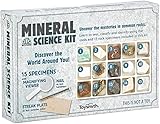
- Explore the wonders of the natural world and unlock the mysteries of common minerals with the Toysmith Mineral Science
- Encourage youthful curiosity in geology with this hands-on natural science activity
- Identify 15 different mineral specimens using a magnifying glass and detailed identification guide
- The kit includes 15 mineral specimens, a magnifying viewer and an identification guide
- Recommended for ages 8 and up
Product prices and availability are accurate as of the date/time indicated and are subject to change. Any price and availability information displayed on Amazon at the time of purchase will apply.

