
What’s actually slowing this PC down?
Pick the symptom - the matching free tool is one click away.
There is no one RAM total that suits every Proxmox VE host with ZFS. Plan separately for the host, concurrently running guests, and ZFS: Proxmox’s administration guide sets a 2 GB minimum for the operating system and Proxmox services, and offers rough ZFS guidance of about 1 GB per TB of used storage. These are starting points, not a guarantee that a particular workload will fit.
How to estimate RAM for a Proxmox VE host with ZFS
Use this planning sequence rather than treating a single rule of thumb as the total for the machine:
- Reserve host memory. Proxmox lists a minimum of 2 GB for the OS and Proxmox VE services. This is a minimum for those components, not the recommended total for a host running guests.
- Add guest allocations. Count the memory assigned to the VMs and containers you expect to run at the same time. Proxmox specifies designated guest memory in addition to the host minimum.
- Allow for ZFS. Proxmox gives an approximate planning estimate of 1 GB per TB of used storage for ZFS and Ceph. It is broad guidance, not a workload-specific guarantee.
- Check for deduplication. If you intend to use ZFS deduplication, account for its additional, workload-dependent memory needs before choosing a host total.
- Check the remaining capacity. Compare the physical RAM installed with the host, guest, and storage demands together. If the plan leaves too little headroom for the actual workload, reduce concurrent allocations or increase compatible host memory.
Proxmox documents the 2 GB minimum and used-storage estimate in its VE Administration Guide.
What ZFS’s ARC rule of thumb means
ZFS uses memory for its Adaptive Replacement Cache (ARC). The Proxmox guide’s ARC section gives a separate rule of thumb: at least 2 GiB base plus 1 GiB per TiB of storage. Read this alongside the guide’s broader estimate of about 1 GB per TB of used storage; they are distinct planning statements, not two mandatory allowances to add together. ARC is part of ZFS’s memory use, while the host total must also cover the host services and guests.
Recommended Free Tools
#1 Best Overall

- Disclaimer: Maximum Speed requires overclocking/PC BIOS adjustments. Maximum speed and performance depend on system components, including motherboard and CPU
- Hand-sorted memory chips ensure high performance with generous overclocking headroom
- VENGEANCE LPX is optimized for wide compatibility with the latest Intel and AMD DDR4 motherboards
- A low-profile height of just 34mm ensures that VENGEANCE LPX even fits in most small-form-factor builds
- A solid aluminum heatspreader efficiently dissipates heat from each module so that they consistently run at high clock speeds
Proxmox warns that enough ARC memory matters for I/O performance and says to reduce its limit with caution. A smaller cap may constrain caching, so do not treat lowering it as a free way to make more RAM available to guests.
Does ZFS use half of your RAM?
Not as a universal current setting. The Proxmox VE 8 guide describes ZFS as using 50% of host memory for ARC by default, but qualifies that new installations beginning with Proxmox VE 8.1 set the ARC usage limit to 10% of installed physical memory, capped at 16 GiB. The installation version matters: do not assume the older general default description applies unchanged to every host, or that the newer setting describes all existing installations.
Rank #2

- Requires overclocking/BIOS adjustments. Maximum speed and performance depends on system components, including motherboard and CPU.
- G.SKILL RipjawsV Series DDR4 U-DIMM Memory Kit, Model: F4-3200C16D-16GVKB
- Non-ECC, DDR4 U-DIMM, 288-pin, for Desktop PC & Gaming
- Includes JEDEC default profile, and Intel XMP memory overclock profile
- Do not mix memory kits. Memory kits are sold in matched kits that are designed to run together as a set. Mixing memory kits will result in stability issues or system failure.
OpenZFS documents ARC limits as adjustable and version- and platform-dependent. It also notes that lowering the maximum below the ARC’s current size does not by itself force an immediate shrink; memory pressure is needed. Check the Proxmox VE and OpenZFS versions on your host before changing ARC settings. See the OpenZFS module parameter documentation for version-specific behavior.
How much extra memory does ZFS deduplication need?
Deduplication is a separate memory decision, not part of a simple baseline estimate. OpenZFS describes it as resource-intensive, advises against enabling it without a specific reason, and recommends planning at least 1.25 GiB of RAM per 1 TiB of stored data. Actual needs depend on block sizes and how much data is duplicated, so that figure is not a universal total-memory formula. Review the OpenZFS deduplication documentation before enabling it.
Rank #3
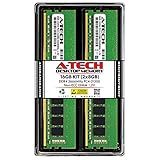
- Compatible with select DDR4 Desktop computers + Easy to install at home, no expertise required
- Maximize your system's performance, boost loading speeds and multitask with ease
- Backed by A-Tech's Lifetime Warranty + Friendly tech support team available to help before and after your purchase
- 16GB RAM Kit ( 2 x 8GB Modules ) | DDR4 DIMM 288-Pin | Speeds up to 2666MHz (2667MHz), PC4-21300 / PC4-2666V
- NON-ECC Unbuffered | 1Rx8 or 2Rx8 - Single or Dual Rank | JEDEC DDR4 standard 1.2V
What to check before upgrading RAM
The memory-planning guidance does not identify a universal DIMM type, generation, speed, capacity, rank, or ECC requirement. Those depend on the actual server or motherboard. Before buying, check its supported memory specifications and compare them with the capacity your host plan calls for.
Quick Recap
Rank #4

- Boosts System Performance:16GB DDR4 laptop memory RAM kit (2x8GB) that operates at 3200MHz to improve multitasking and system responsiveness for smoother performance
- Easy Installation: Upgrade your laptop RAM with ease—no computer skills required Follow step-by-step how-to guides available at Crucial for a smooth, worry-free installation
- Compatibility Guaranteed: Ensure seamless compatibility with your laptop by using the Crucial System Scanner or Crucial Upgrade Selector—get accurate recommendations for your specific device
- Trusted Micron Quality: Backed by 42 years of memory expertise, this DDR4 RAM is rigorously tested at both component and module levels, ensuring top performance and reliability
- ECC Type = Non-ECC, Form Factor = SODIMM, Pin Count = 260-pin, PC Speed = PC4-25600, Voltage = 1.2V, Rank and Configuration = 1Rx16, 1Rx8 or 2Rx8
- Concurrent VM and container memory allocations
- ZFS used-storage capacity and the rough memory allowance it implies
- Whether deduplication is enabled or planned, including the data and block-size mix
- Installed Proxmox VE and OpenZFS versions, especially for ARC behavior
- Platform support for the memory type and configuration you intend to purchase
Product prices and availability are accurate as of the date/time indicated and are subject to change. Any price and availability information displayed on Amazon at the time of purchase will apply.

