
This is a fictional Geiger-counter prop for an escape room or game, not a radiation detector. An Arduino buzzer imitates Geiger clicks, while indoor-positioning hardware makes the sound intensify as the prop approaches a target—or trigger when it reaches a configured point. No radioactive material is needed.
What the project does
Samuelvdv designed the project to make escape-room play more interactive: players carry a counter-like prop while searching for a hidden clue in a post-apocalyptic or missile-base setting. The project appeared on Arduino Project Hub on April 27, 2018, and Hackster.io on October 30, 2018. The author states, “This project does not require any radioactive material!”
The effect is entirely simulated. Its buzzer produces clicks; the location hardware supplies distance or position data. The build does not measure radiation, and a reused analog gauge should not be treated as a working detector.
Parts and their roles
| Component | Role in the prop |
|---|---|
| Arduino Uno (Arduino Project Hub identifies the board as Uno Rev3) | Runs the sketch and controls the sound effect. |
| Pozyx tag | Mounted with the prop; provides the ranging or positioning data described by the project. |
| Pozyx anchor hardware | Provides reference points for measuring distance or locating the tag indoors. |
| Buzzer | Produces the simulated Geiger-counter clicks. |
These are the components named by the project pages; the pages do not establish current model availability or compatibility. Verify that any positioning hardware you source works with your board and intended setup before building around it.
The Tool Desk
Outbyte PC Repair FREEClear out junk files and repair common Windows errorsFree Scan →Outbyte Driver Updater FREEScan for outdated or missing drivers - takes under a minuteDriver Scan →#1 Best Overall
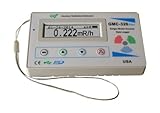
- Newly designed digital Geiger Counter/Data recorder,Record the radiation data. Play it back later
- Automatic data recording and play back from PC later
- Open communication protocol for wide range radiation network support made easy.
- Technical support forum from GQ Electronics website
- Money back warranty within 30 days and one year factory warranty
Choose how the prop responds to location
| Approach | Hardware and behavior | Trade-off |
|---|---|---|
| Distance/ranging | The tag measures its distance from one anchor. The described sound becomes more frequent as the prop approaches that anchor. | The effect follows distance to the anchor, so the anchor must be placed at the target area. |
| Position-based triggering | Four anchors are used to define the prop’s position in the room; the sketch can react when the tag reaches a chosen point. | Anchor positions must be measured manually or configured through the Pozyx web interface. The project article does not provide the completed position-mode code. |
When one-anchor ranging fits
Use the ranging approach when the game design calls for a signal that grows stronger as a player moves toward one fixed clue or location. In the Hackster description, the author sets a maximum base delay of 3 seconds, adds random variation of up to 150 milliseconds, includes a 20% chance of no delay, and randomizes the tone. Those values describe the author’s implementation, not independently tested performance or a guaranteed behavior of other hardware.
When four-anchor positioning fits
Use position-based triggering when the effect should respond to a defined point in the room rather than simply to proximity to a physical anchor. This option entails configuring four anchor locations, and builders must complete the positioning logic themselves because the article leaves that code to the reader.
Rank #2
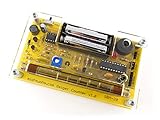
- Kit includes all components needed to build a working Geiger counter, including a high quality printed circuit board, sensitive Geiger-Muller tube, laser-cut acrylic case, and 2xAAA batteries.
- Included SBM-20 Geiger tube is sensitive to beta and gamma radiation. LED and piezo speaker alert you to detected radioactivity.
- Mute button for silent operation.
- 100% Open Source Hardware (OSHW). Full schematics, PCB layout, and source code available online.
- Expansion headers allow you to connect your kit to other devices, such as Arduino and Raspberry Pi. Supports data logging. Can be connected to a laptop or desktop PC using a USB-serial cable (not included).
Sound and enclosure choices
Buzzer or speaker
A buzzer provides the compact click effect in the documented build. The author notes that a speaker can be used in a related approach when greater loudness is needed; the project does not specify a measured loudness comparison.
Vintage survey-meter casing
The project suggests a vintage Radiation Survey Meter 715 as an optional enclosure. Its author describes dismantling the case and reusing the analog gauge, rotary selector, and zero-offset control. For that specific donor gauge, the project gives a 0–5 R/hr scale and describes using PWM with a voltage divider to drive it. These are fabrication notes for a fictional prop—not instructions for measuring radiation, and not proof that the modified instrument functions as a detector.
Rank #3

- Accurate & Fast: Geiger counter built with a Geiger Miller sensor is capable of detecting γ-ray, β-ray, and X-ray radiation with alarm in sound, flash and vibration when the pre-set real-time dose and accumulative dose are reached
- LCD screen: Geiger counter features an LCD screen that displays real-time radiation levels, easy to read and interpret the data
- Multiple dosage units: Geiger counter can measure radiation levels in 5 different dosage units, including μSv/h, mR/h, CPM, CPS, and μGy/h
- Type-C Rechargeable battery: Geiger counter equipped with a 1200mAh rechargeable battery, providing long-lasting use and convenience
- Versatile applications: Geiger counter is suitable for use in a variety of settings, including home decoration, geological survey, metal exploration, CT scans, ceramic and marble testing, food and metal radiation detection, lab, and more
A separate fake-counter build documented by Ken Cox Design on October 20, 2020, also uses a Cold War-era radiation-detector enclosure with an Arduino sound effect. It illustrates the enclosure approach, but it is a different build and does not establish availability or compatibility of the exact project’s components.
Accuracy claims and safety
The Hackster project page claims 10 cm accuracy and says the system is robust around obstacles and metal. That is an older, project-author/vendor-associated claim, not an independent test or a current performance guarantee. The author says they work at Pozyx, so treat the positioning statements in that context; the project pages do not establish current product specifications.
Rank #4

- [Userfriendly Interface] With a simple design, this detector is easy to use for all individuals, allowing convenient radiation testing at home.
- [Accurate Radiation Measurements] Utilizing advanced geiger tube technology, this detector provides precise readings for beta, gamma, and x rays.
- [Powerful Battery] Equipped with a 400mah polymer battery, this detector is portable and can be taken to any location for radiation detection.
- [ Performance] Ensuring accuracy and reliability, this detector is suitable for homes, hospitals, and workplaces for monitoring radiation levels.
- [Versatile Applications] Ideal for various settings including home renovation, building materials, petrochemical industries, and more.
- Label and use the device as a sound-and-location prop, never as a radiation-safety instrument.
- Do not use its reused gauge, buzzer pattern, or positioning readings to assess exposure or decide whether an area is safe.
- If a real radiation concern exists, use an appropriate, functioning, calibrated instrument and qualified guidance instead.
Lower-effort alternative
If the goal is only a quick simulated effect rather than a physical prop that responds to indoor location, Apple’s Digital Geiger Counter – Prank Radiation Detector listing describes tilt and touch controls. An app does not provide the Arduino build’s physical, location-triggered behavior.
Quick Recap
Best Value

- Wide Detection: Suitable for home decoration environment detection, distance detection after ion implantation, radiological detection, airport security inspection machine detection, overseas shopping Japanese goods detection, maternity and baby products radioactivity detection, jewelry, stone and jade articles radioactivity detection, cosmetics radiation detection, etc
- ±10% Accuracy Error: Radiation detector can accurately detect the strength of beta (β), gamma (γ) and X , and the accuracy error can be controlled within ±10%
- Simple And Accurate Detection: Simple and convenient operation, just a few steps to start accurate detection of environmental radiation parameters
- Various Sound Types: Adopt energy compensation type tube sensor, sound source types include real particle sound, alarm sound, mute
- Scratch ABS: Adopt good quality ABS material, possess impact resistance, scratch resistance, environmentally friendly
Project references
- Hackster.io: Fake Geiger Counter with Indoor Positioning (published October 30, 2018).
- Arduino Project Hub: Fake Geiger Counter with Indoor Positioning (published April 27, 2018).
- Ken Cox Design: Fake geiger counter project (published October 20, 2020).
Product prices and availability are accurate as of the date/time indicated and are subject to change. Any price and availability information displayed on Amazon at the time of purchase will apply.

