
Choose a backup by adding up the power needs of every device required for your connection—usually the router and modem or fiber ONT—then selecting a unit with enough watt output and a runtime chart that covers that combined load. An AC UPS works with the devices’ usual power adapters; a DC mini UPS can be smaller, but only when its output voltage, current, polarity and connector all match the equipment. Either option can keep your home network powered, but it cannot keep your internet service online if the provider’s network is down.
Which devices need backup power?
Make an inventory before comparing UPS units. A powered router cannot connect to the internet if the modem or fiber ONT it depends on has shut down. Include every device that must remain on for your intended setup to work:
- Wi-Fi router
- Cable, DSL or other modem, or fiber ONT
- Mesh nodes or access points needed for coverage
- Network switches or other essential wired-network equipment
Use the power label on each device or its manufacturer’s specifications to determine its demand. Add the loads for the equipment you plan to back up; that total is the basis for choosing capacity and estimating runtime. Don’t assume a router’s power needs represent the whole network.
How much UPS capacity do you need?
Compare the combined equipment load in watts with the UPS’s maximum output in watts. Schneider Electric recommends choosing output watt capacity 20–25% above the connected load. That is the manufacturer’s sizing guidance, not a universal regulatory requirement. Schneider also states, “A UPS should have a VA rating higher than your total device watt load.” VA and watts are distinct ratings: check both the VA and watt limits, and do not treat the VA figure as a runtime estimate.
PC Slower Than It Used to Be?
A free scan shows the junk files, broken settings and background clutter dragging Windows down - then fixes them in one click.Free scan · Windows 10 & 11Crashes, No Sound, or Screen Glitches?
Random freezes, missing sound and display glitches usually trace back to one bad driver. Find and replace yours safely.Free scan · under a minute#1 Best Overall

- 425VA/260W Standby Uninterruptible Power Supply (UPS): Uses simulated sine wave output to provide battery backup power and to safeguard home office, home entertainment including computers, gaming consoles, and broadband routers
- 8 NEMA 5-15R OUTLETS: Four battery backup & surge protected outlets; Four surge protected outlets; INPUT: NEMA 5-15P right angle, 45 degree offset plug with five foot power cord
- ADDITIONAL FEATURES: LED status light indicates Power-On and Wiring Fault, transformer-spaced outlets
- GREENPOWER UPS HIGH EFFICIENCY DESIGN: Reduces power consumption by utilizing a compact charger and power inverter to create an ultra-efficient backup power system for home and office use
- 3-YEAR WARRANTY – INCLUDING THE BATTERY; 75K USD Connected Equipment Guarantee; UL SAFETY CERTIFIED: Product has been tested in a UL certified lab and listed with UL as meeting or exceeding safety standards
For example, if the labels or specifications for all the equipment you want backed up add up to a particular watt load, apply Schneider Electric’s 20–25% headroom recommendation to that total, then make sure the candidate UPS’s watt output meets it. The actual load—not a generic estimate for a router—is what matters. Schneider Electric’s UPS buying guide explains its sizing advice.
How long should the backup run?
Decide how long you want to bridge an outage, then consult the manufacturer’s runtime chart for the UPS at your combined equipment load. Runtime changes with the connected load: adding a modem, mesh node or switch uses more of the available battery power. A chart value at full or half load is not a reliable promise for a much lighter networking load unless the manufacturer provides data for that load.
Rank #2
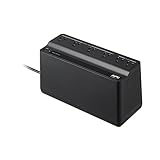
- 425VA / 255W RELIABLE BACKUP POWER: Supplies short-term battery power during outages to maintain internet connectivity and allow safe shutdown of devices during power interruptions
- SMALL UPS FOR ESSENTIAL DEVICES: Delivers up to 15 minutes of runtime when powering a 100W load. Provides basic battery backup for low-power equipment like Wi-Fi routers, modems, VoIP phones, and small home-office electronics
- SURGE PROTECTION AGAINST POWER SPIKES: 6 well-spaced outlets (4 battery backup + surge protection; 2 surge-only) help protect connected electronics from damaging surges and spikes caused by lightning or power fluctuations
- COMPACT WALL-MOUNTABLE DESIGN: Space-saving form factor fits easily under desks or mounts on a wall for apartments, dorm rooms, and small workspaces
- ENHANCED PROTECTION FOR CONNECTED ELECTRONICS: Supported by a 3-Year Warranty and $75,000 Equipment Protection, offering enhanced coverage for connected devices and added assurance against power-related damage
Battery capacity alone does not tell you how long your specific setup will run. Check the stated runtime for the candidate model and the load that matches your equipment, and follow the manufacturer’s stated conditions. Do not infer a typical router runtime from another product’s specifications.
For instance, Cradlepoint documents a 56.62 Wh battery and estimated runtime of up to eight hours per fully charged battery for its E100 Series at a 17 W discharge power, and the same battery capacity and estimated runtime for its E400 Series at a 25 W discharge power. Those figures apply to the named router series and specified battery; they are not a runtime estimate for consumer Wi-Fi routers. See Cradlepoint’s battery specifications.
Rank #3

- 【KEEP YOUR WIFI ONLINE DURING POWER OUTAGES】 MARSRIVA KP3 provides uninterrupted backup power for routers, modems and ONU devices, keeping your internet running during blackouts.
- 【0ms SEAMLESS POWER TRANSFER】 Instant switching technology ensures connected devices continue operating without interruption during power failures.
- 【IDEAL FOR ROUTERS, CCTV & SMART DEVICES】 Compatible with routers, LED lights, CCTV cameras, modems and other low-power DC devices.
- 【SAFE & RELIABLE BATTERY BACKUP】 Overcurrent Protection, Voltage Stability Protection, Short Circuit Prevention, Overcharge Prevention, Deep Discharge Protection, Thermal Management System, Integrated safeguards for safe device operation
- 【COMPACT DESIGN FOR HOME & OFFICE】 Small footprint with multi-port DC outputs for flexible installation anywhere.
AC UPS or DC mini UPS?
AC UPS
An AC UPS is the straightforward choice when your networking devices use their supplied AC power adapters. Plug the adapters into the UPS’s battery-backed AC outlets, checking the unit’s watt capacity and runtime at your combined load. Count battery-backed outlets specifically: some UPS units have outlets that provide surge protection but do not supply battery power.
DC mini UPS
A DC mini UPS may avoid an AC-to-DC adapter stage, but compatibility must be established for every device you plan to connect. Check the required voltage, current, polarity and connector against the mini UPS’s listed output. A matching voltage by itself does not prove a safe or suitable match. Verify the modem or ONT requirements as carefully as the router’s; if the outputs or plugs do not match, choose another compatible backup approach.
Rank #4

- [Uninterrupted Power During Outages] -- During a power outage, our UPS will automatically switch to backup power to prevent equipment shutdown. 6000mAh battery provides up to 5 hours runtime (varies by device)
- [1 USB + 4 DC Output Ports] -- The mini uninterruptible power supply features multiple output ports: 1 USB 5V/2A, 1 DC 5V/2A, 1 DC 9V/2A, and 2 DC 12V/2A ports
- [Stable & Secure] -- The mini UPS features built-in intelligent safety protection mechanisms, including short-circuit protection, overcharge and over-discharge protection, and temperature control, ensuring safe and stable operation of your equipment when connected to the UPS
- [Easy to Use & Space Saving] -- The mini UPS is plug-and-play and easy to operate. Measuring only 4.72 x 3.54 x 0.98 inches, it takes up very little space
- [Wide Application] -- The mini ups battery backup is designed specifically for power outages and is compatible with a wide range of devices, including routers, modems, security cameras, smartphones, fax machines, fingerprint scanners and DSL equipment (not for AC devices)
What details should you check before buying?
- Battery-backed outlets or outputs: Confirm how many devices can actually run on battery during an outage, rather than counting all outlets.
- Regional plug and voltage: Make sure the unit is intended for your region and matches the input requirements of your equipment.
- Adapter clearance: Check the outlet layout and spacing if your devices use bulky power adapters.
- Battery service: See whether the battery is user-replaceable and whether the manufacturer supports replacement for that specific model.
- Runtime expansion: Treat external battery-pack support as model-specific; do not assume a UPS can be expanded.
- Indicators and alarms: Check what the unit provides to show battery or power status and warn of an outage.
- Placement: Ensure the UPS can be placed near the equipment and its power connections without obstructing plugs or ventilation.
These features vary by model. Confirm them in the exact product documentation rather than inferring them from a brand or product category. Schneider Electric’s buying guide discusses model-dependent features such as surge-only outlets, user-replaceable batteries and external battery packs.
Will a UPS keep your Wi-Fi and internet working?
A UPS can keep powered equipment in your home running, so your router may continue broadcasting Wi-Fi during a power cut. That does not guarantee internet access: the ISP’s outside equipment and neighborhood infrastructure must also remain operational. If those parts of the network lose power or service, your devices may still connect to your router locally while internet access is unavailable. A home UPS is backup power for the equipment connected to it, not a guarantee against a wider outage.
What’s actually slowing this PC down?
Pick the symptom - the matching free tool is one click away.
How to compare candidate units
Compare the exact model documentation against your equipment inventory. A higher capacity label or a claimed maximum runtime alone is not enough to establish that a unit suits your setup.
- List each device that must remain powered and total its stated power demand.
- Check that the unit’s watt output covers the total load, with headroom such as Schneider Electric’s 20–25% recommendation.
- Find the runtime chart for that model and check the estimate at your actual combined load.
- Confirm the needed battery-backed AC outlets or, for a DC mini UPS, verify voltage, current, polarity and connector compatibility for every device.
- Check regional plug and voltage, outlet spacing, battery replacement and any model-specific expansion support, alarms or indicators.
Manufacturer documentation provides the key specifications, but the cited guidance is not independent comparative testing. Without model-specific runtime and compatibility information, it is not possible to establish that a particular unit will meet your requirements.
Quick Recap
Product prices and availability are accurate as of the date/time indicated and are subject to change. Any price and availability information displayed on Amazon at the time of purchase will apply.

