
What’s actually slowing this PC down?
Pick the symptom - the matching free tool is one click away.
For most laptop desk setups, look for a powered subwoofer—one with its own amplifier—but choose it only after checking how audio will travel from your laptop to the subwoofer and speakers. The right input, output routing, and bass-management behavior matter more than a connector that merely fits.
Start with the complete audio path
Before comparing subwoofer specifications, identify the devices and connections in your setup. A laptop headphone jack, a USB audio interface, and powered speakers with a dedicated subwoofer output can each require a different connection plan. Check the source output, the subwoofer’s inputs and outputs, and the speakers’ inputs. A matching plug does not guarantee the system will route or filter bass as you expect.
- Laptop to subwoofer to speakers: This may work when the subwoofer accepts the laptop’s output and provides an output compatible with the speakers. Confirm whether that output filters bass or carries full-range audio.
- Laptop or interface to powered speakers with a subwoofer output: If the speakers have a dedicated sub out, check the speaker and subwoofer manuals for the required cable and signal type.
- Audio interface to subwoofer to monitor speakers: This is a common studio-monitor arrangement, but the output behavior and crossover controls depend on the specific subwoofer and interface.
Focusrite’s stereo-mixing setup guide describes an interface-to-subwoofer-to-monitor-speaker route and explains that the crossover determines what is sent onward to the monitors. Treat that diagram as an example for compatible equipment, not a universal wiring instruction.
Choose powered or passive based on your equipment
Powered subwoofer
A powered subwoofer contains its own amplifier, making it the simpler category for a direct desktop setup. You still need to verify that its input accepts the signal from your laptop, interface, or speakers, and that its outputs suit the speakers if you plan to connect them through the sub.
The Tool Desk
Outbyte PC Repair FREEClear out junk files and repair common Windows errorsFree Scan →Outbyte Driver Updater FREEScan for outdated or missing drivers - takes under a minuteDriver Scan →#1 Best Overall

- Convenient Control Pod
- 25 Watts (RMS) Output
- Compact Subwoofer
Passive subwoofer
A passive subwoofer does not have its own amplifier. It generally needs a suitable external amplifier or home receiver, which also has to handle the system’s crossover and connection requirements. Focusrite’s guide notes this need for passive subwoofers and speakers. Unless you already own compatible amplification and want this arrangement, a passive model adds equipment and setup complexity.
Check inputs, outputs, and bass management
Compare the actual ports on every device rather than shopping by cable name alone. The setup examples in manufacturer guidance include RCA line inputs, 3.5 mm connections, and dedicated subwoofer outputs. A 3.5 mm-to-dual-RCA cable, for example, is relevant only when one device has the matching 3.5 mm output and the subwoofer has RCA inputs. Edifier documents that connection for compatible active speakers with a sub out in its sub-out setup instructions.
Rank #2

- 2.1 stereo speakers with subwoofer deliver 18W peak power and 9W RMS; system includes a ported four inch side firing poly carbon subwoofer and two inch satellite drivers
- Control pod allows for volume adjustment and to turn the speakers on and off; bass volume control located on the subwoofer
- Flat panel designed stereo speakers and subwoofer
- We recommend that you set the volume on your device between sixty five and eight percent and then use the volume controls on the speaker system to raise and lower the volume
- Includes CA 3090 2.1 speakers with subwoofer, 110V AC power adapter, and user guide; includes one year manufacturer warranty
Pay particular attention to the subwoofer’s signal output. “Pass-through” describes audio being sent onward, but the word alone does not tell you whether the main speakers receive full-range audio or audio with bass removed. Edifier’s T5 product page documents a signal-in and signal-out route for speakers without a dedicated subwoofer port: connect the source to Signal In and the speakers to Signal Out. Confirm the signal behavior in the manual for the exact equipment you are considering; do not assume a crossover dial filters the speakers’ signal as well as the subwoofer’s.
Understand crossover, level, and phase controls
Crossover or low-pass control
The crossover sets the upper frequency the subwoofer handles. It should work with the low-frequency capability of your main speakers and with the way audio is routed through the system. Focusrite uses 80 Hz as an example in its setup guidance; Klipsch advises matching the crossover setting to the main speakers’ low-frequency response. Neither reference makes 80 Hz a universal laptop setting. See Focusrite’s guide and Klipsch’s subwoofer guidance.
Windows Errors? Fix Them Before They Spread
Repair common Windows errors and clear accumulated junk for a smoother, more stable PC - no reinstall needed.Free scan · no reinstallOutdated Drivers Are Slowing You Down
One free scan finds every outdated or missing driver and matches the right update for your exact hardware.Free scan · exact hardware matchRank #3

- High-quality audio – 2.1 speakers with subwoofer deliver 62W peak power and 30W RMS. Each satellite features dual 2-inch titanium drivers that deliver crisp highs and warm mid-tones while the 5.25-inch down-firing subwoofer with tuned port puts out deep, powerful bass, for excellent sounding music, movies, or games.
- Convenient control pod – Adjust volume or bass levels to customize your sound just the way you want it. Easily accessible 3.5mm aux input allows for quick connection of a gaming system or tablet or smartphone with a 3.5mm audio connection. Speakers also feature a headphone jack for a private listening experience.
- Versatile usage – Speaker system works great as desktop computer speakers for PCs and Macs, or as PC speakers with any laptop. They are also great for gaming systems such as PS4, PS5, Xbox, or Nintendo Switch, tablets and smartphones with 3.5mm audio output or headphone jacks.
- Attractive design – Satellites feature an angled design that look great on any desktop. The compact subwoofer fits under most desks and in smaller spaces.
- Includes – CA-3610 2.1 speakers with subwoofer, 120V AC power adapter, and user guide. Includes 1 year manufacturer warranty. Our US based customer service team is here to help. Contact us through Amazon.
Level and phase
A level control lets you adjust the subwoofer’s volume relative to the speakers. A phase control can help with integration, but the useful setting depends on the speakers, room, and placement. Klipsch recommends experimenting with settings and notes that where a subwoofer sits in a room can change the bass heard at the listening position. Its hookup guidance is a starting point, not a placement rule for every desk.
Compare specifications without treating them as a ranking
Published wattage, driver size, and frequency response give context, but they do not establish which subwoofer sounds best. Frequency-response figures may not be directly comparable when manufacturers use different measurement methods. Look at the stated response alongside the connection plan, controls, size, and intended use.
Rank #4

- 【Clear, Balanced Sound with DSP Tuning】These computer speakers for desktop PC deliver clear vocals and balanced audio for everyday listening. Built-in DSP tuning reduces distortion and harsh highs for smoother, more comfortable sound for desktop, PC setups and work-from-home use
- 【2.1 Computer Speakers with Dedicated Subwoofer】These PC speakers with subwoofer feature an independent bass unit for low frequencies, keeping satellite speakers clear. Enjoy deep, punchy bass without muddy sound—ideal for movies, music, gaming, and immersive desktop entertainment
- 【Bluetooth 5.4 & Wired Connections, Plug and Play】Use these speakers for pc as bluetooth computer speakers or connect via USB, USB-C, or 3.5mm AUX. Adapter-powered design means just plug in and play for desktops, computers, and home office setups
- 【Desk-Friendly RGB Lighting】These desktop speakers add a modern look to your desk setup. Choose dynamic colors or a soft static glow to enhance your workspace without distraction—perfect as stylish pc speakers for desktop
- 【All-in-One Control Knob】These speakers for computer desktop easily adjust volume, play or pause audio, change lighting effects, and switch modes with one control knob. Designed for simple, everyday use on desktop speakers for pc
As one product-specific example, Edifier lists the T5 as having a 70 W RMS output, an 8-inch driver, and a 38 Hz–160 Hz frequency response. These are the manufacturer’s published figures, not independent test results. Its product page also lists RCA audio inputs, signal in and out, an integrated DSP low-pass filter, and phase control: Edifier T5 specifications. Those features make it an example to evaluate against a particular setup, not a universal recommendation.
Use this buying checklist
- Write down the signal route. Identify whether sound will go from the laptop’s headphone jack, a USB audio interface, or powered speakers’ subwoofer output.
- Match the ports at both ends. Verify the source output, subwoofer input, subwoofer output if speakers connect through it, and speaker input. Check cable type against those ports.
- Confirm what the output sends to the speakers. Determine whether it is filtered or full-range from the specific model’s documentation. Do not infer bass management from the presence of pass-through outputs.
- Check the controls. Look for crossover adjustment and level control; consider phase adjustment if available. Confirm how each control affects the system.
- Check space and placement. Measure the cabinet, plan for power access, and consider whether stronger low-frequency sound could disturb others nearby. Room position can change the bass you hear.
- Compare published specs cautiously. Use driver size, power, and frequency response as context, not as a standalone sound-quality score.
When a complete 2.1 system may make more sense
If you do not already have external speakers, compare complete 2.1 speaker systems as well as standalone subwoofers. A separate subwoofer needs compatible speakers and a workable signal route; a packaged system may provide a more straightforward path from laptop to speakers and bass. The right choice depends on the connections and controls provided by the specific system.
Quick Recap
Best Value
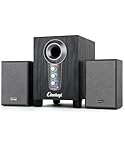
- ① Powerful 2.1 Speaker System:Equipped with a 3" subwoofer and dual 2" satellite speakers, delivering 10W + 3W×2 output power. Enjoy full-range sound with enhanced bass, clear mids, and crisp highs—perfect for movies, gaming, and music.
- ② Bass & Mid–High Frequency Control:Features independent bass adjustment and mid–high frequency/vocal tuning, allowing you to customize your listening experience. Rotate the knobs to fine-tune lows and highs to your preference.
- ③ Easy Volume Control & Mode Switching:Convenient multifunctional volume knob: press and hold to power on/off, rotate to adjust volume, short press to switch between AUX and Bluetooth modes. Simple and intuitive for everyday use.
- ④ USB Powered & Universal Compatibility:Plug-and-play USB 5V power supply with 3.5mm AUX input. Compatible with PCs, laptops, desktops, monitors, projectors, and any device with a 3.5mm audio output. No driver required.
- ⑤ Compact Desktop-Friendly Design:Main unit size: 150×200×225mm; Satellite speakers: 100×95×150mm. Space-saving design fits neatly on any desk while delivering big sound. Ideal for home offices, study rooms, and entertainment setups.
Product prices and availability are accurate as of the date/time indicated and are subject to change. Any price and availability information displayed on Amazon at the time of purchase will apply.

